
Uncategorized
What Illuminati membership truly required of its initiates
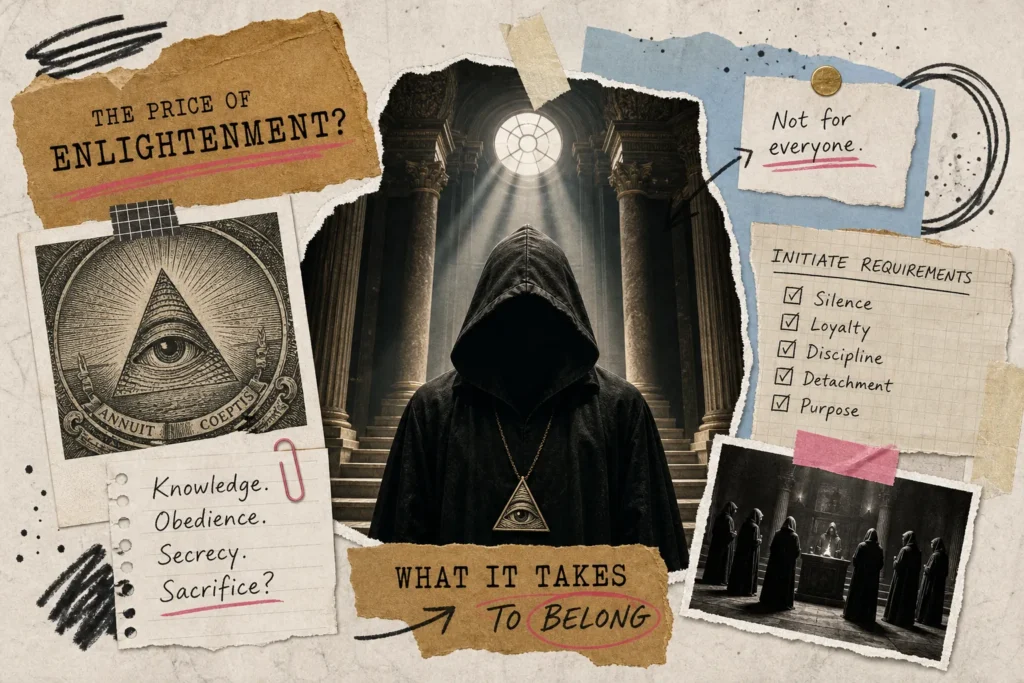
Across the internet, searches for how to join the Illuminati number in the tens of millions annually, yet almost none of those searching find what the original Order actually required. The illuminati membership requirements and initiation process documented in surviving statutes bear no resemblance to what circulates online. What most people find instead is a sprawling ecosystem of myth, marketing, and fraud: websites promising wealth in exchange for a registration fee, social media recruiters claiming to hold the keys to a centuries-old brotherhood, and an entire genre of entertainment content that has woven conspiracy theory into pop culture so thoroughly that fiction and history have become nearly indistinguishable.
This article cuts through that noise. Drawing on surviving statutes, documentary evidence, and the scholarship of historians such as René Le Forestier and Richard van Dülmen, it reconstructs the real Illuminati membership requirements and initiation process of the Bavarian Illuminati, founded by Adam Weishaupt on 1 May 1776. The historical record is specific and demanding, nothing like what circulates online. For readers who want to understand the founding philosophy of the original secret society rather than its pop-culture shadow, this is where that examination begins.
Adam Weishaupt and the philosophy that shaped the Order
Adam Weishaupt was not a shadowy occultist operating from a hidden chamber. He was a professor of canon law at the University of Ingolstadt, driven to frustration by Jesuit control over European intellectual life and by the suppression of rational, enlightened thinking in the universities of his era. His founding of the Order of the Illuminati was, at its core, an act of philosophical ambition rather than crude hunger for power.
Weishaupt’s vision was precise: place educated, morally aligned men in positions of social and political influence and reform society from within. This founding philosophy shaped every membership decision the Order ever made. The organisation was never designed to be open or democratic. It was designed to be ideologically exact, selecting individuals who could carry out a long-term programme of enlightened reform without drawing the attention of church or state authorities.
The Order’s internal culture drew on two models. The Jesuit system of hierarchy and discipline provided one template; Freemasonry, with its ritual structure and lodge-based secrecy, provided another. From these sources Weishaupt built an organisation where members only learned what their current grade entitled them to know. Secrecy was not theatrical, it was structural, embedded into the architecture of the Order from the outset.
Who the Bavarian Illuminati actually accepted as members
The original Illuminati membership rules were far more exacting than modern mythology suggests. Surviving documents confirm that candidates needed an established reputation, social standing, family connections of note, and in most cases financial means. The Order was not recruiting the economically desperate or the socially marginal. It was recruiting the already influential and placing them in a framework designed to shape their loyalties and direct their energies.
Weishaupt’s recruitment instructions specified the qualities he sought in candidates: clever, skilful, hard-working, and ideally well-connected or prosperous. Le Forestier’s study of surviving recruitment documents notes a general preference for men of Christian background and good character, with a practical focus on candidates aged roughly eighteen to thirty who were considered receptive to instruction. Women, monks, and members of rival secret societies were excluded from consideration entirely.
No candidate could join through self-nomination. Admission required the active consent and endorsement of existing members who vouched for the recruit’s character and usefulness to the Order’s aims. This closed-loop recruitment process was deliberate: it kept the risk of infiltration low and ensured that ideological alignment existed before the initiation process even began. A man who arrived at the threshold of the Illuminati had already been assessed, discussed, and approved by peers within the brotherhood.
Illuminati membership requirements and initiation process: Novice to Minerval
The initiation process of the Order was structured, progressive, and deliberately slow. Entering as a Novice did not grant a man access to the Order’s true aims, its statutes, or its inner fraternal network. He was observed, guided, and tested across a probationary period. Le Forestier and van Dülmen both indicate this phase lasted roughly one to two years, though surviving accounts vary by source and region. Patience and loyalty were themselves the first tests.
The Novice stage
Before a Novice could advance to the Minerval grade, he was required to submit a detailed written self-account. This disclosure included the titles of his books, the names of his enemies, his personal weaknesses, his family connections, his friends, and his financial circumstances. The personal information the Order demanded was not incidental. It served as both a vetting mechanism and a source of leverage: the Order knew things about its members that those members would not want made public.
The Minerval rite
Elevation to the Minerval grade was the first true initiation rite. The candidate swore an oath placing the society’s interests above his own and committing to absolute secrecy and obedience to higher-ranking members. Only after this oath did he receive the Order’s statutes, gain access to its secret signs and passwords, and enter the broader fraternal structure as a recognised participant. The Minerval ceremony was, in the language of the statutes, a ceremony of binding rather than welcome.
Higher degrees
Beyond the Minerval, further advancement required continued demonstration of loyalty, philosophical alignment, and capacity for the responsibilities attached to each successive grade. Progress was never automatic. The Order advanced those who had earned it.
The rank structure and the degrees the inner circle held
Beyond the Minerval grade, the Order expanded into a hierarchy of thirteen degrees grouped into three classes. This structure evolved considerably following the reorganisation carried out by Baron von Knigge in the early 1780s, who incorporated Masonic-style degrees and terminology into the framework and gave the rank system much of the complexity it is known for today.
The three classes moved from the foundational grades, Novice, Minerval, and Illuminated Minerval, through a middle tier of Masonic-aligned degrees, and finally to the mystery grades at the apex: Priest, Regent, Magus, and Rex. Each class held knowledge the class below it could not access. Progressive disclosure was the Order’s central mechanism of both control and reward, offering deeper understanding as the prize for demonstrated loyalty, a framework described in detail by van Dülmen in his analysis of the Order’s internal documents.
The rationale behind withholding knowledge from lower grades was not mysticism. Weishaupt understood that revealing the Order’s full ideological programme too early would alienate recruits whose thinking had not yet been shaped by years of guided instruction. By the time a member reached the higher mystery grades, his worldview had been formed within the Order’s framework and his commitment had been tested across multiple stages of advancement.
Illuminati membership myths and what the historical statutes actually prove
The gap between documented Illuminati membership rules and what modern “join the Illuminati” websites claim is not a matter of historical interpretation. The evidence is clear enough. Historical statutes describe a controlled, vetting-heavy system grounded in philosophical alignment, personal disclosure, and sworn obligation. Modern online recruitment operations promise wealth, celebrity access, and supernatural protection in exchange for a payment, investigative reporting on these scam networks has documented fees typically quoted in the range of $115 to $600, often converted into local currencies for their target markets.
The documented fraud pattern is consistent across platforms. Applicants are funnelled toward registration fees, asked to submit sensitive personal data, and promised rewards that no historical secret society ever offered: monthly cash payments, lottery numbers, luxury property, or direct access to global elite networks. No credible primary source supports the idea that the Bavarian Illuminati ever operated this way. The surviving statutes and scholarly accounts consistently show something quite different, and the contrast with modern scam portals is stark.
Primary sources and scholarly accounts agree on what the original Order actually required: recommendation by an existing member, detailed personal disclosure, a formal oath of secrecy and obedience, and advancement only after demonstrated loyalty across a probationary period. Curiosity alone was never sufficient qualification. The belief that enthusiasm or a payment replaces these requirements is not alternative history, it is fraud dressed in symbolic clothing.
What genuine Illuminati alignment looks like for the modern seeker
The Bavarian Illuminati was suppressed by the Bavarian government in 1785, but the philosophical framework Weishaupt constructed has never stopped attracting serious attention. The ranked progression, the emphasis on values alignment, the subordination of personal gain to collective purpose, these elements still speak to something real in those drawn to the esoteric tradition. The question for the modern seeker is not whether to romanticise this history, but whether to understand it honestly.
What the historical Order demanded points to a consistent standard: men who were already morally serious, intellectually prepared, and capable of placing collective purpose above personal ego. The Order did not manufacture these qualities through an initiation ceremony. It selected for them in advance through the vetting process, then deepened them through years of guided instruction. That standard has never become less relevant to any organisation that takes its own criteria seriously.
For those who want to understand the full requirements and philosophy behind Illuminati membership without being redirected to a scam portal, Illuminati Fraternities documents the historical criteria and walks prospective members through the stages of the process. The lore, the symbolism, the rank structure, and the philosophical commitments are all accessible for those ready to engage with them seriously.
The historical record as the only honest starting point
The Bavarian Illuminati operated a rigorous, philosophically grounded membership system built on social vetting, progressive initiation rites, personal disclosure, and sworn oaths. It bears no resemblance to the fee-based fantasy sold by modern scam portals, and it requires no exaggeration to be compelling. The system Weishaupt designed was demanding precisely because he understood that genuine change required the right people, properly prepared, advancing through a structured path of knowledge and loyalty.
For anyone seriously interested in what the Illuminati membership requirements and initiation process genuinely entailed, the historical record is the only honest starting point. Historians such as René Le Forestier and Richard van Dülmen have done the scholarly work; the surviving statutes and documentary evidence do the rest. The myths can be set aside. What remains is an organisation whose actual requirements were, in many ways, more demanding and more interesting than anything its imitators have invented.
For those drawn not merely to the history but to the tradition it inspired, understanding those original standards is where every genuine inquiry must begin. The historical Order selected those who were already serious about the work, and that principle, at least, has endured.
