
Uncategorized
Bavarian Illuminati history: founding, fall and legacy
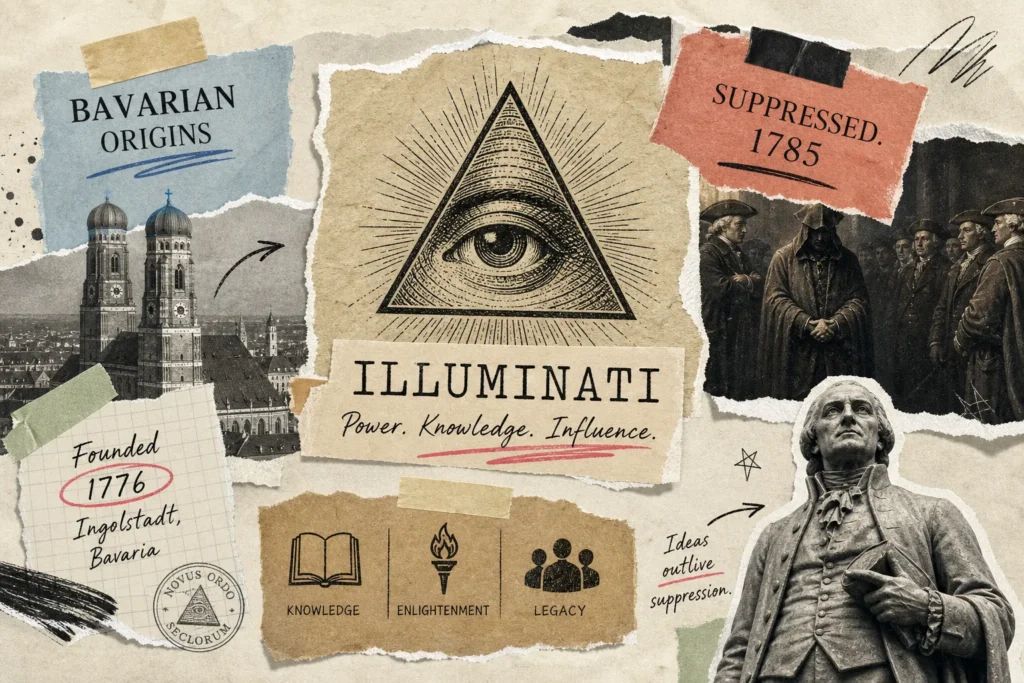
The bavarian illuminati history begins on 1 May 1776, when a 27-year-old professor in the Bavarian university town of Ingolstadt set a chain of events in motion that would outlast him by centuries. Adam Weishaupt founded a small, secretive association of like-minded reformers, gave it a philosophy rooted in Enlightenment reason, and watched it grow into something the Bavarian state would eventually pursue with edicts, raids, and banishments. The Order he created was effectively suppressed by 1785, with final follow-up measures and the publication of seized papers completed by 1787. Its name has never stopped circulating.
That gap between historical reality and cultural afterlife is the story worth telling here. The documented Bavarian Illuminati of the 18th century is a specific, traceable institution with founding documents, internal correspondence, and a clear suppression record. What grew around it afterwards, the centuries of conspiracy claims, is something else entirely. This article covers the founding, the aims, the structure, the collapse, and the long mythological afterlife of the Order’s name, and points toward where the genuine primary record survives.
Bavarian Illuminati history: Adam Weishaupt and the birth of the Order
Weishaupt was born in 1748 and educated under Jesuit influence before taking up a professorship of canon law at the University of Ingolstadt. His appointment was itself a product of upheaval: the Society of Jesus had been suppressed across Europe in 1773, leaving the chair vacant for the first non-Jesuit holder in the university’s history. Weishaupt stepped into a role the Jesuits had shaped, surrounded by an intellectual culture they had built, and he found the experience radicalising.
The Perfectibilists: the Order’s first name
The group that Weishaupt founded on 1 May 1776 did not yet call itself the Illuminati. Its original name was the Perfectibilists, a title that revealed the organisation’s core purpose directly: the perfectibility of human reason and virtue. Initial membership was small and the structure was informal, gathering a handful of Weishaupt’s students and associates in Ingolstadt. The shift to the name Illuminati came later, as the group formalised its identity and ambitions.
Why 1776 was not a coincidence
The same year the Perfectibilists met for the first time, the American colonies signed the Declaration of Independence. This was less a coincidence of calendar than a coincidence of context. The 1770s were a decade in which Enlightenment ideas were actively reshaping the political landscape of the Western world, questioning the legitimacy of monarchical authority, the reach of the Church, and the nature of human governance. Weishaupt’s Order was one concentrated expression of an intellectual shift occurring across an entire continent, scholars of transatlantic Enlightenment have noted how closely the reformist impulses of the period tracked one another across national boundaries. His frustration with clerical dominance at Ingolstadt was local; the philosophy he turned it into was European in scope.
What the Order actually stood for
The stated aims of the Bavarian Illuminati, as the historical documents record them, were reformist rather than revolutionary in the violent sense. The Order sought to promote reason and virtue, oppose superstition, resist religious interference in public life, and challenge abuses of state power. These were not fringe positions in the intellectual culture of the 1770s; they were broadly shared by the philosophers, academics, and progressive nobles who made up the Enlightenment’s wider conversation.
Reason, reform and the rejection of superstition
Weishaupt’s philosophical influences included the rationalism of Christian Wolff, filtered through his teacher Johann Adam von Ickstatt, and the empirical philosophy he encountered in the mid-1770s. He was anti-clerical in the specific Enlightenment sense: he believed that organised religion had accumulated too much influence over public institutions and that rational governance required separating those two domains. The Order gave that belief an organisational form.
The ambition to reshape society
The more ambitious dimension of the Order’s aims was the desire to replace clerical authority over social life with what might be called a religion of reason, weakening the grip of both monarchical and ecclesiastical power structures. These goals made the Order politically dangerous in the eyes of Bavarian authorities, even though the Order never mounted any violent or insurrectionary campaign. The danger was philosophical: the documents stated views that directly challenged the legitimacy of existing power arrangements, and that was sufficient to draw official attention and eventually official suppression.
Hierarchy, recruits and the men who expanded the Order
The Order of the Illuminati‘s internal structure was hierarchical and deliberately opaque. Members at lower levels did not know the full shape of what existed above them, a design feature Weishaupt borrowed in part from the Jesuit organisational methods he had grown up observing. The three foundational ranks were Novice, Minerval, and Illuminated Minerval. Beyond those, the Order developed further grades across three classes: an initial nursery class, a second class built on Masonic-style degrees including Apprentice, Fellow, and Master, and a third class of Mysteries that culminated in the grades of Magus and Rex. Scholars note that the naming and ordering of higher grades varied across Knigge’s reforms and later accounts, so specific degree titles should be read against their source.
Adolph Freiherr Knigge and the drive for growth
The Order’s most consequential organiser after Weishaupt was Adolph Freiherr Knigge, who joined in the early 1780s and transformed its social reach. Knigge recruited aggressively among educated nobles, civil servants, and professionals, giving the Order a degree of legitimacy it had previously lacked. His efforts drew in members across the German-speaking world, expanding the group far beyond its Ingolstadt origins. Tension developed between Knigge and Weishaupt over the Order’s direction, and Knigge departed in 1784, but by then the expansion he had driven was already attracting the scrutiny of Bavarian authorities.
How far the Order actually reached
At its peak, the most frequently cited scholarly estimates place membership between 600 and 2,500, with recruits drawn predominantly from academics, minor nobility, and the educated professional classes. The geographic spread reached beyond Bavaria into other parts of the German-speaking world. The much larger membership claims that appear in later conspiracy literature have no archival basis and should be treated with corresponding scepticism.
Suppression, edicts and the collapse of the Order
Accusations had been building since 1783 that the Illuminati were hostile to religion and the state, and internal defections had begun exposing the Order’s existence and activities to official notice. By 1784, the Bavarian government was moving against it in stages, responding with escalating legal measures that would dismantle the organisation within two years.
The 1784 and 1785 edicts
On 22 June 1784, the Bavarian government issued an edict banning all associations and brotherhoods formed without sovereign approval, treating them as inherently suspect and ordering subjects to withdraw from unauthorised secret meetings. This was a broad measure, but it was followed on 2 March 1785 by a more targeted instrument: an edict that named the Illuminati and Freemasonry explicitly and imposed a definitive ban on both. The legal basis for dissolution was now unambiguous, and organised activity within the Order effectively ceased around this time.
Raids, seized papers and the published record
Between 1786 and 1787, Bavarian authorities raided members’ homes, seizing books, correspondence, and internal Order documents. The follow-up measures intensified the penalties substantially: recruiting for the Order was made punishable by death, civil servants who were members faced dismissal and exile, and confiscated assets were divided between the poor box and the informant who had reported the membership. The Bavarian government then took the unusual step of publishing the seized correspondence in 1787 under the title Einige Originalschriften des Illuminaten Ordens, with a supplement issued as Nachtrag von weitern Originalschriften, as a public justification for the suppression. These Bavarian Order documents had lasting consequences: they created a permanent documentary record that historians can consult today, and that later conspiracy writers would draw on selectively and distort freely.
Weishaupt’s exile and the Order’s end
Weishaupt was stripped of his professorship and banished from Bavaria. He eventually settled in Gotha under the protection of Duke Ernst II, where he continued to write but never rebuilt the Order. He lived until 1830, outlasting the institution he had founded by more than four decades. The Bavarian Illuminati did not survive as a functioning body beyond 1787. What came after was not the Order’s continuation but its mythology.
How historians became mythmakers: the long afterlife of the Order’s name
The transformation of the historical record into conspiracy narrative happened quickly. Within a decade of the Order’s suppression, two writers had already constructed the foundational myth that would persist for more than two centuries.
Barruel, Robison and the first conspiracy narrative
Augustin Barruel, a French Jesuit priest, and John Robison, a Scottish physicist, both published major works in the 1790s arguing that the Illuminati had not dissolved but had continued operating covertly through Masonic networks and had driven the French Revolution. Barruel portrayed the Order as having systematically infiltrated lodges to undermine the throne and the Church. Robison’s book framed the group as a pan-European conspiracy against established religion and government. Both men were writing polemically, not historically. Their books were widely circulated in counterrevolutionary circles across Europe, and they gave the conspiracy theory its initial shape and wide readership.
From revolution to celebrity: 200 years of myth-building
The narrative Barruel and Robison constructed proved remarkably adaptable. In the 19th century, the Illuminati were blamed for revolutions and political instability. In the 20th century, the conspiracy expanded to encompass the Russian Revolution, political assassinations, global governance schemes, and eventually the celebrity culture references that brought the name to a new generation through music, film, and social media. The Illuminati became a flexible symbol for fears about invisible power, applicable to virtually any era’s anxieties about who controls events behind the visible surface of politics. Scholarly consensus, drawing on studies of the Barruel, Robison tradition and subsequent debunking literature, finds no evidence of continuity between the original Bavarian Order and any of these later claims.
Bavarian Illuminati history: the original legacy and what the record actually reveals
Reading the genuine Bavarian Illuminati origins rather than the mythology built around them is a clarifying exercise. The authentic record is specific, traceable, and in several respects more interesting than the conspiracy version, because it is grounded in a real set of human decisions, political conflicts, and philosophical convictions.
Primary sources: Bavarian Order documents and where to find them
Researchers who want to engage with the primary record have several access points. The Bavarian government edicts of June 1784 and March 1785 set out the official legal basis for suppression. The 1787 state publication, Einige Originalschriften des Illuminaten Ordens, and its supplement Nachtrag von weitern Originalschriften, compiled from seized correspondence, give direct access to the Order’s internal documents and discussions. The original archival holdings are associated with Bavarian state repositories in Munich, though the provenance of specific collections has been complicated by the disruptions of the 20th century. These materials, read in full rather than mined selectively, give a clear picture of what the Order was and, equally important, what it was not.
How the vision persists: why the original ideas still resonate
Weishaupt’s founding impulse was straightforward at its core: bring together exceptional, like-minded individuals under a shared philosophy of reason, self-improvement, and collective influence, and create the conditions for those individuals to shape the world around them. That idea did not become irrelevant when the Bavarian government suppressed the Order. It simply lost its institutional home. Some modern groups claim inspiration from the Bavarian Illuminati, drawn by this founding conviction that the right people, united under the right principles, can direct the course of events rather than simply observe them. Illuminati Fraternities is one such organisation, drawing on this original legacy and the membership philosophy it represents. This is a philosophical continuity, the Order’s founding idea outliving the Order itself by more than two centuries.
Illuminati myths vs facts: a final distinction
The documented Bavarian Illuminati and the mythology that replaced it are two entirely different stories. The real Order lasted fewer than ten years as a functioning body, attracted educated reformers and progressive nobles, articulated a clear Enlightenment philosophy, fell to government suppression backed by specific legal instruments, and left behind a paper trail that historians can read and verify today. What came after, the centuries of conspiracy claims attaching the Illuminati’s name to revolutions, assassinations, and celebrity culture, is a story about human psychology and political fear, with very little connection to the original Order.
Reading the bavarian illuminati history carefully, through primary sources rather than secondhand mythology, gives any serious reader a foundation that conspiracy literature simply cannot offer. The genuine record is more intellectually substantial than the myth. The ideas at its core, reason, collective organisation, the pursuit of influence through structured membership and shared philosophy, have never stopped being worth exploring, and organisations like Illuminati Fraternities exist because that original vision was built on something real.
