
Uncategorized
Illuminati temple: history, symbols, and real places
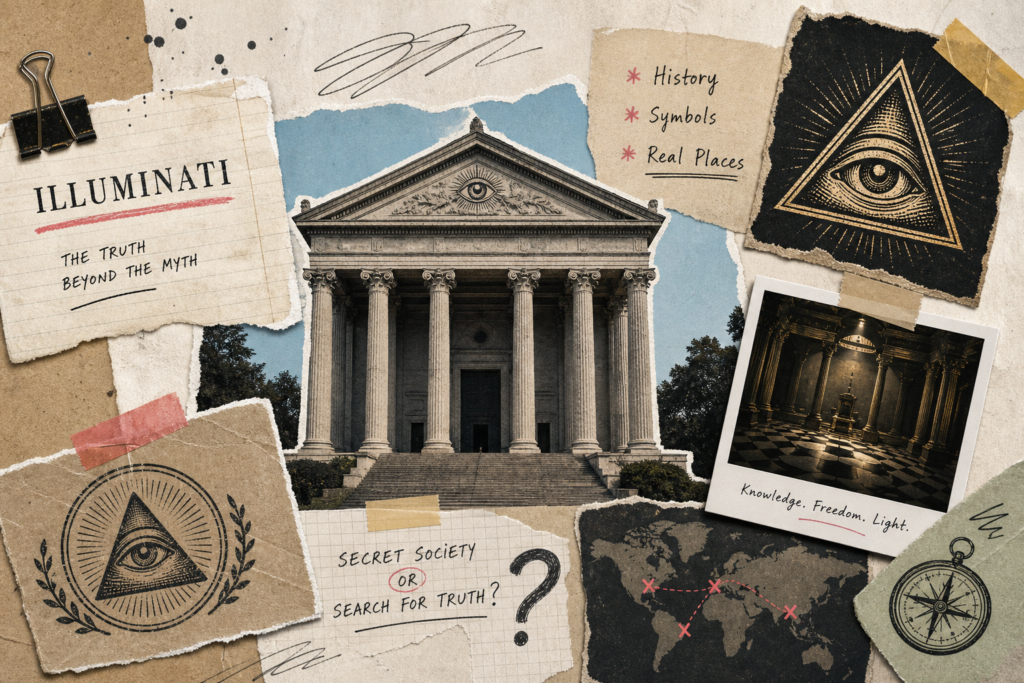
Is there an Illuminati temple? The phrase appears everywhere, yet the historical record points to meetings, correspondence, and symbols rather than a single sacred shrine. If you want certainty, you have to move past memes and into documents you can actually examine. This guide shows what is known, where it happened, and how to verify every claim using primary sources and credible scholarship.
We start in Ingolstadt in 1776 with the Bavarian Illuminati’s formation, then trace their meeting places, the symbols that keep getting misattributed, and the real sites you can still research today. Along the way, we separate theatrical rumor from the eighteenth-century paper trail. The goal is straightforward: identify fact, flag fiction, and read with receipts.
Think of this as designing a mental blueprint. Each section gives you a structural element, history, place, symbol, and practice. By the end, you will know why the idea of an Illuminati temple persists, what the sources actually say, and how to build a disciplined inner lodge for your own study.
What people imagine when they ask about an Illuminati temple
Myth vs. record: why “temple” sticks
Temple is a powerful word. It compresses secret power, ritual space, and permanence into one image, which is exactly why it dominates headlines and movie scripts. The historical record for the Bavarian Illuminati describes an order with ranks, rules, and meetings, not a purpose-built, central sanctuary. In the sources, “temple” is metaphor far more than masonry.
Pop culture fuel: music videos, memes, and viral photos
Illuminati conspiracy theories turned symbols into spectacle. An eye on a stage set becomes proof of control; a pyramid on a hoodie becomes damning evidence; a vaulted room photographed from a dramatic angle becomes an “Illuminati temple” in the caption. These are frequently misattributions, recycled images from Masonic halls, churches, or museums that circulate without context. The 2009 viral spread of Rihanna’s “Umbrella” imagery, later traced to standard Masonic stage design, is one well-documented example of how quickly the misattribution cycle runs. Without verifiable dates, provenance, and institutional context, a frame from a video is not history.
Sacred space as metaphor: the inner lodge and secret society temple
There is a more useful reading of all this. Treat “temple” as a disciplined inner room built through study, not stone. Circles, triangles, and measured light are tools for focus and clarity, which is why sacred geometry and circular design language appear across esoteric traditions, from lodge floors to cathedral windows. The real work happens wherever a reader organizes sources, notes, and intent. These occult meeting places were rarely grand; they were borrowed rooms made meaningful by the conversations held inside them.
Where Illuminati Fraternities fits
Illuminati Fraternities is a guided path that decodes symbols and philosophy beyond buildings. The focus is on clarity first: community discussions, the Illuminations eBook series, and a study-forward approach that prizes sources over spectacle. For those who want a community that respects evidence, the lodge begins with reading and builds toward action through its Department of Citizen Outreach.
The Bavarian Illuminati on paper: origins, dates, and documents
Ingolstadt 1776: from Perfectibilists to a network
On 1 May 1776 in Ingolstadt, Adam Weishaupt, a professor of canon law at the city’s university, founded a small circle he initially called the Perfectibilists. Recruitment began among students, then spread into Bavarian cities including Munich, Eichstätt, and Freising. Within a few years the Ingolstadt Illuminati had evolved from a campus society into a coordinated regional network with tiered ranks and formal correspondence protocols.
What the seized papers reveal
Bavarian authorities suppressed the order in the mid-1780s and seized its internal materials. The published caches, most notably Einige Originalschriften des Illuminaten-Ordens (Munich, 1787), available via university libraries and Internet Archive scans, include statutes, instructions, correspondence, and inventories that describe ranks, duties, secrecy practices, and meeting routines. These documents are the backbone of what historians know about how the order actually worked. Any claim about the group that cannot be traced to this record deserves immediate skepticism.
Member lists and aliases
Members used classical aliases and codenames, which appear in surviving lists and letters alongside their real identities. The geography in these records is specific: Ingolstadt, Munich, Eichstätt, Freising, and other Bavarian nodes recur consistently. Aliases complicate attribution, but cross-referenced letters, arrest records, and career histories still allow scholars to map the network with reasonable confidence.
Primary sources to cite and where to find them
- Einige Originalschriften des Illuminaten-Ordens (Munich, 1787): the Bavarian government’s publication of seized papers; scans available through the Bavarian State Library and Internet Archive.
- Die Korrespondenz des Illuminatenordens: modern edited volumes of the order’s letters; English excerpts of Weishaupt’s correspondence appear in scholarly portals and university digital collections.
- Weishaupt’s post-exile writings from Gotha, which explain the order’s aims and structure from his own perspective.
- Contemporary polemics, John Robison’s Proofs of a Conspiracy (1797) and Augustin Barruel’s Memoirs Illustrating the History of Jacobinism (1797-98), read critically for ideological bias.
- Vernon Stauffer’s New England and the Bavarian Illuminati (1918), available on Project Gutenberg, and additional scans and translations on Internet Archive and Wikimedia Commons.
If a claim about meetings or ranks does not align with these documents, treat it as story, not source.
Where they met and the real places behind the stories
Borrowed spaces and ordinary rooms
Eighteenth-century secret societies typically met in borrowed spaces: Masonic lodges, private studies, rented salons, and tavern rooms. The Illuminati were no different, and their activity frequently overlapped with Freemasonry’s existing infrastructure. The 1782 Wilhelmsbad convention near Hanau illustrates the wider milieu, rationalist and mystical currents negotiating reforms in rooms owned by established Masonic bodies, not in any dedicated secret society temple.
Munich’s “Theodore of the Good Council”
The best-documented case of lodge influence involves Munich’s lodge Theodore of the Good Council. Founded under a Grand Lodge warrant in 1779, it was systematically recruited into by Illuminati members and used for coordination and outreach. Surviving correspondence, documented in the seized papers published in 1787 and in Die Korrespondenz des Illuminatenordens, describes both strategy and internal disputes. Even here, however, what we see is influence operating within an existing Masonic lodge, not a proprietary Illuminati temple built for the purpose.
Ingolstadt, Munich, Eichstätt, and Freising
Member lists and letters tie the order to these Bavarian cities with unusual clarity. Ingolstadt is the founding site, anchored to the university; Munich hosted key lodge activity; Eichstätt and Freising appear in recruitment and administration records. Clergy and academics moved through these circles, including church canons, but that does not convert cathedrals into Illuminati sites. When you encounter a famous church or civic building labeled an “Illuminati temple” online, check careers and correspondence rather than architecture before drawing conclusions.
Illuminati temple myth: what the archival evidence actually shows
There is no trace in the sources of a central, purpose-built Illuminati temple. Later writers use the term symbolically or conspiratorially, and modern “temple” photos circulating online are routinely miscaptioned images of Masonic halls, churches, or government buildings. Reverse-image search the photo, read the building’s institutional history, and verify dates before you file anything under fact. The record shows meetings and influence, distributed across ordinary rooms, not a single sacred address.
Symbols people call “Illuminati”: Eye, pyramid, owl, and geometry
Eye of Providence before Weishaupt
The Eye predates the order by centuries, appearing in Christian iconography and Renaissance art as an eye within a triangle signifying divine providence or the Trinity. Early Masonic usage is attested by the mid-1700s and was later formalized in lodge monitors by the century’s end. The Eye signals watchfulness or the Great Architect without implying Bavarian Illuminati authorship. Association is not origin, and the chronology makes that plain.
The unfinished pyramid and the Great Seal
On the U.S. Great Seal, the unfinished pyramid entered through Charles Thomson’s 1782 design submission to Congress. His explanation was explicit in the congressional record: the pyramid signifies strength and permanence, the Eye alludes to providence, and “Novus Ordo Seclorum” marks a new American era dating from 1776. National iconography is not Illuminati property, and the primary sources say so plainly.
Owls and other sigils
Owls signal wisdom across many traditions, yet reliable eighteenth-century evidence does not establish the owl as a standard emblem of the Bavarian Illuminati. The association is largely a modern overlay, drawn from conspiracy culture and festival-era imagery. If an image offers no citation to period documents, treat the owl as folklore rather than badge.
Sacred geometry and circular design language
Circles, triangles, and proportional grids shape ritual aesthetics from cathedrals to lodge floors. Circular design, representing continuity and return, appears in ecclesiastical architecture, Masonic floor work, and esoteric diagrams across centuries; it is not a trademark owned by any single order. When you design your study space, these forms can direct light, sightlines, and attention so the room itself supports focused thinking.
Building a modern Illuminati temple: practice and next steps
Design a personal study space
- Choose a quiet corner and orient your desk toward a single light source to create a focal cone.
- Lay a simple triangle on paper or board that frames your daily reading stack. Keep only three texts visible at once.
- Install a circular clock or mirror above eye level to anchor a sense of return and continuity.
- Place no more than two minimal symbols, an Eye print and a small pyramid form, for example, to avoid clutter.
- End each session by closing your notes in a single bound dossier. Protect the order of your thoughts.
Read with receipts: a study path
Start with the seized papers published in 1787, then read Weishaupt’s later writings from Gotha for the founder’s own perspective. Move to the edited correspondence collections to see recruitment and administration in real time. After that, sample reliable commentary that cites these documents directly. Log every claim with its date, author, and page number so bias and context remain visible throughout your research.
The digital lodge with Illuminati Fraternities
Illuminati Fraternities operates as a study-first community. Members access curated materials including the Illuminations series, hold focused discussions on symbols and history, and receive guidance on tracing sources through digital libraries. The aim is to turn fascination into literacy, and literacy into belonging. When you are ready, the Department of Citizen Outreach is the entry point for joining that conversation.
Choose evidence over fantasy
- Source: what document is being cited, and where can you read it in full?
- Date: when was it written or published, and does that fit the timeline?
- Author: who wrote it, and what incentives or biases shaped their account?
- Context: what event, city, or lodge is described, and is there independent corroboration?
- Image audit: reverse-image search and check the building’s institutional history before sharing.
- Cross-check: find at least two independent references before accepting any claim as settled.
Beyond the myth of a single Illuminati temple
The eighteenth-century record is steady and specific. It shows an order born in Ingolstadt in 1776, active across Bavarian cities, operating within Masonic settings, and documented through seized papers and surviving correspondence. It does not reveal a formal, central Illuminati temple. The temple that matters is your method.
Build a clear room in your life for study, use symbolic forms to support attention, and treat every viral image as a hypothesis until the documents confirm it. If you want a community that takes both the arcane and the accurate seriously, Illuminati Fraternities offers a doorway, a library, and a circle that closes each night and opens again at dawn.
Begin with the sources named here. Assemble your dossier, bring your questions to the lodge, and let the work of decoding history be grounded in evidence rather than echo.
