
Uncategorized
Freemasons and the Illuminati: What History Reveals
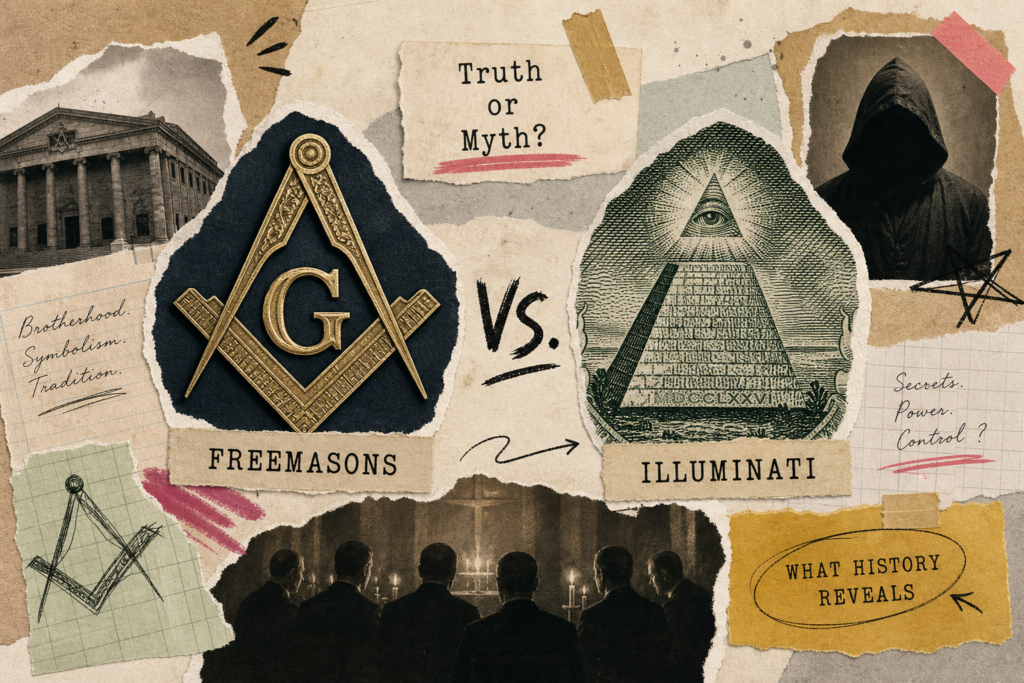
Few topics in the history of secret societies generate more confident misinformation than the connection between Freemasons and the Bavarian Illuminati. Most people use both names interchangeably, treating them as two labels for the same shadowy network. That assumption is historically inaccurate and, frankly, intellectually lazy. These were two distinct organizations with different founders, different goals, and a documented period of overlap that lasted roughly a decade before one of them ceased to exist entirely. People who search for “freemasons and illuminati” often meet summaries that skip these basics.
What follows traces that history properly: origins, the documented interactions between the two groups, shared symbols and what they actually mean, the ideological chasm that separated their missions, and the cultural machinery that fused them into a single myth. For readers who want to go beyond the historical surface into Illuminati-specific symbolism and philosophy, Illuminati Fraternities offers curated resources; first, the record deserves a straight reading.
Two organizations born in very different centuries
From stonecutters’ lodges to speculative brotherhood: Freemasonry’s origins
Freemasonry didn’t appear fully formed. It emerged gradually from medieval stonemasons’ guilds in Britain and Europe, where operative craftsmen organized into lodges to protect their trade, share knowledge, and support fellow members. By the 1600s, those lodges began admitting non-masons, and the fraternity shifted from practical craft to what historians call “speculative” Masonry: moral instruction delivered through ritual and symbolic teaching. The first Grand Lodge in London was formally established in 1717, marking the start of modern organized Freemasonry under centralized oversight. For an overview, see Encyclopaedia Britannica’s entry on Freemasonry and the United Grand Lodge of England’s primer.
The organizational structure that emerged centered on the local Masonic lodge, led by a Master and Wardens, with members advancing through three degrees: Entered Apprentice, Fellowcraft, and Master Mason. The core purpose was inward-focused, emphasizing personal moral development, fraternal support, and charitable work. It was never a political movement. Brotherhood and self-improvement through symbolic teaching were the mission from the beginning.
Adam Weishaupt and the Bavarian Illuminati: a professor with a political agenda
The Bavarian Illuminati came into existence on May 1, 1776, in Ingolstadt, founded by Adam Weishaupt, a professor of canon law at the University of Ingolstadt and a former Jesuit. Weishaupt’s stated mission was explicitly ideological in a way Freemasonry never was: he sought to replace religion with reason, dismantle superstition, and reorganize society under enlightened governance. Historian Terry Melanson characterizes this more specifically as Weishaupt’s attempt to build a secretive, virtue-promoting network capable of steering institutions from within (see Melanson, Perfectibilists: The 18th Century Bavarian Order of the Illuminati).
That political edge is the first and most important distinction between the two organizations. Freemasonry taught morality through ritual. Weishaupt wanted to engineer society through organized influence. Those are fundamentally different ambitions, and confusing them produces a distorted picture of both.
How the Illuminati actually used Masonic lodges: Freemasons and Illuminati on the ground
Weishaupt’s infiltration strategy from the late 1770s onward
The documented historical interaction between the two groups is strategic rather than symbolic. From the late 1770s, the Illuminati formally began using Masonic lodges as recruitment channels, entering into relations with lodges and working to populate them with Illuminati members. In 1779, they secured permission to establish a lodge in Munich, the Theodore of the Good Council, which was quickly filled with Illuminati members and effectively run by Weishaupt’s order. Through contacts in Frankfurt and other cities, they gained Masonic recognition and expanded their recruitment reach considerably.
The architect of this deeper integration was Adolph von Knigge, who joined the Illuminati in 1780. Knigge rewrote the Illuminati’s rituals in a decidedly Masonic form, restructuring the grade system to mirror Masonic degrees so that Freemasons moving into the order would find the structure familiar. By January 1782, historians document that he had adapted the rituals sufficiently to make the Illuminati far more attractive to lodge members. The strategy worked in select locations: in some lodges, senior officers could effectively deliver their entire membership to Illuminati influence.
The Convent of Wilhelmsbad and the limits of their ambition
The Illuminati’s highest-profile attempt to extend influence across broader Freemasonry came at the 1782 Convent of Wilhelmsbad. The event is often cited in conspiracy literature as the moment the Illuminati captured Masonic leadership, but what historians actually conclude is more measured. Wilhelmsbad primarily dealt with the collapse of the Strict Observance system and its Templar origin claims, concluding that Freemasonry had no essential connection to Templarism. The conference weakened one dominant Masonic current and opened space for rival ones, including the Illuminati.
The Illuminati gained influence in specific networks and lodges. Their plan to unify Craft Freemasonry under Illuminati control, however, was never achieved. Freemasonry remained fragmented, governed by independent Grand Lodges, and largely unresponsive to any centralized Illuminati program. The embedded relationship was real; the takeover was not.
Freemasons and Illuminati symbols: what they actually mean
The Eye of Providence: God’s gaze, not a shadow government’s logo
The all-seeing eye is the symbol most people associate with both Freemasonry and the Illuminati simultaneously, and it’s the most consistently misread symbol in modern Illuminati conspiracy theories. Its appearance in Masonic literature is documented from 1797, when it was published in Thomas Smith Webb’s Freemason’s Monitor as a representation of God observing a Mason’s moral conduct. The meaning was straightforward: the divine watches your actions, so act accordingly.
Its most recognizable modern appearance is on the United States dollar bill, where it sits atop the pyramid on the reverse of the Great Seal. That design traces back to the first Great Seal committee in 1776, where artist Pierre Du Simitière proposed an eye in a radiant triangle. Secretary of Congress Charles Thomson explained the symbolism as referring to Providence and divine favor during the American Revolution. The Masonic association came later as an interpretive overlay, not an official explanation. For historical context, see the Library of Congress exhibit on creating the Great Seal.
The square and compasses: morality encoded in a craftsman’s tools
The square and compasses are Freemasonry’s most recognized emblem, with roots in medieval stonemasons’ guilds. Their documented meanings are precise: the square represents moral conduct and acting fairly toward others; the compasses represent self-restraint and the discipline to keep one’s behavior within ethical bounds. Together they encode a complete moral instruction in a craftsman’s everyday tools.
These are Masonic symbols specifically. Their occasional use or adaptation by other groups doesn’t create organizational connection any more than two schools sharing a library building makes them the same institution. Symbols travel across cultures, traditions, and centuries without implying shared leadership or coordinated purpose. The historical record supports this: there is no documented evidence that the Illuminati formally adopted the square and compasses as their own iconography.
Freemasons and Illuminati: where their ideologies diverged
Brotherhood versus revolution: fundamentally different missions
Freemasonry was built around moral improvement, fraternal support, and charitable work directed outward into local communities. Its design was apolitical by stated intention: lodges were meant to be spaces where men of different political and religious backgrounds could meet as equals under shared ethical principles. The organization looked inward, toward the character of its members, not outward toward the architecture of governments.
Weishaupt’s vision pointed in the opposite direction entirely. The Illuminati’s mission was the rationalist restructuring of society, opposition to monarchy, opposition to organized religion, and the use of secrecy as an instrument of social engineering rather than ritual fraternity. Weishaupt treated secrecy as a tool of political leverage; Freemasonry treated it as a condition of sacred ritual. The contrast shows up in practice: Masons guarded recognitions, grips, passwords, and degree rituals to preserve the integrity of instruction; the Illuminati used ciphers, pseudonyms (Weishaupt signed as “Spartacus,” Knigge as “Philo”), circular letters, and compartmentalized cells to channel information upward for influence, methods later exposed when Bavarian authorities published seized papers in 1787.
The 1785 suppression and what it ended
The Bavarian government’s patience with the Illuminati ran out quickly. Through a series of edicts, culminating in the decisive edict of March 2, 1785, the Bavarian government formally suppressed the Illuminati Order, viewing it as hostile to religion and politically treacherous. House searches followed, government-employed members were dismissed, and in 1786 and 1787, seized internal documents were published, exposing the order’s structure and methods to public scrutiny. Weishaupt fled Bavaria. The order dissolved as a functioning entity. For a concise overview, see Britannica’s article on the Illuminati.
This historical endpoint matters more than most conspiracy accounts acknowledge. The documented Bavarian Illuminati had a lifespan of roughly nine years: founded in 1776, suppressed by 1785. Everything attributed to a modern, continuous Illuminati operating after that date has no primary-source foundation. The organization of Weishaupt’s design ended. What came after was myth, literature, and cultural projection.
How pop culture collapsed two groups into one myth
Music videos, celebrity rumors, and the Illuminati’s pop reinvention
The Illuminati re-entered mainstream American consciousness through hip-hop culture in the 1990s and early 2000s, when artists, producers, and conspiracy commentators began using “Illuminati” as shorthand for shadowy elite control over celebrity, industry, and government. The concept spread through music videos, interviews, and social media into a cultural brand. Masonic symbols, particularly the Eye of Providence and the pyramid, were picked up and reframed as Illuminati imagery in this new context, even though their documented origins are either Masonic or older Christian iconography.
The result was a merger that had no historical basis: two organizations with distinct origins, different ideologies, and a brief documented overlap were flattened into a single conspiratorial entity. The word “Illuminati” became elastic enough to absorb any symbol that looked mysterious and any elite figure who seemed too successful to have earned their position through ordinary means.
Why conspiracy theories need a single villain
The appeal of merging both groups into one narrative is psychological before it is historical. A single networked elite pulling all the strings satisfies the human drive for pattern recognition and offers a clean explanation for complex systems of power that are genuinely difficult to understand. The actual historical picture is messier: two organizations, overlapping membership in one narrow period, fundamentally different goals, and no evidence of coordinated global influence at any point in either group’s documented existence. Scholars have analyzed this cognitive tendency and its role in sustaining conspiracy narratives.
Writers including Mike Jay, in work reconsidering John Robison’s 1798 Proofs of a Conspiracy, trace the conflation back to the late 18th century itself. Analyses of Robison’s pamphlet and its reception show how easily emotionally satisfying narratives can outlast counter-evidence; the framework persisted anyway, because emotionally satisfying narratives tend to outlast the evidence against them.
Going deeper into Illuminati-specific philosophy and symbolism
The esoteric layer Freemasonry never fully offered
Masonic lodges provided ritual structure, moral teaching, and fraternal community. Those are real and meaningful things. But Weishaupt’s original vision carried something distinctly different: the pursuit of reason as a governing force, hidden knowledge as a tool of transformation, and organized influence over the systems of power as an explicit goal. That philosophical edge, arcane and aspirational in equal measure, is what drew people to the Illuminati mythology in the 18th century and keeps it alive in the 21st.
The iconography that travels with that tradition: the Eye, the pyramid, the Eternal Circle, and sigils of hidden order, carries a different weight than Masonic emblems of moral craft. It points to something older and more provocative, the idea that knowledge, properly organized and wielded, can reshape the world from the inside out.
Where serious students of Illuminati lore go today
Illuminati Fraternities curates that current of thought and iconography, not Masonic tradition, but the distinct philosophical and symbolic framework that traces back to Weishaupt’s vision and extends into modern esoteric culture. You’ll find concise guides to the origins of the Illuminati, symbolism primers on the Eye, the Pyramid, and the Eternal Circle, and publications like Illuminations: Wisdom From This Planet’s Greatest Minds. For readers drawn less to lodge ritual and more to the arcane structures Weishaupt first mapped out, it offers a direct entry point into that tradition and additional resources via the More, Illuminati Fraternities section.
Freemasons and Illuminati: what the record actually shows
Freemasons and the Bavarian Illuminati were two separate organizations. Their documented overlap was real but limited: roughly a decade of strategic embedding by the Illuminati within select Masonic lodges, driven by a recruitment agenda, and brought to an end by Bavarian government suppression in 1785. Their origins were different, their missions were different, and their fates were different.
The conflation in pop culture is powerful and emotionally coherent, but it doesn’t survive contact with primary sources. The symbols most people associate with both groups carry documented meanings rooted in moral instruction, Christian iconography, and craft tradition, not evidence of a unified global command structure. Many historians, including Margaret C. Jacob in Living the Enlightenment, have emphasized this distinction between Freemasonry’s fraternal culture and the short-lived, political program of the Bavarian Illuminati.
Knowing the real history doesn’t diminish the fascination. It sharpens it. When you strip away the misinformation, what remains is compelling: an Enlightenment-era organization that embedded itself inside a wider fraternal network, pursued a vision of reason-governed society, and left a symbolic and philosophical legacy that still shapes how many people think about power and knowledge. That legacy belongs to the Illuminati specifically, not to Freemasonry, and it deserves study on its own terms.
FAQ: Freemasons and Illuminati
Were freemasons and illuminati the same group?
No. They were distinct organizations with different origins and aims; their overlap was limited to a brief, strategic period in the 1770s, 1780s.
Did the Illuminati control Freemasonry after Wilhelmsbad?
No. The Convent of Wilhelmsbad weakened the Strict Observance, but Freemasonry remained decentralized under independent Grand Lodges.
What does the Eye of Providence mean in Masonic use?
It represents divine oversight and moral accountability, as documented in Webb’s 1797 Freemason’s Monitor, not a logo of secret world government.
Where can I study the origins of the Illuminati further?
See Britannica’s overview, scholarly works such as Melanson’s Perfectibilists, and curated primers at Illuminati Fraternities. You can also consult the site’s FAQs, Illuminati Fraternities for quick answers to common questions.
