
Uncategorized
The Illuminati secret society: origins, symbols, and myths
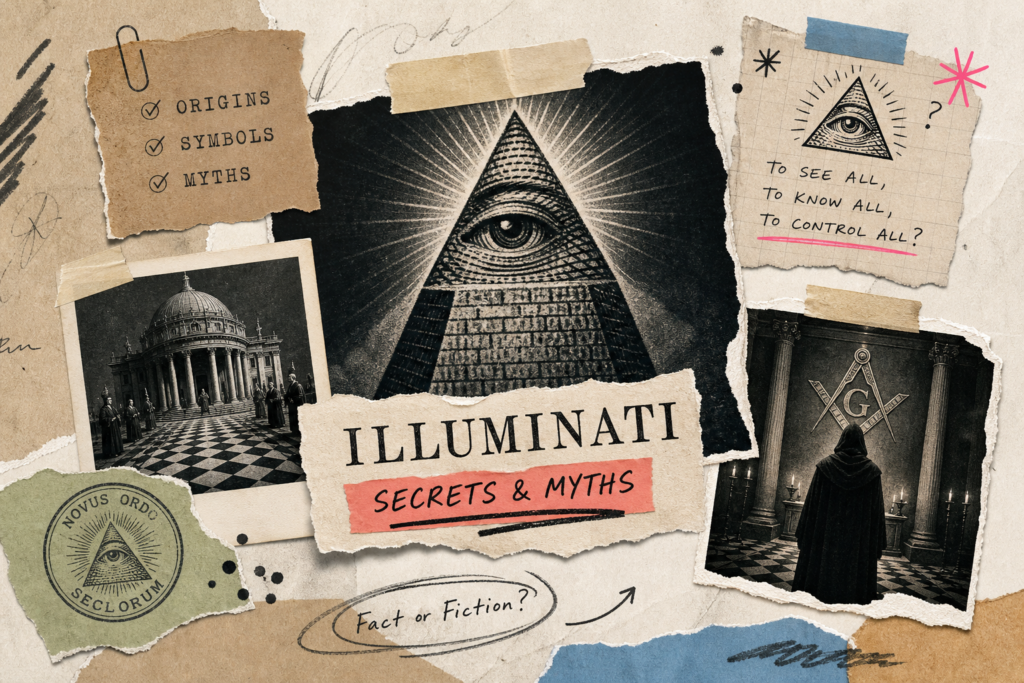
The secret society Illuminati was a real organization. It operated for nine years, drew somewhere between 500 and 2,000 members, and was gone before the French Revolution began. Much of modern Illuminati mythology traces to two late‑18th‑century polemics written after the order had already dissolved (Barruel, 1797; Robison, 1798). That gap between documented history and living legend is where the real story resides, and it is worth understanding on its own terms.
The confusion is understandable. The name has been attached to everything from dollar bills to music videos to presidential inaugurations, and the imagery seems to appear everywhere once you start looking. But the Eye, the Pyramid, the whisper of hidden architects shaping world events: these signs have specific meanings that predate later Illuminati conspiracy theories. At Illuminati Fraternities, we treat esoteric history as serious study, an inquiry into the currents that shaped Western thought, power, and iconography, rather than tabloid spectacle. This is where that inquiry begins.
What follows covers the verified founding, the internal structure, the suppression that accidentally immortalized the order, the iconography that outlived it, and the modern narratives that replaced it. Facts first; then the fascinating part that follows.
The man who built the order: Adam Weishaupt and the founding of the Bavarian Illuminati
Illuminati history: how the secret society Illuminati began
Adam Weishaupt, a professor of canon law at the University of Ingolstadt and the only non‑clerical faculty member at a Jesuit‑shaped institution, defined himself against that authority. A scholar steeped in Enlightenment ideas who watched religious power constrain open inquiry, he concluded that reason and secular governance would spread fastest through organized, discreet channels. The irony of borrowing Jesuit methods to counter Jesuit influence did not escape him.
On May 1, 1776, Weishaupt founded the order in Bavaria with a small circle, initially calling the group the “Perfectibilists.” The name did not last. What grew from that founding was a carefully structured network that recruited young men of status and intellectual promise, typically aged 18 to 30, through cells in Munich, Eichstätt, and eventually beyond Bavaria. Secrecy was not theater; in a state openly hostile to Enlightenment ideas, discretion was necessary for the program Weishaupt intended.
By the early 1780s, Weishaupt had joined Freemasonry and began using Masonic lodges as recruiting channels. His lieutenant, Adolf Knigge, accelerated growth, pushing estimates from a few hundred to over 2,000 at the order’s peak (Schüttler, 1991; Melanson, 2009). The expansion was deliberate and disciplined, and it moved faster than Weishaupt anticipated.
Inside the order: hierarchy, initiation, and how it actually functioned
Degrees, ciphers, and aims
The Bavarian Illuminati used a tiered system often summarized as Novice, Minerval, and Illuminated Minerval. That shorthand simplifies a more complex ladder of classes and grades developed over time, including additional “mystery” and “higher” grades beyond Minerval (see Schüttler, 1991; Melanson, 2009). Members adopted classical codenames (Weishaupt as Spartacus; Knigge as Philo), corresponded in cipher, and organized into cells that limited how much any individual knew about the wider body. The initiatory flavor, signs, passwords at the Minerval grade, later fueled imaginations more than the sober historical record warranted.
Membership was selective. Women, monks, members of rival secret societies, and several other categories were explicitly excluded. The order sought young, socially mobile, intellectually capable men who might later hold influence in government, education, and the church. The strategy was to reshape institutions from within, not to stage a visible revolution, a distinction later narratives often miss.
The order’s lifespan divides cleanly into three phases: the founding years from 1776 onward; rapid expansion under Knigge through the early 1780s; and, finally, collapse, nine years from founding to suppression. Short by any measure, but the legacy proved far harder to suppress than the membership rolls themselves.
The suppression that turned a dead order into a living myth
Edicts, seizures, and publication
On March 2, 1785, the Bavarian government issued an edict banning secret societies. Weishaupt fled. Authorities seized internal correspondence and organizational papers, then made a fateful decision: they published key Illuminati documents in 1786, 1787 to expose and discredit the order. Those volumes, Einige Originalschriften des Illuminatenordens (1787) and the Nachtrag von weiteren Originalschriften (1787), aimed to close the book; instead, publication made the ideas visible to a far wider audience than the order had ever reached on its own (Bavarian state publications, 1787).
Then came the books that reframed the story. Augustin Barruel’s Memoirs Illustrating the History of Jacobinism (1797) and John Robison’s Proofs of a Conspiracy (1798) argued that the Illuminati had survived suppression and orchestrated the French Revolution. Neither author provided verified documentary evidence; both were widely read. These texts sit at the fountainhead of modern Illuminati history in the popular imagination; much that followed, conspiracy theories, celebrity rumors, dollar‑bill exegesis, traces back to their claims (Barruel, 1797; Robison, 1798).
In the United States, minister Jedidiah Morse carried Robison’s claims into churches and newspapers in 1798, planting the narrative on American soil decades before the Eye of Providence or the unfinished pyramid became cultural flashpoints (Morse, 1798). The American appetite for such stories has never fully faded.
Illuminati symbols decoded: what the secret society Illuminati iconography actually means
Eye of Providence symbolism and timing
The Eye of Providence did not originate with the Illuminati. Its roots lie in late‑Renaissance Catholic iconography: God’s watchful presence rendered as an eye inside a triangle representing the Trinity. Pontormo painted it above a supper scene in 1525; it appears across European church architecture as a sign of divine omniscience. Freemasonry adopted the motif later; a widely documented Masonic appearance is in Thomas Smith Webb’s The Freemason’s Monitor (1797), published twelve years after the Bavarian order had disbanded (Webb, 1797).
Pyramids, progress, and Enlightenment imagery
The pyramid carried specific meaning in Enlightenment iconography: hierarchy, the ascent of reason, the ordered structure of human progress toward light. These were rationalist signals, not occult emblems. They communicated a philosophical program. Modern popular culture often strips that context and replaces it with theater. The visual language used in Illuminati history and related traditions, the Eye, the Pyramid, the Eternal Circle, belongs to a substantive iconographic lineage, not a collage of internet tropes. For a focused discussion of iconographic elements, see The Mark of the Illuminati.
Currency and the Great Seal
The one‑dollar bill connection is the most persistent “proof” in modern claims. The Eye above an unfinished pyramid is the reverse of the Great Seal of the United States, adopted in 1782, and that reverse was placed on U.S. currency in the 20th century (first appearing on the one‑dollar note in the 1930s). The imagery referenced founding ideals and drew from the same broad Enlightenment visual vocabulary that the Illuminati used. Shared imagery is not shared membership (see U.S. State Department, Great Seal history; Bureau of Engraving and Printing overviews).
The Illuminati vs. other secret societies: allies, rivals, or something else?
Freemasonry and the network effect
The relationship between the Illuminati and Freemasonry is specific. Weishaupt joined Freemasonry in 1777, and by 1779 the Illuminati influenced at least one Munich lodge. Knigge organized a formal Masonic wing and used lodges across German lands as recruiting networks. By 1782, the Illuminati sought to shape German Masonry more broadly at the Wilhelmsbad Convent. The two groups were never identical, but their overlap inside German Masonic structures helps explain why later narratives conflate them.
Rosicrucians and different ambitions
The Rosicrucians offer a useful comparison. They predated the Illuminati and shared an interest in hidden knowledge, hierarchical initiation, and layered symbolism. What set Weishaupt’s order apart was explicit political ambition. Where most esoteric orders of the era focused on inner transformation, spiritual development and symbolic study, the secret society Illuminati aimed outward: to reshape political and religious institutions at the structural level. That aim made it threatening to Bavarian authorities and helped its legend endure.
Modern conspiracy theories about the secret society Illuminati: what researchers have confirmed and what they’ve debunked
Illuminati conspiracy theories vs. evidence
Modern theories sort into familiar categories. The New World Order narrative imagines a cabal of global elites building a one‑world government. The entertainment‑industry version reads celebrity gestures, album art, and lyrics as coded proof of membership. Political‑control versions claim elections and world events are orchestrated by the order. Jay‑Z, Beyoncé, Kanye West, and Rihanna recur in celebrity‑focused claims, with triangle hand gestures and Eye imagery offered as evidence.
The phrase “New World Order” itself has a public political history unrelated to secret societies: Woodrow Wilson used it around the League of Nations; Franklin Roosevelt applied it to postwar arrangements; George H. W. Bush used it in 1990 to describe post‑Cold War cooperation. Conspiracy rhetoric mapped the phrase onto an existing Illuminati template, a tidy label for anxieties about globalization. The fit is rhetorical, not historical.
What the historical record confirms: the original Bavarian Illuminati existed, operated for roughly nine years, and was suppressed. What it does not confirm: continuous organizational survival into modern times. The “Biden Illuminati Bible” rumor in 2021 illustrates the dynamic. The Bible used at the inauguration was a family heirloom Douay‑Rheims edition; the Eye that appeared on it is standard Catholic iconography predating the order by centuries. The claim collapsed under basic scrutiny, but not before millions saw it, an example of how symbols, pattern‑matching, and a media ecosystem can amplify a story faster than verification can contain it.
The psychology behind these claims deserves attention. The idea of a hidden elite managing events grows attractive as the world feels more chaotic. That is not naïveté; it is a cognitive response to complexity, one that secret‑society narratives have long satisfied. Understanding the real history of the secret society Illuminati does not simplify the world, but it provides a sound frame.
The full picture, and where to go deeper
The Bavarian Illuminati was a real organization, born from Enlightenment frustration with religious authority and state power, structured along Jesuit and Masonic lines, and suppressed within a decade of its founding. The symbols it shared with its era predate it; the narratives attached to it came later. The gap between those two facts is the space where the lasting fascination lives, and most treatments of the subject never locate that gap precisely. For an authoritative overview of the historical order, see this treatment of the Bavarian Illuminati.
The modern conspiracy version of the Illuminati is not the historical one. That does not make it uninteresting; it makes it a different subject, a study in how ideas survive suppression, how symbols gather meanings across centuries, and how the desire for hidden order shapes the way we interpret visible chaos. Both subjects reward serious attention.
If this explainer opened more doors than it closed, Illuminati Fraternities offers curated pathways into further study: the philosophy behind the order, Eye of Providence symbolism, the Pyramid’s meaning in Enlightenment art, the Eternal Circle, and the wider web of Illuminati history. Explore the secret society Illuminati with us, begin with Why A Secret Society and follow the architecture beneath the myths. For a quick orientation, see our Sample Page.
