
Uncategorized
Where the Illuminati came from: Bavaria to global myth
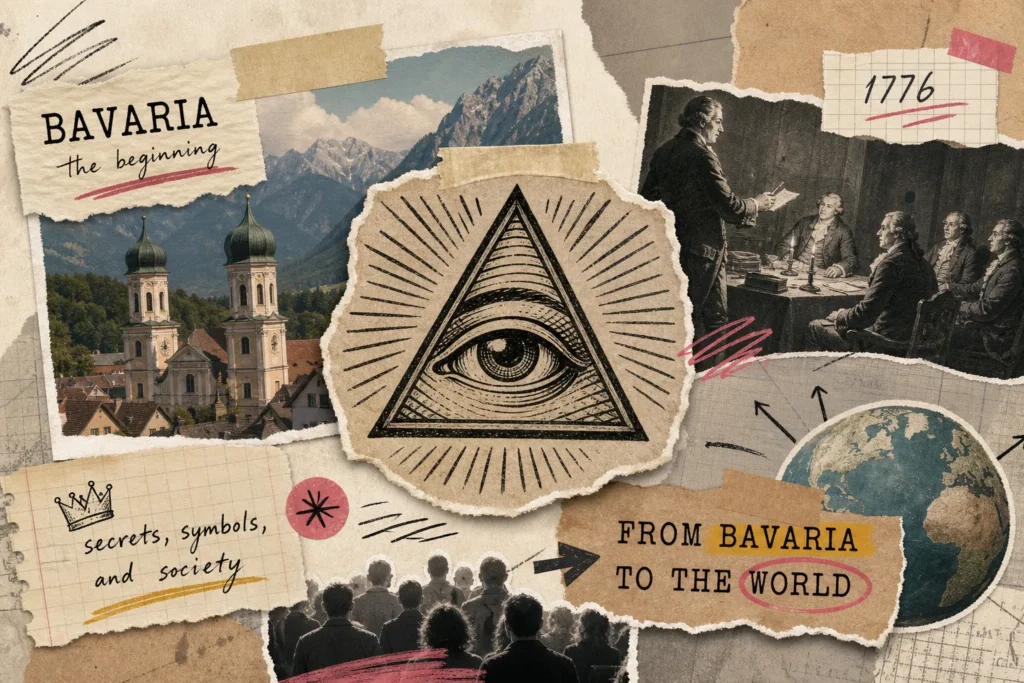
Most people have heard the name. Very few know the real story behind it. Where did the Illuminati come from? The answer is precise, documented, and far more compelling than two centuries of myth have allowed. The word carries enormous cultural weight today, appearing in music videos, political commentary, and countless online forums, yet its actual origins trace back to a single man, a founding date, and an obscure Bavarian university town in 1776.
The record is clear: Bavaria, 1776, one man’s reformist vision, and a structured fraternal organisation so compelling it outlived its own existence by more than two centuries. What follows is the documented history, stripped of mythology and grounded in the archival record.
The man who lit the torch: Adam Weishaupt
His formation at Ingolstadt University
Adam Weishaupt was raised within the very institution he would spend his adult life working against. Educated by Jesuits at the University of Ingolstadt in Bavaria, he became professor of canon law in the early 1770s. Ingolstadt was a firmly Catholic institution, conceived as a bastion against Protestant influence, with the Bishop of Eichstätt serving as chancellor and Jesuit teachers dominating the intellectual atmosphere from 1549 onward. That environment produced a sharp, productive tension in Weishaupt between institutional obedience and rational enquiry.
The irony is worth dwelling on: the man who would found the Order of the Illuminati was formed entirely by the culture he set out to challenge. The Jesuit model of hierarchical, disciplined organisation clearly left its mark on him, even as its theology did not. When Weishaupt eventually built his own fraternal structure, he borrowed from the same organisational logic his educators had used, only pointed in the opposite direction.
Where did the Illuminati come from? Ingolstadt and the founding of 1776
Weishaupt had grown increasingly frustrated with the clerical domination of Ingolstadt and the glacial pace of Enlightenment reform in Bavaria. On 1 May 1776, with only five founding members and no financial backing, he established what history would come to call the Bavarian Illuminati. The group began as a small intellectual circle, referred to by some historians as the Order of the Perfectibilists, before Weishaupt settled on the more resonant title.
The date deserves notice. In the same year that the American Declaration of Independence was signed, a young Bavarian professor gathered a handful of men in secrecy and started something that would outlast his own intentions entirely. This 1776 secret society was not a shadow government or a cabal of dark magicians. At its founding, it was closer to a radical reading group operating under conditions where open dissent carried real professional and legal risk.
What the Order actually stood for
The Enlightenment ideals at the core
Weishaupt’s stated aims drew directly from the Enlightenment thinkers he admired: Voltaire, Rousseau, Locke, and Kant shaped his intellectual framework. The Order opposed superstition and religious interference in public life, sought to curb abuses of state power, and promoted reason, equality, and moral reform. These were not sinister ambitions. In the context of late 18th-century Bavaria, they were dangerous ones, which is precisely why they required a protective shell of secrecy to survive.
Many historians argue that the arcane trappings of the Order were largely practical rather than mystical. Secret signs, ceremonial initiation, and graded ranks existed because open reformist organisation was impossible under Bavarian political conditions, not because Weishaupt was constructing an esoteric religion. The philosophy was genuinely reformist; the secrecy was a delivery mechanism.
The three classes of membership
The Order’s hierarchical structure is where the organisational logic of secrecy becomes most apparent. Membership was arranged into three broad classes. The first, known as the Nursery, contained the entry-level grades: Novice, Minerval, and Illuminatus Minor. The second consisted of Masonic grades, Apprentice, Fellow Craft, and Master, reflecting the Order’s deliberate overlap with Freemasonry as a recruitment channel. The third and highest class, the Mysteries, contained the Lesser Mysteries (Priest and Regent) and the Greater Mysteries (Magus and King).
In practice, most members never advanced beyond the lower grades. Some historians believe the upper mystery rites existed more as aspiration than documented ritual, and that they were never fully formalised. This tiered structure, in which knowledge was rationed by rank, fed conspiracy theory for decades after the Order’s suppression, even though its practical purpose was simply controlling the pace of recruitment and maintaining discipline across a geographically dispersed network.
Ranks, rituals, and the architecture of secrecy
Codenames, ciphers, and initiation ceremonies
The Order operated through a system of arcane protocols that would feel familiar to any student of esoteric organisation. Members adopted classical pseudonyms, according to the seized correspondence later published by Bavarian authorities, Weishaupt used “Spartacus” as his own. Locations were renamed in code, and all official correspondence was conducted in cipher. Initiation ceremonies involved vows of secrecy and obedience, with signs and passwords recognisable only to those of equivalent grade.
The internal surveillance system is perhaps the most remarkable detail. Members were expected to report on one another, filing assessments of fellow initiates with superiors. This mechanism maintained discipline and filtered out those who showed signs of unreliability. For an examination of the motives that make secrecy necessary in reformist organisations, see Why A Secret Society.
Growth and reach across Europe
By the early 1780s, the Order had expanded dramatically, attracting intellectuals, noblemen, and reformers across Bavaria and into Austria, Italy, and beyond. Weishaupt’s decision to recruit through Masonic lodges gave the Order immediate reach across existing elite networks. Membership estimates vary among scholars: conservative assessments place the peak membership at around 1,300 individuals, while some accounts suggest figures approaching 2,500; the most commonly cited range runs from roughly 1,300 to just over 2,000. That figure represents significant growth for an organisation that began with five men in a Bavarian lecture hall, and it was precisely this scale of expansion that drew the attention of the Bavarian authorities. For a concise reference on the historical Bavarian movement, see the Bavarian Illuminati entry.
The crackdown that tried to erase it
The 1785 edict and its consequences
The Bavarian government, under Elector Charles Theodore, issued an edict in 1785 banning secret societies outright. Weishaupt was stripped of his professorship at Ingolstadt and banished from Bavaria. He spent the remainder of his life in Gotha, living under the protection of the sympathetic Duke Ernst II of Saxe-Gotha-Altenburg until his death. Other members were imprisoned or expelled. The suppression was swift, official, and bureaucratically documented; this is not a contested chapter of history.
This sequence of events is worth stating plainly: the Bavarian Illuminati existed for nine years, was dismantled by government decree, and its founder spent the rest of his life in Gotha under ducal protection, writing philosophical works that attracted limited readership. The organisation did not survive, did not go underground in any meaningful sense, and did not, as far as the documentary record shows, continue as a functioning body after 1785.
What the seized documents revealed
In 1786 and 1787, Bavarian authorities seized the Order’s internal correspondence and papers and then published them. These documents, catalogued in records including The Legal Proceedings in Bavaria to October 10, 1786, were intended to expose and discredit the Illuminati, and they largely succeeded in that immediate political goal. The government laid out the Order’s internal structure, communications, and stated aims for public inspection.
The profound historical irony is this: by publishing everything, the Bavarian authorities handed future conspiracy theorists an extraordinarily rich archive to misread. The published papers proved that the Illuminati existed, had a hierarchical structure, used codes and pseudonyms, and sought to influence political affairs. Every one of those facts was true. The leap from those facts to a centuries-long global shadow government was entirely the work of later writers with other agendas.
How history became conspiracy
Robison, Barruel, and the 1797 template
Just over a decade after the suppression, two writers published near-simultaneous works that changed the conversation entirely. John Robison’s Proofs of a Conspiracy (1797) argued the Illuminati had infiltrated Freemasonry and driven the French Revolution. Abbé Barruel’s Mémoires pour servir à l’histoire du jacobinisme made a parallel case and was translated rapidly into six languages, giving the argument transnational reach. Together, these two works created what historians now recognise as the classic conspiracy template: a hidden global network operating behind political events and pulling strings from the shadows. For a focused essay on Robison’s influence and how that narrative was constructed, see Darkness Over All: John Robison and the birth of the Illuminati conspiracy.
Neither work was historical scholarship. Both were politically motivated polemics, produced at a moment of European-wide anxiety about revolution, democracy, and the collapse of traditional authority. Robison and Barruel were not writing history; they were fighting a political battle using history as ammunition. The origins of modern Illuminati conspiracy theories are traceable to specific texts written by specific people with specific political agendas. That context matters.
From New England pulpits to pop culture
Robison’s book was reprinted in New York and circulated through American Federalist networks, where its claims were repeated from New England pulpits through 1798 and 1799. George Washington received a copy from Reverend G. W. Snyder in 1798 and offered a measured response, acknowledging that individuals might have spread Illuminist doctrines while doubting that Masonic lodges as institutions had done so. That exchange alone illustrates how thoroughly the conspiracy framework had entered mainstream American political life within a decade of the Order’s actual dissolution.
From those early republic anxieties, the mythology moved through 19th-century anti-Masonic movements, 20th-century political paranoia, and finally into hip-hop, Hollywood, and social media, where the Illuminati name became shorthand for any perceived hidden power structure. The concept expanded precisely because it was severed from its historical roots. Stripped of Weishaupt, Ingolstadt, and the 1785 edict, the idea could attach itself to almost anything. For a modern primer on the subject’s evolution in popular discourse, see this Illuminati overview: history and theories.
Where those origins live on
The philosophy that refused to disappear
What Weishaupt actually built did not die with the 1785 edict. The framework he constructed, a structured fraternal organisation built around the pursuit of reason, reform, and hidden knowledge, with grades of initiation, arcane symbolism, and a commitment to pushing beyond the limits of conventional thought, outlasted the institution that housed it. The desire to seek esoteric understanding, to belong to something with deeper structure than surface-level society, and to align oneself with a tradition of intellectual daring: these impulses are older than Weishaupt and have never required his specific organisation to survive.
The sigils, the iconography, the Eye and the Pyramid: these symbols have carried layered meaning across centuries, their power drawn not from conspiracy but from what they represent, the aspiration towards illuminated understanding, the belief that the world contains layers of meaning accessible only to those willing to look beyond the obvious. For a focused reflection on those emblems, see The Mark of the Illuminati.
Illuminati Fraternities and the living tradition
Illuminati Fraternities is an organisation that takes the philosophical and symbolic legacy of the 1776 Order seriously, engaging with the genuine intellectual and fraternal lineage that the historical record supports, from the Eternal Circle and the Pyramid to the esoteric frameworks Weishaupt envisioned for structuring human ambition and collective reform. Rather than recycling conspiracy mythology, it engages with the documented history and the symbolic tradition that grew from it. The philosophical content, symbolic education, and membership tradition available through Illuminati Fraternities are intended for readers who want to go beyond surface-level familiarity with this history.
Where did the Illuminati come from? The answer, clearly stated
The question of where the Illuminati came from has a clean, specific answer: Bavaria, 1776, founded by Adam Weishaupt at the University of Ingolstadt, dissolved by government edict in 1785, and transformed into global myth by a pair of polemical writers in 1797. The conspiracy mythology did not emerge from the Order itself. It was constructed afterwards by politically motivated writers who found the historical facts useful for other purposes.
Knowing the real story does not make the Illuminati less fascinating. It makes it considerably more so. A small group of Enlightenment reformers in an obscure Bavarian university created an architecture of secrecy so compelling that it outlived its own existence by more than two centuries, absorbed the fears and ambitions of successive generations, and became the defining symbol of hidden knowledge in modern culture.
For those who want to go deeper into the philosophy, the symbolism, and the tradition that carries these origins forward, Illuminati Fraternities offers an archive of historical and esoteric content that begins exactly where the historical record leaves off. The pursuit of illuminated understanding does not require mythology, it requires only the willingness to look clearly at what the history actually says, and then to follow where it leads. See the organisation’s Sample Page for a starting point.
