
Uncategorized
How to get into the Illuminati: the official path explained
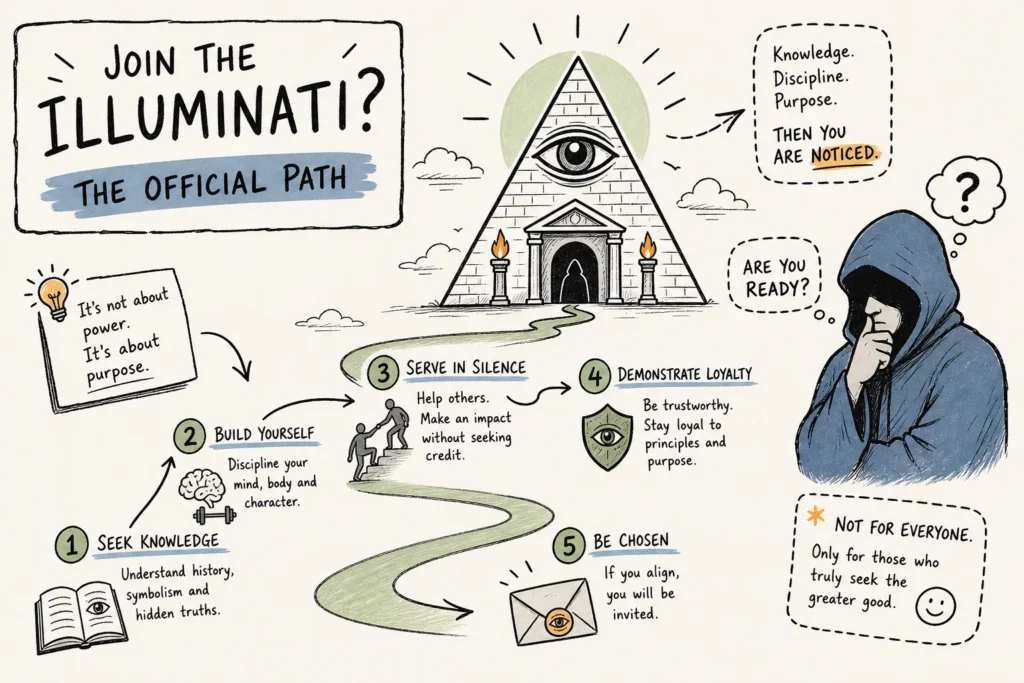
Millions of people search for how to gain access to the Illuminati every year. Many literally type “how to get in illuminati” into a search box. Most land on one of two things: a sceptical debunking piece that treats the question as absurd, or a recruitment page that takes their money and disappears. Neither is honest, and neither actually answers what the person is asking.
The allure is real and worth taking seriously. The Illuminati represents something most institutions cannot offer: a global network of influence, a framework for understanding power, and the sense of belonging to something that operates beyond the ordinary. That pull is not naivety; it is ambition. The question is whether there is a credible path to act on it, and the answer is more nuanced than most sources admit.
The historical Bavarian Illuminati was a real secret society, founded in 1776 and dissolved less than a decade later. The overwhelming majority of modern “join the Illuminati” websites are fraudulent operations designed to extract money and personal data (see, for example, Snopes and consumer-complaint trackers). One contemporary route some seekers consider is Illuminati Fraternities, a self‑described esoteric lifestyle brand and membership organisation in the entertainment/novelty space. There is no independent evidence that any modern group is a verified continuation of the eighteenth‑century order; proceed with due diligence before you engage.
What the Illuminati actually is, and what it stands for today
The Bavarian origins and why they matter
Adam Weishaupt founded the Order of the Illuminati on 1 May 1776 in Ingolstadt, Bavaria. The society was built on Enlightenment principles: the primacy of reason, opposition to superstition, and a belief that a carefully selected network of influential individuals could steer society towards moral and rational progress. Membership was never open. Candidates were recruited selectively, vetted extensively, and initiated through a hierarchy of grades beginning with Novice and Minerval (see Encyclopaedia Britannica for a concise overview).
The original order was suppressed by Bavarian authorities in 1785 and had effectively ceased to function by 1790. Its suppression did not erase its influence; it amplified it. The very secrecy and abrupt dissolution of the Illuminati seeded conspiracy narratives, including the modern New World Order conspiracy, that have grown around it ever since. Understanding this history helps to establish what a historical Illuminati‑aligned order looked like: selective, structured, and purposeful, not openly advertised.
The modern order and its guiding philosophy
Illuminati Fraternities presents itself as carrying the founding principles forward into the present, framed around a globalist, prosperity‑focused outlook. The philosophical terms it uses, for example, the “Maze of Existence” and the “Pendulum of Power”, appear in the group’s own materials and should be treated as self‑described concepts rather than independently verified doctrines. They are offered as tools for navigating a world defined by competing forces of influence, wealth, and institutional power.
This is not the Illuminati of conspiracy films or music‑video aesthetics but, at least in its presentation, a structured organisation with a defined outlook and an internal vocabulary. Candidates who approach expecting spectacle will be disappointed; those who treat it as an intellectual and networking framework for self‑advancement within a collective vision may find its claims align with their aims. For the organisation’s published origin narrative, see ILLUMINATI, The First Testament, Illuminati Fraternities.
Who actually qualifies for Illuminati membership
The mindset the order looks for
The historical Illuminati did not recruit on existing status alone. Weishaupt sought ambition, intellectual capacity, and alignment with the order’s goals. Wealthy and well‑connected recruits were valued, but the underlying question was always whether a candidate could advance the order’s design. That logic is echoed today. Illuminati Fraternities says it assesses prospective members for drive, openness to a larger worldview, and sincere commitment to growth within a shared framework.
In practice, the bar is defined by character rather than current circumstances. A candidate who is already wealthy has no automatic advantage over one who is ambitious and clear‑eyed about why they are pursuing membership. The order is not looking for passengers; it is looking for people prepared to move with intent and discipline.
Common assumptions that disqualify nobody who is truly ready
You do not need to be rich, famous, or politically connected before you apply. The historical order recruited young men of promise, not only men of existing power, with a preference for individuals under 30 who were full of drive rather than already settled into comfort. What disqualifies a candidate is not their current position in life but the absence of sincere motivation. Passive curiosity is not a qualification; considered ambition is.
The misconception that Illuminati membership is reserved for celebrities or billionaires is a product of pop culture, not the order’s historical criteria. The order seeks transformation candidates, not validation seekers. If your reason for pursuing membership is primarily to tell people you are a member, you are already misaligned with its ethos.
The scam landscape: why most “join Illuminati” websites are dangerous, and how to get in illuminati without being scammed
How these scams recruit people searching how to get in illuminati, and what they actually want
The mechanics of fake Illuminati recruitment follow a consistent pattern. An unsolicited message arrives by email, WhatsApp, Telegram, or social media, claiming to be from a recruiter, “Grand Master”, or official representative of the order. The message is rich with exclusivity and philosophical language designed to feel legitimate. Reported scam domains have included illuminatiofficial.org, illuminati.am, illuminati.mp, and dodis.co, names circulated on consumer‑complaint forums and scam‑tracking sites (as reported by users; status can change, so always verify the current domain owner). Investigative reporting such as Disinfo’s “Want to get rich? Apply today and join the Illuminati” examines the recruitment pitch used by these schemes.
Once contact is made, the target is moved off the original platform into a private WhatsApp or Telegram conversation. A “membership form” follows, requesting sensitive personal data: full name, date of birth, address, phone number, occupation, marital status, and often a photograph. Then comes the fee, framed as a registration charge, activation payment, or initiation cost. Victims who pay are ignored and their data is retained. Public reports commonly cite fees in the range of $115, $600 (roughly £90, £470 at recent rates), alongside risks of identity fraud once personal details are submitted. Technical analysis of such schemes is summarised in Bitdefender’s report on the anatomy of Illuminati scams.
Red flags to recognise immediately
The following signals should prompt you to disengage and report the contact:
- An unsolicited message claiming to be from an Illuminati recruiter or “Grand Master”
- Promises of guaranteed wealth, fame, or protection in exchange for a fee
- Pressure to move the conversation to WhatsApp or Telegram
- Requests for sensitive personal data before any formal, verifiable application process
- Payment demands framed as “activation”, “initiation”, or “processing” fees
- Poorly designed websites with no verifiable organisational history, legal details, or transparent contact information
Why legitimate orders rarely operate this way
Historical secret societies, including the Bavarian Illuminati, relied on trusted networks and careful screening rather than mass solicitation (see Encyclopaedia Britannica). Likewise, reputable modern fraternal orders, for instance, the United Grand Lodge of England (Freemasonry), state that they do not cold‑message strangers or promise riches, and prospective candidates initiate contact themselves via official channels. As a rule of thumb: treat unsolicited, fee‑seeking invitations with extreme caution and verify independently before sharing data or money.
How to get in illuminati via Illuminati Fraternities: the application process
Finding the membership portal, and verifying it
If you are serious about exploring Illuminati membership with a contemporary organisation, start at the publicly listed Join The Illuminati, Illuminati Fraternities. According to the site, the portal reflects a selective but accessible model: candidates come forward, the organisation assesses alignment, and communications remain on official channels. These are the site’s own claims; given the prevalence of impostor pages, verify the URL carefully, avoid links received in DMs, and cross‑check any domain against reputable look‑up tools and the organisation’s FAQ.
The process is intentionally paced. This is not a subscription with instant access but the beginning of an evaluation. Approaching it with patience and clarity of motive is itself a positive signal. Whatever you choose, never pay fees requested through private messages and never send identity documents to contacts you cannot verify.
The Department of Citizen Outreach: your formal point of contact (as described)
On the Illuminati Fraternities website, a Department of Citizen Outreach is presented as the team handling prospective‑member enquiries. It reviews applications, replies to suitable candidates, and guides those who qualify through next steps. Treat this as the formal point of contact for that organisation via its site, but note there is no independent verification that this represents an “official” channel of any continuous historical Illuminati. If someone claims to be from this department on WhatsApp or Telegram, disengage and use the site’s own contact route at Contact Us, Illuminati Fraternities.
Using the website’s contact route is more than a formality; it is a basic safety threshold. By initiating contact through the published portal rather than responding to a cold message, you avoid the most common fraud vectors and keep control of what you share.
What happens after you submit
The review process is not instantaneous. Applications are assessed for alignment with the organisation’s stated principles, and candidates are evaluated on the quality of their motivation rather than the speed of their replies. The measured pace is intentional: patience under evaluation is often a signal of readiness. Candidates who submit and then immediately demand updates tell the evaluators something unhelpful about their disposition.
What Illuminati membership actually entails
The benefits and what belonging to the order opens up
Membership within Illuminati Fraternities, as described by the group, offers access to an international network, conceptual frameworks for navigating influence and wealth, and an intellectual inheritance that references Enlightenment‑era ideas. The “Illuminations” e‑book and symbolic material around the Eye, Pyramid, and what the site calls the “Eternal Circle” are part of that self‑published ecosystem; there is no independent verification of these products beyond the organisation’s own channels. Its references to a “Globalist Agenda” should be read as the group’s terminology for engaging with interconnected systems, distinct from conspiracy‑theory usage of the term, and approached critically with source awareness.
The identity that comes with authentic membership in any meaningful order is rarely trivial. Belonging to something aspirational can change the way a person carries themselves, makes decisions, and builds relationships. The value is not a certificate or a badge but a shift in perspective and access, provided the claims of the organisation prove sound.
The commitment the order expects in return
Membership is not passive. The historical order required secrecy, obedience to the hierarchy, and sustained dedication to the society’s aims. The modern equivalent asks for thoughtful engagement with stated principles, discretion, and commitment to a collective vision rather than purely personal accumulation. A candidate who treats membership as a transaction will find little of worth; one who treats it as a transformation is closer to the design.
Taking the first step: how to get in illuminati and contact the order now
Moving from curiosity to candidacy
Reading about the Illuminati is not the same as pursuing membership. Most people who search the topic read a few articles, encounter a scam or a debunking piece, and move on. The minority who take a considered, verified step towards engagement are already demonstrating something that sets them apart, the foundations of initiative and discipline.
The next step is straightforward: visit the Join The Illuminati, Illuminati Fraternities, review what the organisation says it stands for, and use the Contact Us, Illuminati Fraternities form to make formal contact. Do not use any other channel. Do not pay any unsolicited fee. Do not submit personal data to any site or person who contacted you first. If you are asking yourself how to get in illuminati without falling for a scheme, start with verification, then take the initiative on your terms.
What to bring to the application
There are no trick questions and no impossible prerequisites. What helps is clear motivation, a candid account of your ambitions, and an honest statement of what you seek from membership. Candidates who arrive knowing why they are there, and who can articulate that plainly, are the ones any serious order takes seriously. Prepare that clarity before you make contact, and the process will follow its natural course.
The practical answer to how to get in illuminati is simple but exacting: understand the history, recognise common scams, verify the portal you use, and, if you proceed, reach out through the organisation’s own published channel. Start at the Join The Illuminati, Illuminati Fraternities and direct questions to the Contact Us, Illuminati Fraternities. The threshold is there; the decision to cross it remains yours.
References and further reading:
- Wikipedia, “Illuminati” (overview)
- Encyclopaedia Britannica, “Illuminati (Bavarian)” and entries on secret societies (historical context)
- Snopes, reports on “Illuminati invitation” scams (documented scam patterns and fee ranges)
- BBB Scam Tracker, user‑reported “Illuminati” advance‑fee scams (case examples)
- Action Fraud (UK), guidance on advance‑fee fraud and social‑media scams
- United Grand Lodge of England, “How to Join” (example of a legitimate fraternal order’s approach to enquiries)
