
Uncategorized
Eye of Providence symbol: the all-seeing eye explained
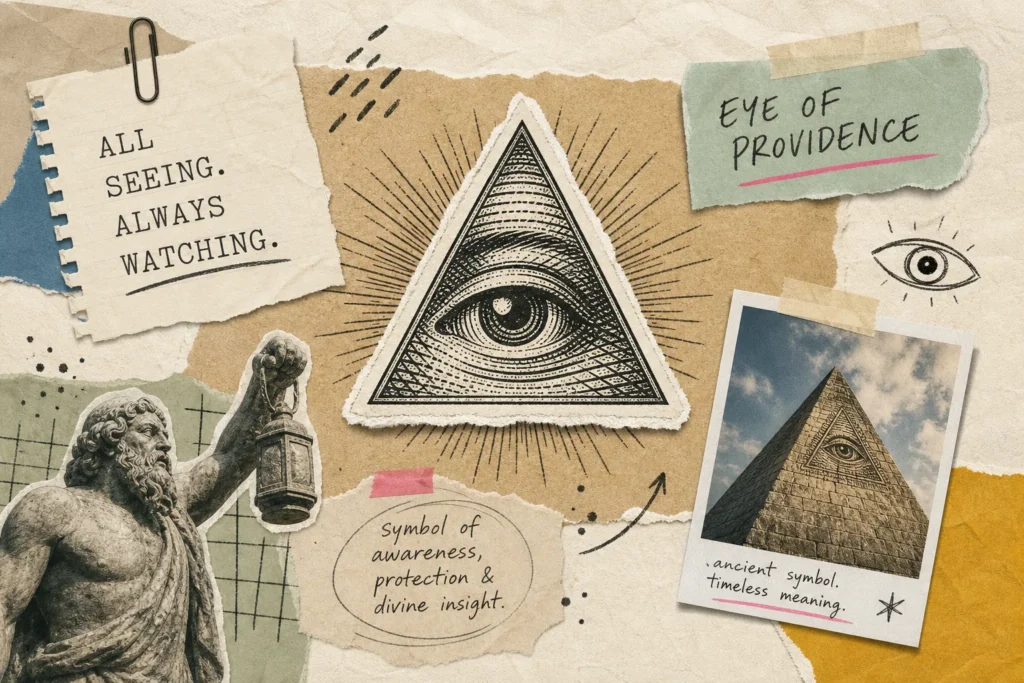
Flip a US dollar note over and the Eye of Providence symbol stares back: an eye suspended above an unfinished pyramid, surrounded by radiating light. It appears carved into cathedral ceilings, printed on the spines of esoteric paperbacks, and flashing across music videos. The all-seeing eye is one of the most widely recognised emblems in Western popular culture, and also one of the most misread.
The documented history of this symbol is not shadowy or speculative. It travels through Renaissance Italy, Christian theology, American statecraft, and Masonic ritual in a sequence that is fully traceable through primary sources. That history is what this article covers, alongside the visual relatives of the eye: the ancient Egyptian Wedjat and the Middle Eastern Hamsa amulet. By the end, readers will be able to distinguish what the historical record actually shows from what modern conspiracy culture invented.
Organisations such as Illuminati Fraternities have placed the Eye at the centre of their symbolic identity precisely because its layered meanings run so deep. Understanding where the emblem truly comes from is the first step to understanding what it still represents to those who carry it today.
Where the Eye of Providence symbol actually comes from
The 1525 painting that changed iconographic history
The earliest documented appearance of the Eye of Providence in European art is Jacopo Pontormo’s Supper at Emmaus, painted in 1525 for the Carthusian monks of the Certosa del Galluzzo in Florence. Pontormo had taken refuge at the charterhouse during a plague outbreak in 1523, and the monks commissioned the panel for their guest quarters. The eye, set within a radiant triangle above the seated figures, conveyed divine presence and omniscience at the moment Christ revealed himself to his disciples.
Scholars note an ongoing debate about whether the eye was added by a later restorer during the Counter-Reformation rather than by Pontormo himself. Either way, the debate reveals something significant: by the late Renaissance, the eye in triangle symbol had already become a recognisable shorthand for God’s watching presence in Christian iconography, considered theologically appropriate regardless of authorship.
Cesare Ripa’s Iconologia and the meaning of the triangle
In 1593, the Italian humanist Cesare Ripa published his Iconologia, the period’s definitive guide to emblematic imagery. Ripa explicitly described the eye within a triangle as a representation of the Christian Holy Trinity: Father, Son, and Holy Spirit, one divine person for each side. The eye itself drew on Biblical passages, including Psalm 33:18, to stand for God’s omniscience. By the late Renaissance, a radiant eye enclosed in a triangle was standard Christian iconography, displayed openly in painting and architecture across Europe.
This is the origin of the symbol now called the Eye of Providence. It was not born in the shadows. It was created in full daylight, in monastic Italy, for explicitly theological purposes, and it carried that meaning for nearly two centuries before anyone associated it with secret societies.
How the all-seeing eye ended up on the US dollar
The 1782 Great Seal and the language of divine providence
The symbol entered American statecraft through the Great Seal of the United States, formally adopted by the Continental Congress on 20 June 1782, as recorded in the Journals of the Continental Congress, Vol. XXII. Charles Thomson, Secretary of the Congress, provided an explicit written explanation: the Great Seal eye above the thirteen-step unfinished pyramid alluded to “the many signal interpositions of providence in favour of the American cause.” The accompanying motto, annuit cœptis (“He approves our undertakings”), reinforced that reading directly.
The design team included no Freemasons, and the symbol was selected for its Biblical and classical authority, not for any fraternal or esoteric reason. The pyramid’s thirteen steps represented the original thirteen states; the eye above declared that divine oversight had guided their struggle for liberty. This was civic theology, not occult signalling.
From the Great Seal to the 1935 dollar bill
The eye did not appear on American currency for more than 150 years after the seal’s adoption. It was introduced to the US one-dollar note in 1935, when President Franklin D. Roosevelt’s administration first printed the reverse of the Great Seal on paper currency. Numismatic historians note the Nova Constellatio coppers of 1783 as a brief earlier precedent, but the mass-circulation version most people recognise dates entirely from 1935, and there is no documentary evidence, in any archive, that the design was intended as a Masonic cipher or a signal from any secret society.
Freemasonry and the Eye of Providence: what the records show
Robert Moray and the 17th-century esoteric trace
The earliest known Masonic association with the eye symbol belongs to Robert Moray (1609, 1673), a Scottish soldier and one of the founders of modern speculative Freemasonry. His personal seal depicted a circle with a central eye and radiating rays. This was a personal and esoteric choice: the symbol did not appear in standardised Masonic ritual or lodge documentation during Moray’s lifetime, and it remained confined to his private iconographic world.
Thomas Smith Webb’s 1797 codification
The eye entered American Freemasonry formally through William Preston’s degree lectures in the 1770s and 1790s, and was codified in Thomas Smith Webb’s The Freemason’s Monitor in 1797, fifteen years after the US Great Seal had already been adopted. Webb described the “All-Seeing Eye” as a reminder that God, the Great Architect of the Universe, “pervades the inmost recesses of the human heart, and will reward us according to our merits.” For Freemasons, the emblem carried a moral standard: a call to brotherly love, relief, and truth, and a constant reminder that just actions are required because nothing is hidden from divine sight.
The sequence matters. The Eye of Providence symbol existed in Christian art for over two centuries before Freemasonry standardised it. Masonry adopted the Eye because it already carried spiritual authority, not because Masonry created it.
Eye of Horus, Hamsa, and the symbols most often confused with the Eye of Providence
Three ocular symbols are routinely conflated in popular culture, but their origins, meanings, and cultural functions are entirely distinct from one another.
The Eye of Horus, known in ancient Egypt as the Wedjat, is a stylised human eye with falcon characteristics rooted in Egyptian mythology from the early third millennium BCE. Its core meanings are protection, healing, restoration, and prosperity, tied to the mythological battle between Horus and Set. It carries no triangle association and makes no theological claim about omniscience. In 1499, Francesco Colonna’s Hypnerotomachia Poliphili translated an Egyptian eye motif into a representation of “God,” contributing to the visual synthesis later expressed in Renaissance Christian art, though scholars are clear that this was creative reinterpretation rather than a continuation of Egyptian mythology. It is also worth noting that the Eye of Ra (the right eye, solar) and the Eye of Horus (the left eye, lunar) are distinct from each other within Egyptian tradition, and neither maps onto the Christian symbol.
The Hamsa, also called the Khamsa, is a hand-shaped amulet used across Jewish, Islamic, and broader Middle Eastern traditions, with an eye positioned at the centre of the palm. Its function is protective: a ward against the evil eye rather than a declaration of divine omniscience. In some Jewish traditions, the “world-seeing eye” was regarded as a negative force, making the Hamsa a counter-symbol rather than a related emblem. All three symbols draw on the human instinct to use the eye as a spiritual agent, but their cultural lineages do not intersect. Treating them as variants of a single tradition is a common error with no scholarly support.
From church ceilings to music videos: the Eye of Providence symbol’s modern journey
The eye-in-triangle motif is physically embedded in the built environment across Europe and the Americas. Church facades, Baroque ceiling frescoes, and Enlightenment-era public buildings display it openly as a declaration of faith and divine patronage. These appearances share a consistent Christian interpretive framework: the symbol was displayed precisely because its significance was widely understood, with nothing hidden about its meaning.
The 20th century transformed it into conspiracy shorthand. Robert Shea and Robert Anton Wilson’s Illuminatus! trilogy of 1975 linked the eye on the dollar bill to a shadowy global elite, introducing that reading to a vast popular audience. By the time hip-hop, Hollywood, and social media amplified these associations through the 1990s and 2000s, the eye-in-triangle had become a catch-all marker for alleged Illuminati involvement in celebrity culture. Performers including Rihanna, Jay-Z, Beyoncé, and Madonna all referenced the symbol in videos and performances, sometimes as satire, sometimes as deliberate provocation, and sometimes simply because the imagery carried an irresistible cultural charge.
The scholarly consensus on this point is clear: the conspiracy reading is a historically inaccurate reinterpretation. What those same academics acknowledge is that the cultural force of that reinterpretation has been enormous, generating entire industries of content, merchandise, and community built around the idea of hidden elites communicating through shared iconography.
Who claims the Eye today, and why it still carries power
Across centuries, individuals and organisations have adopted the Eye of Providence because it concentrates an unusual density of meaning into a single image: divine oversight, hidden knowledge, elevation above the ordinary, and connection to a lineage of symbolic authority. It has belonged to Carthusian monks, American founders, and Masonic lodges in turn.
Today, The Eye, Illuminati Fraternities places the Eye at the centre of its symbolic identity, alongside The Pyramid, Illuminati Fraternities and the Eternal Circle, as one of the foundational emblems of membership in a global order. That order traces its aspirations to the same principles of enlightenment, ambition, and collective influence the symbol has embodied since the Renaissance. For those drawn to the arcane and the aspirational alike, it remains the most direct visual expression of what belonging to such an order means.
The symbol endures because no amount of historical clarification fully drains it of its charge. It speaks to the human desire to be watched over, to belong to something larger than oneself, and to move through the world carrying knowledge others do not possess. Whether the interpretive frame is theological, Masonic, nationalist, or esoteric, the Eye functions as an invitation: look up, be seen, and understand that nothing is concealed from those who know how to look.
The documented record and its living significance
The Eye of Providence symbol is not a Masonic invention, not a secret cipher embedded in the US dollar, and not a derivative of the Eye of Horus. It is a Christian symbol of divine omniscience with documented roots in 16th-century Italian art that travelled into Freemasonry, American statecraft, and global popular culture through a series of well-sourced historical steps. The primary sources, from Ripa’s Iconologia to the Journals of the Continental Congress to Webb’s Freemason’s Monitor, tell a coherent and fully traceable story.
Organisations across the centuries, from Carthusian monks to American founders to modern esoteric orders, have used this symbol to declare something about power, oversight, and aspiration. For those who want to explore its living significance rather than its historical record alone, the organisations that still carry the Eye as an active emblem of identity and membership are the natural next destination (see Symbols Of Illuminati, Illuminati Fraternities).
The symbol has outlasted every attempt to reduce it to a single meaning, and that staying power is itself the most telling thing about it.
