
Uncategorized
How did the Illuminati start: Ingolstadt 1776 to legend
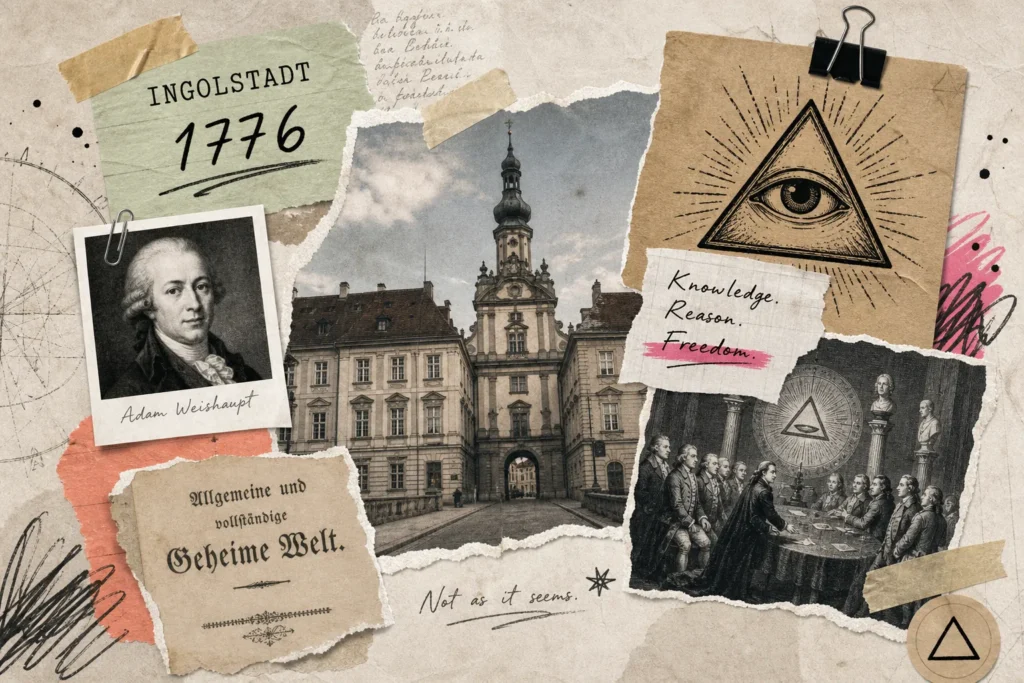
How did illuminati start? Many expect a tale of ageless power, yet the real story is sharper and more human: a small Enlightenment circle founded by a young professor who wanted ideas to move faster than censors. That friction between reason and restraint lit the fuse.
In this guide, you will see how the Bavarian Illuminati formed in Ingolstadt in 1776, what its statutes required, who scaled it across Europe, and how Bavaria dismantled it by 1787. You will also learn how a short‑lived order became a durable myth, from confiscated papers and political panic to the global afterlife of a name.
How did illuminati start? The spark in Ingolstadt
Jesuit dominance at the University of Ingolstadt
In the 1760s and early 1770s, the University of Ingolstadt operated under tight Jesuit influence. Chairs, including the prestigious canon law post, and much of the curriculum reflected Jesuit priorities rather than open scholarly debate. After the papal suppression of the Jesuits in 1773, the university began to loosen, yet habits and networks of control remained (Britannica: Suppression of the Jesuits).
Adam Weishaupt, trained in law and raised within this environment, pushed for change. He argued for non‑Catholic books in the library, for scientific subjects in the syllabus, and for a university that served inquiry rather than doctrine. His frustration with clerical vetoes seeded a plan: build a parallel network devoted to reason, virtue, and strategic discretion.
Adam Weishaupt’s frustrations and Enlightenment ideals
Weishaupt believed institutions should protect the public from superstition and abuse of power. He envisioned an inner school for adults, where members improved their character, learned to test ideas, and supported one another in public life. He also understood that some work had to proceed quietly to survive censorship and shape policy at the margins.
That form was a secret society. It would mirror the discipline he saw in Jesuit organization while aiming at opposite ends: promote reason, restrain tyranny, and strengthen civic virtue. In this design, secrecy was not a vice; it was a technique for sheltering fragile ideas until they could stand in open air.
Founding the Order, 1 May 1776: statutes and structure
The night of the oath, origins of the Illuminati, from Novice to Minerval (1776)
The Bavarian Illuminati began on 1 May 1776 in Ingolstadt under Adam Weishaupt. A small circle swore vows and took classical aliases, a practice that hid identities while reinforcing shared myth. Weishaupt became “Spartacus,” and early companions adopted names such as Ajax and Tiberius to signal a republic of reason rather than a court of flattery.
Entry moved in stages. A recruit started as a Novice under scrutiny, then advanced to Minerval after proving zeal and discretion, and later to Illuminated Minerval once trusted with wider correspondence. Advancement was never automatic; it was earned through study, service, and a reliable habit of keeping one’s word.
Rules of the order: secrecy, diaries, and mutual aid
The statutes blended moral improvement with practical safeguards. Members vowed secrecy and obedience to superiors, kept personal diaries for self‑audit, contributed to a common treasury according to means, and assisted brethren in need. Communications traveled in cipher with disguised place names, and some instructions urged prolonged secrecy for the fraternity’s protection (Einige Originalschriften des Illuminatenordens, 1787).
Aliases enforced compartmentalization and pride in equal measure. Early code names recorded in seized papers included:
- Adam Weishaupt as “Spartacus”
- Massenhausen as “Ajax”
- Merz as “Tiberius”
- Sutor as “Erasmus Rotterdamus”
- Bauhoff as “Agathon”
Women were not admitted, and the order drew from scholars, civil servants, nobles, and tradesmen who favored reform. The rules created a habit of mind: learn constantly, help your circle, and speak little outside it.
A hierarchy by design: Jesuit rigor meets Masonic form
The internal design used three classes that mixed Jesuit discipline with Masonic ceremony. Degrees paced learning, incorporated ritual, and aligned members to a chain of command that simplified oversight. The structure looked like this:
- First class: Novice, Minerval, Illuminated Minerval
- Second class: Masonic grades such as Apprentice, Companion, Master, with Scottish higher grades
- Third class, the mysteries: Priest or Regent, then Mage or Magus, and King
Superiors audited correspondence and performance, centralizing direction without exhausting local energy. The result was a network that could grow while preserving a shared language of symbols and goals.
Networks and momentum: recruitment across Europe
Knigge’s redesign and the Masonic bridge into Enlightenment secret societies
Baron Adolph von Knigge became Weishaupt’s most effective organizer. He refined the degree system, wrote clearer rituals, and used Masonic circles as a bridge to recruit educated men already trained in lodge discipline. That connection expanded the Order beyond Bavaria into a continental conversation linking salons, workshops, and courts.
Knigge’s contribution went beyond volume; he turned ideals into a repeatable process. By giving the Order a portable grammar of grades and signs, he made it legible to Freemasons and attractive to reform‑minded elites who wanted a fraternity of purpose rather than performance.
Zwack, Bode, and elite patrons expand the Bavarian Illuminati
Xavier von Zwack, an early and trusted member, handled administration and much of the Order’s sensitive correspondence. His home later became the archive Bavaria would seize, which shows his centrality. Johann Bode recruited across cultural circles and helped initiate prominent intellectuals, extending the Illuminati’s reach into the arts.
Patrons such as the Duke of Brunswick, Ernest II of Saxe‑Gotha‑Altenburg, and other high‑status figures gave the Order credibility and access. Their presence did not turn the fraternity into a court faction; it signaled that reformist elites were hungry for a disciplined network that blended learning with action.
Who joined and how fast the order scaled across salons and courts
At its peak the Bavarian Illuminati likely counted between about 1,500 and 2,000 members across central Europe (estimates vary among historians; see EBSCO Research Starters: Illuminati). Most were scholars, officials, and professionals who saw in the Order a school for character and a shield against caprice. Women were excluded, which limited the network’s social range even as it grew quickly through existing lodge channels.
Growth brought scrutiny. Internal surveillance helped maintain standards, yet it also generated tensions that opponents exploited. By 1784 the fraternity had momentum and enemies. The second group would soon sit closer to the levers of the state.
Backlash and ban: Bavaria’s crackdown, 1784, 1787
Charles Theodore’s edicts and the decisive March 1785 blow
Elector Charles Theodore of Bavaria moved against unauthorized secret societies with edicts in 1784 and 1785. In March 1785, a decisive decree intensified the ban and targeted the Illuminati’s operations, stripping the fraternity of legal shelter, frightening potential patrons, and marking the beginning of the end for the Order in Bavarian territory (Britannica: Bavarian Illuminati).
The state framed the Order as a danger to religion and public order, a narrative that turned vows of discretion into evidence of conspiracy. Legality flipped quickly: what had been a private moral school now looked, in official eyes, like a subversive machine.
Raids, seized papers, and 1787 publications that exposed the order
Police followed the edicts with arrests and home searches in 1786 and 1787. Zwack’s residence yielded cipher keys, code names, and internal writings that showed both the scruples and the scope of the network. The government then published selections of the seized papers in 1787 to justify its actions and to warn the public (Einige Originalschriften des Illuminatenordens; Nachtrag von weitern Originalschriften).
The publications did not invent the Order’s existence. They presented authentic materials while interpreting them to suggest more menace than the texts warrant. Ciphers, diaries, and internal criticism became, in print, the furniture of sedition.
Exile and unraveling: Weishaupt removed, lodges dispersed
Weishaupt lost his university position and went into exile. Other members faced interrogation, dismissal, or quiet retirement from the fraternity. There was no single dissolution decree that erased the Order at once; the crackdown worked as an attrition machine that starved lodges of safety, leaders, and purpose.
- 1784: First edicts in Bavaria restrict unauthorized secret societies.
- March 1785: A targeted decree delivers the decisive blow within Bavarian jurisdiction.
- 1786, 1787: Raids and seizures expose ciphers, aliases, and correspondence.
- 1787: Government publications of confiscated papers cement the case and chill recruitment.
By the late 1780s, the Bavarian Illuminati ceased to function as an organized body. The historical record closes here; the legend soon reopens it.
From history to myth: the conspiracy is born
Barruel and Robison recast a defunct order as a global menace
Between 1797 and 1798, Augustin Barruel’s Memoirs Illustrating the History of Jacobinism and John Robison’s Proofs of a Conspiracy argued that the Illuminati survived underground and helped cause the French Revolution. Those books transformed a dismantled Bavarian fraternity into a master conspiracy with global reach, a bold and convenient claim, but not documented continuity (Barruel, 1798; Robison, 1797).
This was the pivot. The historical Illuminati ended in the 1780s. The ongoing Illuminati was a literary creation that attached itself to every subsequent shock that needed a hidden hand.
American echoes: sermons, pamphlets, and partisan panic in the 1790s
In the United States, clergy such as Jedidiah Morse preached sermons warning of Illuminati plots, and allied pamphlets circulated as Federalists and Democratic‑Republicans wrestled for power. The theory arrived as an imported explanation and quickly naturalized in domestic politics. By 1800, invoking the Illuminati had become a way to brand opponents as enemies of order (Morse, 1798 sermon).
Print culture did the rest. Newspapers excerpted, ministers amplified, and readers found that “the Illuminati did it” was a simple tool for a complicated world. The pattern never left.
So how did the Illuminati start a legend that endures?
First, it offered memorable ingredients: a founding date, hidden ranks, ciphers, and a crackdown. Second, it left behind confiscated papers that later writers could quote while stretching their conclusions. Third, it appeared at the right moment, when revolutions and reforms begged for meanings that felt larger than chance.
Combine those pieces and you get a myth with near‑endless supply. The conspiracy template that Barruel and Robison popularized still frames modern rumors, even when they point to events that occurred long after Bavaria closed the historical file.
Carrying the light forward: a modern doorway
What endures from 1776: reason, network, and discretion
Three elements from Ingolstadt still matter. Use reason as the standard, not fashion. Build networks that elevate character and competence. Practice discretion so ideas have space to grow before they face the crowd. These are working principles, not relics.
Illuminati Fraternities: membership, symbols, and curated lore
Illuminati Fraternities exists to make those principles useful today. We offer membership pathways, iconography you can carry with pride, and a library of Illuminations that decodes the Eye, the Pyramid, and the Eternal Circle with clarity. Our community blends outreach with initiation so members gain status through service rather than noise. We honor documented history and clearly label myth so you can enjoy the story without losing the facts. Explore our Illuminati Ebooks for curated readings and annotated sources that bridge scholarship and practice.
Your invitation: explore the order’s legacy
If you came here to learn how the Illuminati started, you now hold the arc from Ingolstadt to legend. For anyone asking “how did illuminati start,” our member guide and primary‑source library extend the path. When you are ready, join Illuminati Fraternities and bring your character to a network that values discretion and design. You may also view our illuminated manuscript, Follow The Light, Illuminated Manuscript, which interprets symbols and ritual in modern form.
Begin with the guide, explore the symbols, and contribute to the Order’s modern chapter. For a concise modern overview that ties the 1776 foundation to later interpretations, see this recent summary of the Bavarian Order’s later historiography (A Brief History of the Bavarian Order of the Illuminati).
