
Uncategorized
Pyramid symbolism: ancient origins to modern conspiracy
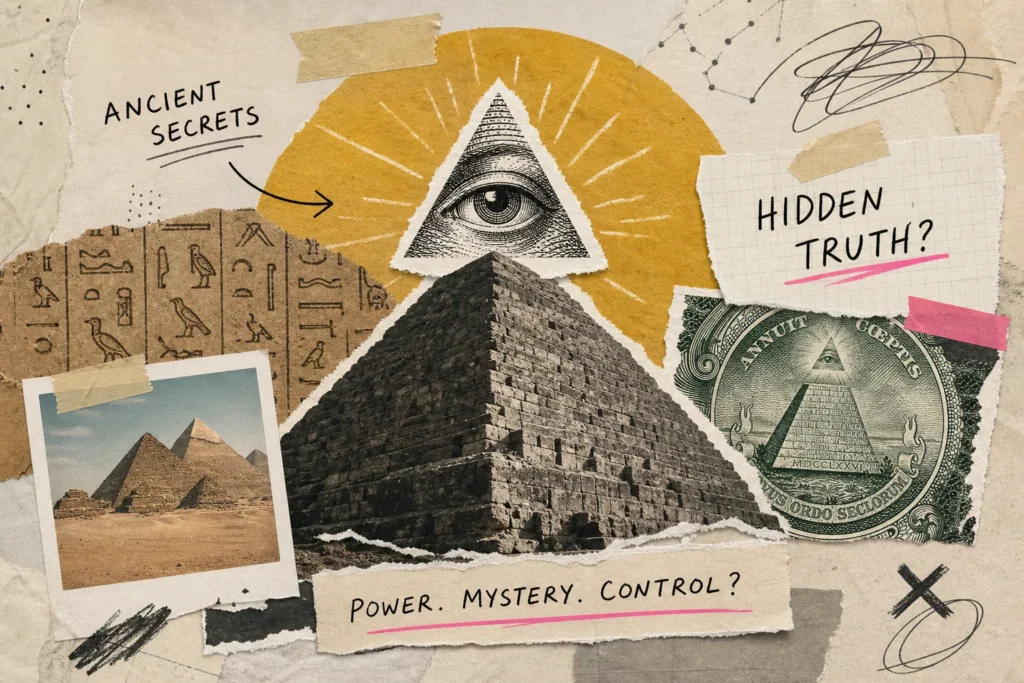
Pyramid symbolism is etched into ancient tomb walls built four and a half millennia ago, printed on the banknote in your wallet, and carved above the entrance to the Louvre. It sits at the centre of esoteric platforms, including organisations like Illuminati Fraternities, which treat the pyramid as one of their most sacred symbols. This is not coincidence, and it is not the result of one group orchestrating its presence across history.
The pyramid is one of the most widely recurring monumental forms in world history, carrying remarkable symbolic weight across cultures and centuries. It appears independently in ancient Egypt, Mesoamerica, Nubia, and the ancient Near East, each time pointing toward the same cluster of ideas: creation, ascent, divine order, and the relationship between the earthly and the eternal. This article traces that meaning from its earliest recorded expression in ancient Egypt, through Masonic and occult reinterpretations, to its present life in conspiracy culture and popular imagination. By the end, you will be able to distinguish what ancient priests, Masonic scholars, and modern esotericists each meant when they pointed to this shape, and understand why that meaning keeps evolving rather than fading.
What ancient Egyptians really believed the pyramid represented
While Egyptian pyramids functioned as royal burial monuments, modern scholarship emphasises their deliberate cosmological and religious symbolism rather than treating them as merely practical tombs. The pyramid was a cosmological statement built in stone, deliberately fusing solar worship, creation mythology, and the mechanics of the royal afterlife into a single architectural form. Ancient Egyptians built large triangular structures not simply for practical burial but because the shape itself carried irreplaceable sacred meaning, the pyramid spiritual meaning was inseparable from its physical form. For a concise overview of the archaeological record and major monuments, see the summary on Egyptian pyramids.
The benben stone and the primordial mound
At the foundation of Egyptian pyramid symbolism sits the myth of the benben, the primordial mound of earth that rose from the chaotic waters of Nun at the moment of creation. The god Atum, creator of the world, settled upon this mound and initiated existence itself. The pyramid shape is a direct architectural reference to that mound, transforming the cosmological event of creation into permanent stone. The formal names of the pyramids confirm this reading: the Bent Pyramid was called “The Southern Shining Pyramid.” Other names such as “Senusret Shines” follow the same pattern, functioning as theological declarations rather than functional labels, each linking the structure to solar luminescence and divine origin.
Sun worship, Ra, and the sloping sides
The sloping faces of the pyramid were understood as descending rays of the sun, the path along which the pharaoh’s soul ascended to join Ra in the heavens after death. Religious texts and architectural evidence present this not as casual metaphor but as a literal mechanism for the royal afterlife, expressed through both ritual inscription and physical design. Solar alignments at Giza reinforce this reading precisely: at the summer solstice, the sun sets directly between the two great pyramids when viewed from the Sphinx; at the equinoxes, the setting sun aligns with the northern side of the Khafre pyramid and the southern side of the Khufu pyramid. Narrow shafts within the Great Pyramid point toward circumpolar stars, which the Egyptians understood as the physical gateway to the heavens, ensuring the pharaoh’s soul could navigate the cosmos after death.
Pyramid Texts: the earliest written evidence
The Pyramid Texts, first inscribed on the walls of the Pyramid of Unas and later the Pyramid of Teti, are the oldest large body of religious inscriptions in ancient Egypt. These hundreds of spells strongly link the funerary ritual and the king’s ascent to solar and cosmic ideas, with constant references to Osiris, Ra, and the maintenance of cosmic order, known as ma’at. The texts frame the king’s transformation from mortal to eternal solar being, with the pyramid as the sacred space in which that transformation occurs, though they address the ritual and theological significance of the structure rather than describing its geometric form in purely architectural terms. This remains the primary archaeological evidence connecting the pyramid’s function to sacred meaning, and it provides compelling support for the cosmological intentions of the builders.
How pyramid iconography evolved across ancient civilisations
The Egyptian pyramid did not exist in isolation. Related structures appeared independently across Mesoamerica, Nubia, and the ancient Near East, each carrying its own cosmological logic while echoing remarkably consistent themes of ascent, divine connection, and legitimacy. The symbolism of pyramids, it turns out, was not a cultural export but a recurring human response to the same fundamental questions.
Mesoamerican pyramid temples, including the Great Pyramid of Tenochtitlan, functioned as active altars connecting the living to the divine. Egyptian pyramids were primarily funerary monuments and much less publicly active than Mesoamerican temple-pyramids, which were living ceremonial venues where public ritual, sacrifice, and astronomical observation occurred continuously. Hieroglyphic inscriptions at Tikal link these structures to dynastic legitimacy and divine sanction, serving the same political and theological function through a completely independent tradition.
The Nubian pyramids of Meroë carried the form forward across generations as sustained statements of legitimacy and connection to ancestral and divine realms, blending Egyptian and indigenous iconographic traditions in their chapel reliefs. Mesopotamian ziggurat texts describe the ziggurat at Sippar as a “stairway to pure heaven,” a concept so close to the Egyptian pyramid’s function as a cosmic bridge that it is tempting to assume influence, yet the two traditions developed separately, which makes the parallel all the more significant. In the Greco-Roman world, the term pyramidos reframed the shape as an emblem of inner knowledge and spiritual light, associating it with the fire at the centre of things rather than with tomb or temple. During the medieval period, the original Egyptian symbolism was largely lost, surviving only in fragmented esoteric traditions that understood the pyramid as a site of spiritual initiation. This gap matters because it shaped why later Western occultists had to reconstruct pyramid meaning rather than inherit it directly.
Masonic pyramid symbolism and the Great Seal mystery
This is where popular understanding of pyramid iconography diverges most sharply from historical fact. Freemasonry is routinely credited with placing the pyramid on the US dollar bill as a coded signal of shadowy control. The reality is both more nuanced and more interesting than that narrative suggests.
What Masonic tradition actually teaches about the pyramid
Within Masonic philosophical writing, the pyramid represents the combination of the triangle (the active, male, divine force) and the square (the passive, female, material force), symbolising the union of opposing principles. For background on the Masonic symbolic triangle and its meanings, see the concise discussion of the triangle in the Encyclopaedia of Freemasonry: The Triangle. The numbers 3, 5, 7, and 9 embedded in the pyramid’s structure signify perfection, with 7 specifically representing the mediation between the human and divine realms. The pyramid is associated with the “Eternal Light of Wisdom” surrounding the Supreme Architect, the divine source of the universe. Crucially, the pyramid does not appear in regular Masonic ritual; this is a philosophical and symbolic engagement with the shape, not a ceremonial one.
The unfinished pyramid on the US Great Seal
The reverse of the Great Seal was finalised by Charles Thomson, Secretary of the Continental Congress, who specified “a Pyramid unfinished” to represent the strength and permanence of the new nation, with the unfinished apex signifying a country still under construction. For a scholarly exploration of the seal and its symbolism, see the detailed article in the British Journal of Political Science discussion of the Great Seal. Thomson was not a Freemason. The Eye of Providence above the pyramid was a pre-existing Christian symbol for divine watchfulness, not a Masonic invention. For an accessible primer on the pyramid motif as it appears in modern iconography of the seal, the explanatory note at GreatSeal.com on the pyramid symbol is useful. When the two were combined on the dollar bill in 1935, the first time the Great Seal’s reverse appeared on currency, the timing coincided with a period of intense political suspicion, and the conspiracy reading took hold far more firmly than the historical record justifies.
Where Masonic symbolism ends and conspiracy reading begins
Masonic symbolic writings do engage seriously with pyramid imagery as a spiritual metaphor, and that engagement is genuinely rich. The claim that Freemasons secretly controlled the design of American currency or embedded coded instructions in the Great Seal is simply not supported by the historical evidence. Drawing that distinction does not diminish the symbolic depth of the Masonic interpretation; it clarifies where the evidence ends and where speculative narrative begins. Readers who want the most sophisticated version of the symbolic reading, rather than the conspiracy overlay, will find more substance in esoteric platforms that take pyramid iconography seriously on its own terms.
The pyramid in modern conspiracy and esoteric culture
Through the 2000s and 2010s, pyramid imagery saturated hip-hop, film, and celebrity culture, becoming shorthand for hidden power, elite control, and forbidden knowledge. Artists from Jay-Z to Kanye West incorporated the all-seeing eye and pyramid into album artwork and stage design, while films such as National Treasure and countless documentaries pushed the imagery further into mainstream consciousness. The symbol lost none of its power in that migration; if anything, it reached a larger audience than at any point since ancient Egypt.
Within this cultural moment, certain organisations have taken pyramid iconography seriously as a sacred symbol rather than a pop culture shorthand. Illuminati Fraternities is one such platform, engaging with pyramid shape symbolism as a central element of their esoteric framework, alongside the Eye, The Eternal Circle, Illuminati Fraternities, and the broader iconography of the Order. For readers who want a more rigorous engagement with pyramid meaning than a music video provides, their platform offers that depth of exploration directly.
The psychological pull of the pyramid is not manufactured. It is a form that simultaneously suggests order, hierarchy, ascent, and hidden apex knowledge, mapping cleanly onto human instincts around power, exclusivity, and spiritual aspiration. This is why pyramid symbolism keeps regenerating across contexts: not because any single group maintains it artificially, but because the shape resonates with something genuinely persistent in how humans think about the relationship between the material and the transcendent.
Esoteric claims versus what the evidence actually shows
One of the most persistent modern claims about pyramids involves not their symbolism but their alleged physical properties. New Age traditions assert that the pyramid shape concentrates cosmic energy, preserves food, sharpens blades, and enhances meditation. No peer-reviewed scientific evidence supports the existence of “pyramid energy” as a measurable phenomenon. A 2018 computer-modelling study published in the Journal of Applied Physics by researchers from ITMO University and Laser Zentrum Hannover found that the Great Pyramid can act as a resonant cavity for specific long-wavelength radio waves under simulated conditions, but this was not a physical measurement, and the effect was modest and applicable to any similarly shaped convex structure.
Controlled studies show food placed inside a pyramid spoils at the same rate as food in a standard container under identical conditions. Any perceived difference is attributable to airflow and humidity variation, not an energy field. The pyramid is not a functional energy device. That conclusion is direct, evidence-based, and does not diminish what the archaeological record does confirm: the Pyramid Texts, solar alignments, pyramid naming conventions, and associated temple layouts all provide robust support for the pyramid as a deliberate cosmological statement. The symbolic meaning is real, historically grounded, and genuinely sophisticated. The absence of measurable pyramid energy takes nothing away from that symbolic truth.
The useful distinction is this: esoteric traditions at their best engage with the symbolic and philosophical dimensions of pyramid architecture symbolism, which are historically supported and intellectually serious. Problems arise only when symbolic claims are presented as literal physical facts. Equipped with that distinction, you can engage with pyramid iconography on your own terms, deciding how much is metaphor and how much points toward something more.
Why pyramid symbolism endures across every era
The thread connecting ancient Egypt, Freemasonry, and modern esoteric culture is consistent: the pyramid represents ascent, the relationship between the material and the divine, and the pursuit of knowledge concentrated at the apex. These are not ancient preoccupations. They are perennial ones, which is why the symbol’s staying power is far better explained by its natural resonance than by any coordinated effort to keep it alive.
The pyramid is, finally, an invitation. Whether encountered on a banknote, in a temple complex, or on an esoteric platform exploring pyramid symbolism in its full sacred depth, this shape asks the same question it always has.
What are you ascending toward?
Conclusion
Pyramid symbolism has travelled from the benben mound of Egyptian creation theology, through Masonic spiritual allegory and the deliberate political imagery of the Great Seal, to the cultural saturation of modern conspiracy lore and dedicated esoteric organisations. Across every context, the shape has carried a recognisable core: the relationship between earth and heaven, material foundation and divine apex, known and unknown.
The key distinction this article has drawn is worth holding onto. The symbolic meaning of pyramid iconography is historically supported, archaeologically evidenced, and layered with genuine philosophical sophistication. Claims about literal pyramid energy, by contrast, are not supported by peer-reviewed science. The pyramid’s endurance as a symbol is not manufactured; it maps onto something deep in human psychological architecture that no single era or organisation has invented or owns.
For those drawn further into pyramid symbolism and the broader tradition of sacred esoteric geometry, platforms like The Pyramid, Illuminati Fraternities offer extended, lore-based explorations of this and related symbols; see also More, Illuminati Fraternities for additional resources. The iconography of the Eye, the Eternal Circle, and the pyramid itself deserves that depth of engagement. The shape has been pointing upward for around four and a half thousand years; it can carry the weight of serious inquiry.
