
Uncategorized
Eye of Providence: What the Illuminati symbol really means
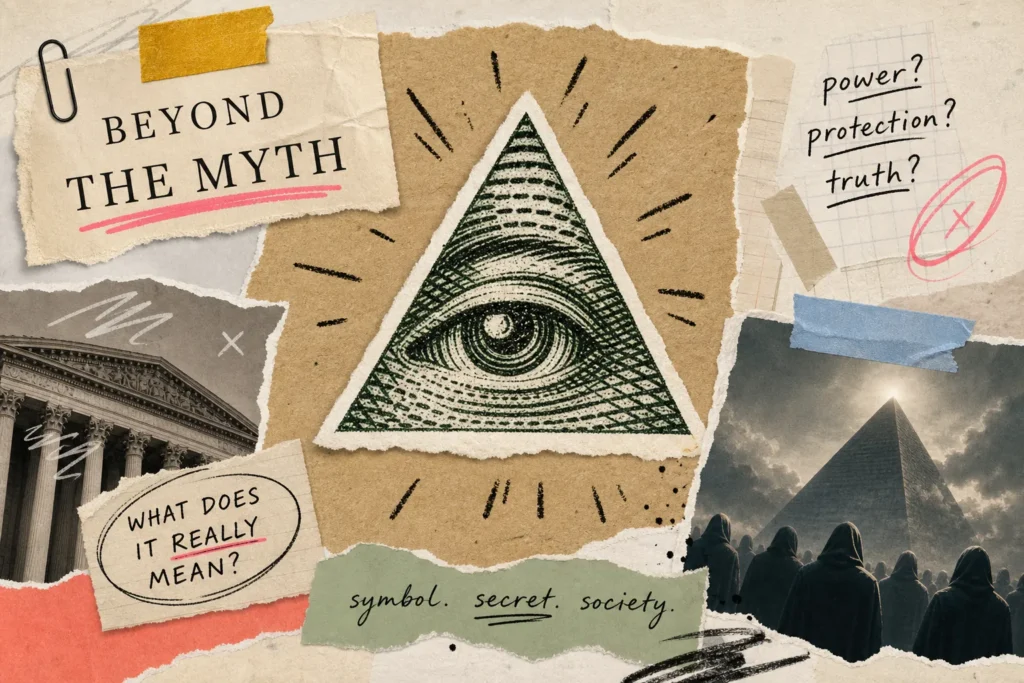
You have seen it. On a dollar bill, in a music video, on the back of a tour hoodie, or tattooed on someone’s forearm at a festival. The eye inside the triangle, radiating light outward, carrying the quiet suggestion that someone, or something, is always watching. That image has a formal name: the Eye of Providence. And its documented history stretches back centuries before a single conspiracy theory existed to claim it. This article has the Illuminati Eye of Providence symbol meaning explained, tracing the image from its Renaissance origins through Masonic ritual, American statecraft, and into the conspiracy culture that reshaped its meaning almost beyond recognition.
At Illuminati Fraternities, this sigil sits at the centre of the organisation’s symbolic mythology. It was not chosen arbitrarily or for shock value. It was chosen because few symbols in Western history carry more genuine philosophical weight, more layered meaning, or more documented institutional use across art, religion, statecraft, and esoteric tradition. The Eye rewards those who look closely at it, which is precisely the point.
By the time you finish reading, you will know where the Eye of Providence actually comes from, what it genuinely represents within Masonic and Christian thought, how it arrived on the US dollar, and how a satirical paperback published in 1975 managed to rewrite the symbol’s popular meaning almost entirely. The history is stranger and richer than the myth.
The Eye of Providence did not start with the Illuminati
A Renaissance painting, not an ancient secret
The earliest known appearance of the Eye of Providence in Western art is Jacopo Pontormo’s 1525 oil-on-canvas work, Supper at Emmaus, commissioned by the Carthusian monks of a Florentine cloister, though some art historians note that the eye element within the triangle may have been added to the composition later, possibly during the 17th century, making its original dating a matter of ongoing scholarly discussion. Whether or not it was part of the 1525 canvas as painted, the image’s theological meaning is unambiguous: the eye placed above Christ’s head inside a luminous triangle represented God’s omniscience, the divine presence watching over a sacred moment. This was not occult iconography. It was Christian theological thought rendered in paint, rooted in the belief that providence, God’s active care for the world, was always present and always observing. Cesare Ripa’s Iconologia (1593) later gave the emblem its first systematic written description, cementing it as a formal symbol within European emblematic tradition.
Why the ancient Egypt connection is misleading
The Eye of Horus, or Wadjet, is an entirely separate symbol with an entirely separate lineage. Dating to pre-3000 BCE, it belongs to ancient Egyptian mythology and centres on personal healing and regeneration: specifically, the myth of Horus’s eye being damaged and restored by Thoth, representing the moon’s cyclical disappearance and return. The Eye of Providence, by contrast, is a Renaissance Christian symbol concerned with collective divine oversight, not individual restoration. The two share surface visual similarity, they are both, after all, eyes, but their cultural origins, mythological functions, and intended meanings have no documented historical connection. The conflation is a product of modern pop culture, not of scholarship.
Illuminati Eye of Providence symbol meaning explained, what the triangle and eye actually symbolise
The triangle and the Holy Trinity
The Eye of Providence is not a single element but a composite one, and each component carries specific meaning within Christian iconography. The triangle represents the Holy Trinity: Father, Son, and Holy Spirit. The eye at its centre represents God’s all-seeing nature, the attribute of omniscience that no corner of human experience escapes. The rays of light radiating outward represent divine illumination extending into the world. Read together, the emblem communicates something precise: that providence is not passive observation but active, luminous oversight of all things.
The Masonic All-Seeing Eye and moral accountability
Freemasonry adopted the Eye of Providence into its ritual symbolism through a clear and traceable path. Thomas Smith Webb’s The Freemason’s Monitor (1797, with the 1802 edition formalising the placement) established the symbol as a permanent hieroglyphical emblem of the Third Degree. Webb described it as “a beautiful representation of the watchful care of the Supreme Architect,” an eye that “pervades the inmost recesses of the human heart” and rewards Masons according to their merits. William Preston’s ritual lectures made the moral dimension explicit: wherever a craftsman goes and whatever he does, the All-Seeing Eye observes. Mainstream Masonic sources assign no hidden agenda to the symbol whatsoever. Grand Lodge publications, including those from the Grand Lodge of Illinois and the Northern Masonic Jurisdiction, describe it consistently as an instrument of moral instruction, nothing more and nothing less. For an accessible overview of this Masonic explanation, see Freemasonry’s account of the Eye of Providence.
How the Eye ended up on the US dollar bill
The Great Seal of 1782 and Charles Thomson’s explanation
Congress approved the Great Seal on 20 June 1782. The Eye of Providence, sitting atop an unfinished pyramid on the seal’s reverse, was explained in plain terms by Charles Thomson, who submitted his official “Remarks and Explanations” to Congress that same day. Thomson wrote that “The Eye over it and the Motto allude to the many signal interpositions of providence in favour of the American cause.” The motto in question, Annuit Coeptis, translates as “He has favoured our undertakings.” Thomson described the pyramid as representing “Strength and Duration”; the Eye, paired with the motto, pointed to divine providence as the guiding force behind the nation’s founding. This was 18th-century Christian statecraft, expressed through the visual language available to educated men of that era. Official summaries of the Great Seal and the Eye’s placement are available from government educational resources and on specialist sites such as the GPO’s guide to the Great Seal and the Great Seal project’s page on the Eye.
The Masonic conspiracy theory that doesn’t hold up
The popular claim that Freemasons secretly engineered the Great Seal as a Masonic statement does not survive contact with the primary sources. Benjamin Franklin, the only Freemason on the original 1776 design committee, had his proposals rejected entirely. The final design was completed by Charles Thomson and William Barton, neither of whom was a Mason. The Eye’s presence on the seal reflects the same 18th-century Christian iconographic tradition that placed it in Renaissance painting and church architecture across Europe. The Masonic reading is a retrospective projection, not a documented intention.
The moment the Eye became an “Illuminati symbol”
Robison’s 1797 conspiracy text and the early conflation
The Illuminati conspiracy narrative has a specific origin: Scottish scientist John Robison’s Proofs of a Conspiracy, published in 1797. Robison argued that the Bavarian Illuminati (founded 1776, dissolved 1787) had engineered the French Revolution through a covert Masonic cell, and that the group represented an ongoing threat to European civilisation. The text launched an enduring tradition of conflating the Illuminati with Freemasonry and shadowy global power. Crucially, however, Robison’s text made no visual connection between the Eye of Providence and the Illuminati. That link did not exist yet. For a deeper look at Robison’s role in inventing the modern Illuminati conspiracy narrative, see the essay on John Robison and the birth of the Illuminati conspiracy.
How a 1975 satirical novel built the myth
Illuminatus! by Robert Shea and Robert Anton Wilson, published in 1975, is a primary cultural milestone in creating the modern Eye, Illuminati association. The novel, a sprawling satirical conspiracy thriller, fictionally linked the Bavarian Illuminati to the imagery on the US dollar bill, making the Eye of Providence the visual shorthand for any and all global conspiracy. The irony is important: the book was a satire, mocking the internal logic of conspiracy thinking rather than endorsing it. Within its own narrative, the connection between the Eye and the Illuminati is framed as an erroneous claim made by conspiracy theorists.
Yet the association proved so culturally compelling that readers absorbed it as mythology regardless. The dominant Illuminati symbol of the 21st century was invented by a satirical paperback, not uncovered by researchers. Understanding that origin is central to understanding the Illuminati Eye of Providence symbol meaning as it exists in popular consciousness today.
Where the Eye appears in pop culture today
Hip-hop, Hollywood, and the currency of conspiracy
From the 1990s onwards, the Eye of Providence migrated from currency and lodge rooms into mainstream entertainment at considerable speed. Hip-hop music videos, album artwork, and celebrity imagery became saturated with the symbol, and commentary followed. Jay-Z, Beyoncé, Rihanna, and Kanye West have all been connected to the Eye by conspiracy commentators, with some analysts interpreting the imagery as deliberate Illuminati signalling and others, such as cultural critics writing in publications like The Guardian and Rolling Stone, identifying it as aesthetic provocation or coincidental visual borrowing from a symbol already deeply embedded in the cultural landscape. For many artists, the symbol’s accumulated weight is the point: carrying five centuries of layered meaning, it does precisely what the best visual provocations do, it generates conversation without requiring a definitive answer.
Why the symbol keeps spreading
The Eye of Providence is geometrically simple, visually arresting, and conceptually open. Its ambiguity is not a weakness; it is the engine of its spread. In an age where ideas travel through images rather than arguments, a symbol that can simultaneously suggest divine watchfulness, hidden power, and cultural sophistication is extraordinarily versatile. Merchandise, tattoo culture, digital aesthetics, and streetwear have all absorbed it for precisely this reason. The Eye does not need to mean one specific thing to be powerfully effective. That is what five centuries of layered usage produces.
The Eye as a foundational emblem within Illuminati Fraternities
A symbol chosen for its depth, not its drama
Illuminati Fraternities places the Eye of Providence at the centre of its iconographic system because few symbols in the Western esoteric tradition carry comparable historical depth. Within the organisation’s symbolic framework, as described in its own membership literature, the Eye represents the principle of enlightened observation: the understanding that those who seek to comprehend the world more fully must first commit to seeing it honestly, without the distortions of fear, tribalism, or unexamined assumption. The organisation presents this as the foundational lesson that every prospective member encounters first, before any other teaching of the Order. For a focused exploration of that emblem within our own materials, see The Eye, Illuminati Fraternities.
Member education and the Eye’s role in the Order’s lore
According to Illuminati Fraternities’ own materials, the Eye functions as an anchor within the organisation’s broader symbolic framework. It connects directly to the Pyramid, representing structure, permanence, and ascending knowledge, and to the Eternal Circle, which represents the unbroken continuity of enlightened thought across generations. Together, these three symbols form the iconographic core of the organisation’s educational content, including the Illuminations publication series. For a broader catalogue of the group’s emblematic vocabulary, consult our Symbols Of Illuminati, Illuminati Fraternities. For those who wish to move beyond passive curiosity about arcane symbolism into active, structured engagement with its history and meaning, membership provides a natural path forward. The Eye, after all, functions as an invitation: it asks whether you are willing to look more carefully at the world you already inhabit.
Illuminati Eye of Providence symbol meaning explained, what the full history tells us
The arc of this symbol’s history is a remarkable one. It began as a Renaissance Christian emblem of divine omniscience, associated with a Florentine monastery in the early 16th century. It was formalised in Masonic ritual by the end of the 18th century as an emblem of moral accountability. It was placed on the Great Seal of the United States as a straightforward statement of national providence, designed by men who were not Masons. And it was linked to the Illuminati by a satirical novel published nearly two hundred years after the Bavarian Illuminati had already dissolved.
The symbol’s endurance across art, currency, religion, and conspiracy culture is not accidental. An image so visually powerful and conceptually open will always attract new meaning from new generations. Every era projects its own fears and fascinations onto it. That is what makes the Eye of Providence genuinely worth understanding rather than simply reacting to.
At Illuminati Fraternities, the Eye is neither a prop nor a provocation. It is a lens: one that, when used properly, sharpens the way you read the systems and symbols that shape the world around you. If the history you have just read has sharpened your curiosity rather than satisfied it, the organisation’s symbolic education content and membership pathways are the logical next step. That knowledge is documented, accessible, and considerably richer than the mythology that replaced it. Learn More, Illuminati Fraternities about membership and educational resources.
