
Uncategorized
What the Illuminati Pyramid and All-Seeing Eye Really Mean
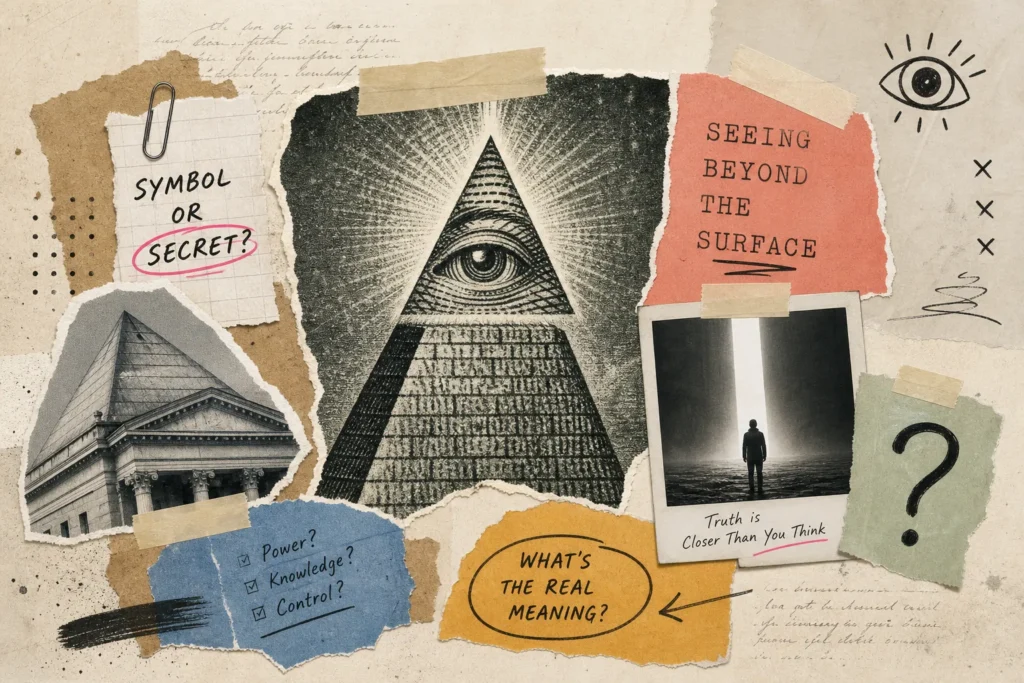
Somewhere between a Renaissance chapel and the back of a one-dollar bill, two symbols became the most scrutinised icons in modern culture. Understanding the illuminati pyramid and all-seeing eye meaning, what these symbols actually represent, where they came from, and why they endure, is more complex, and far more rewarding, than any conspiracy framework suggests. The pyramid and the All-Seeing Eye appear on the US one-dollar bill, in music videos, on social media feeds, and in the mythology of secret societies spanning the 17th, 18th, and 20th centuries. Yet for all their visibility, their actual history is almost universally misread. At Illuminati Fraternities, we have long held that genuine symbol literacy is rarer and more powerful than borrowed mythology. What follows is a guided decoding of two symbols that deserve to be understood on their own terms.
The foundational error most people make is treating the pyramid and the eye as one ancient Egyptian symbol, passed down through pharaonic burial rites to Masonic lodges to the American Founding Fathers. This lineage is compelling, but it is not supported by archaeology or art history. The real story is messier, more interesting, and far more revealing about how symbols acquire power over time.
Two symbols, two entirely separate histories
The all-seeing eye meaning does not begin in ancient Egypt. The earliest recorded depiction of an eye surrounded by rays of light, set within a triangle, appears in a Christian context: Jacopo Pontormo’s Supper at Emmaus, where the symbol represents God’s watchfulness. Art historical scholarship, including work by Liana De Girolami Cheney on Renaissance iconography, notes that the eye itself was likely added to the painting during the Counter-Reformation period, probably in the 1600s, to replace a banned three-faced representation of the Trinity. Cesare Ripa’s 1593 Iconologia then formalised the eye-in-triangle as a codified emblem of the Holy Trinity, securing its place in the visual vocabulary of European Christian iconography.
The illuminati pyramid meaning begins elsewhere entirely. In ancient Egypt, the pyramid form represented the primordial mound of creation, the benben, a stairway along which the ascending soul could travel and a physical echo of the sun’s rays striking the earth. As an architectural and philosophical metaphor, the pyramid carried consistent meaning across widely separated cultures: ascent, hierarchy, permanence. The aspiration to reach the apex is etched into every civilisation that built upward. What no ancient culture ever produced, however, was the specific combination of an eye hovering above the pyramid’s peak. That pairing came later, in America, in 1782.
How the Great Seal fused these images into one
The combined symbol that now occupies the reverse of the one-dollar bill was not commissioned by a secret society. It was designed by Charles Thomson and William Barton as part of the Great Seal of the United States, approved by Congress on 20 June 1782, a date documented in the Congressional record and the National Archives. Thomson’s official explanation was direct: the unfinished pyramid, built in thirteen tiers for the thirteen original states, represented ‘strength and duration.’ The Eye of Providence, positioned above it with the motto Annuit cœptis (‘He approves our undertakings’), alluded to what Thomson described as ‘the many signal interpositions of providence in favour of the American cause.’ The design is rooted in Enlightenment-era Christian symbolism, not occult tradition.
The reverse of the Great Seal was never cut as an official physical seal; it existed only on paper for over 150 years. Its transition to the dollar bill came in the summer of 1935, when Secretary of Agriculture Henry Wallace brought it to the attention of President Franklin D. Roosevelt. According to Treasury Department records and accounts by currency historians, Roosevelt approved it after his Postmaster General reassured him that the imagery would not offend Catholic voters. This administrative decision, not any ancient conspiracy, is what placed the symbol in the wallets of billions of people and triggered the modern wave of speculation. One plausible reading is that the symbol’s mysterious reputation grew in part because it had become so mundane: a secret-society emblem hiding in plain sight on everyday currency.
Illuminati pyramid meaning versus the Eye of Horus: a distinction that matters
One of the most persistent myths in popular conspiracy culture is that the All-Seeing Eye is simply the Eye of Horus in disguise, a direct link between Egyptian esoteric knowledge and Western secret societies. The visual similarity, a stylised eye with connotations of divine power, makes this conflation feel intuitive. The scholarly record, however, does not support it.
The Eye of Horus is specifically the restored left eye of the falcon god Horus, destroyed by Set and healed by Thoth. Its meaning is personal and mythological: it shields the individual from harm, aids healing, and guides safe passage into the afterlife. It is depicted with distinctly Egyptian falcon markings and carries no triangle, no rays of light, no collective theological scope. The All-Seeing Eye, by contrast, represents divine omniscience watching over nations and communities. It is collective where the Eye of Horus is personal, watchful where the Eye of Horus is restorative. Geometrically, it is anchored inside a triangle; the Eye of Horus stands alone in its stylised form.
Recognising this distinction is not pedantic. Conspiracy culture deliberately conflates these symbols to construct a lineage of hidden knowledge running from ancient Egypt through to the modern day, but this lineage is a narrative invention rather than a historical fact. Genuine understanding of the all-seeing eye meaning begins with knowing what the symbol actually meant to the people who first used it.
How Freemasonry gave the all-seeing eye its esoteric reputation
If the Eye of Providence began as a Christian symbol and arrived on the Great Seal as a statement of national purpose, how did it acquire the aura of secret society intrigue? The answer runs through Freemasonry. Thomas Smith Webb’s 1797 Freemason’s Monitor formally described the All-Seeing Eye as a symbol of moral accountability within the lodge, a reminder that no deed escapes divine observation. Masonic lodges placed the eye above the Worshipful Master’s chair in the East, as a representation of the divine presence guiding members toward truth and wisdom. Masonic writers have consistently described the Eye not as an entity but as a principle: constant awareness operating as a form of eternal purpose.
The connection between Freemasonry and the Great Seal is real but limited. Several of America’s Founding Fathers were Freemasons, a fact documented in Jasper Ridley’s The Freemasons and other historical studies, and their familiarity with Masonic-adjacent symbolism almost certainly informed the visual language of the new republic. The Bavarian Illuminati, founded in 1776 by Adam Weishaupt, operated briefly alongside Masonic lodges during this same period. Their historical overlap became the seed of a mythology that has been growing for 250 years. Crucially, though, the pyramid itself carries no official Masonic meaning. Art historical and Masonic scholarship is consistent on this point: the eye-above-pyramid combination is an American creation, not a Masonic one, and it was never adopted as a formal symbol by any Masonic body.
Why the Illuminati claimed these symbols as their own
Understanding the history of these symbols is one thing. Understanding why an organisation built around the ideals of the Illuminati would adopt them as central icons is something else, and it requires thinking philosophically rather than conspiratorially.
The pyramid encodes a specific philosophy. At its base, the many; at its apex, those who have climbed through discipline, knowledge, and vision. For any organisation built on the idea of a hierarchy of understanding, the pyramid is not decoration: it is the structural metaphor of membership itself. The Eye above the apex adds a second layer. The pursuit of enlightenment is not solitary ambition; it is guided by something greater, a purpose that watches and approves the ascent. Together, the two symbols describe a cosmology of aspiration: the climb is real, the structure is real, and the direction of travel is illuminated from above.
At Illuminati Fraternities, these twin symbols are treated not as historical artefacts to be debated but as living principles that orient every member’s journey. The pyramid maps the Order’s structure, tracing the ascent from initiation toward the Apex Circle where influence, vision, and global perspective converge. The Eye represents what the organisation calls the Eternal Circle: the recognition that each member’s actions align with a higher purpose, and that belonging to the Order means building a life worthy of that alignment.
What the illuminati pyramid and all-seeing eye meaning looks like in practice
Illuminati Fraternities teaches that to live under the Eye is to live without contradiction: to act publicly the way you act privately, and to build a life you would not need to conceal. This philosophy runs through the organisation’s publications, including Illuminations: Wisdom From This Planet’s Greatest Minds, which frames the Eye as the guiding metaphor for self-examined, purpose-driven living. Members are not passive consumers of symbolism. They are expected to embody it, in the choices they make daily, in the networks they build deliberately, in the legacy they pursue with intention.
Within the Illuminati Fraternities framework, the pyramid is the map, not merely the logo. It asks every member a simple question: where are you on the ascent, and what is the next step? The Department of Citizen Outreach exists for those ready to begin answering that question, offering a structured pathway into the Order’s philosophy, community, and global network. For those who have spent years observing these symbols from the outside, this is an invitation to an interior view.
The symbols decoded, the door open
The true illuminati pyramid and all-seeing eye meaning is not a history of shadows. The Eye of Providence is Christian before it is conspiratorial; the pyramid is ancient before it is Masonic; their combination is American before it is Illuminati. These are symbols that accrued meaning across centuries, through Renaissance painters, Enlightenment statesmen, lodge rituals, and a presidential decision made on a summer afternoon in 1935. The conspiracy reading is the shallow one. The deeper reading requires knowing where the symbols actually came from, what they actually meant, and why certain organisations chose to carry them forward.
Reading symbols accurately is the first step towards genuine understanding. Once you can do that, you stop seeing memes and start seeing philosophy. If that shift resonates, the next step is not more research. The next step is through the door that Illuminati Fraternities keeps open for those prepared to make the ascent.
