
Uncategorized
Illuminati Signs Explained: Eye, Pyramid & More
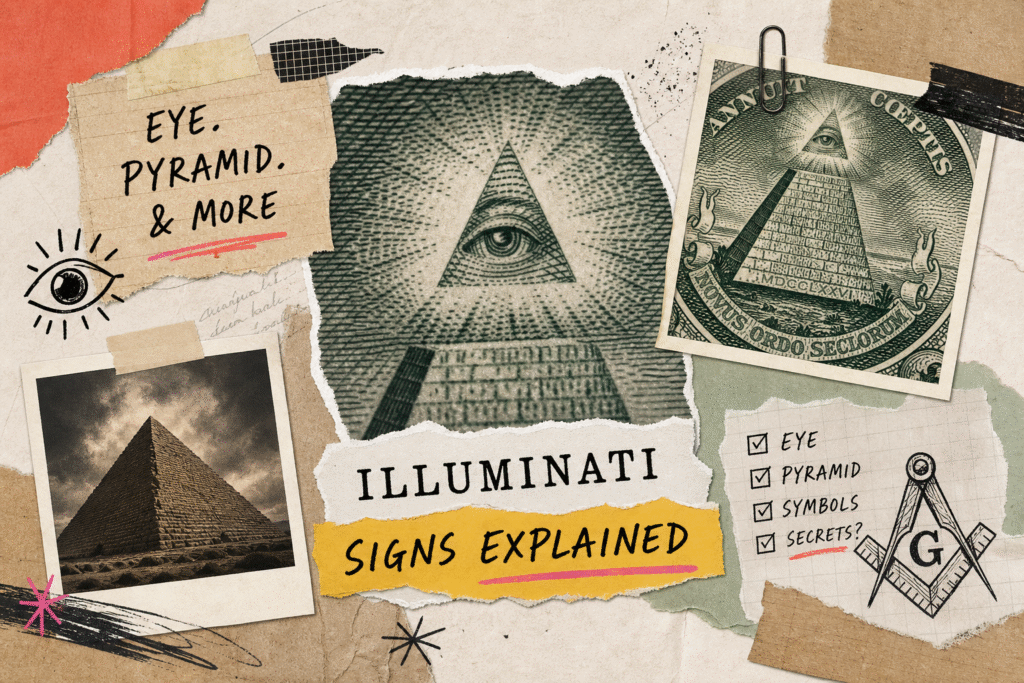
Every time you open your wallet, you encounter an illuminati sign staring back at you. The all-seeing eye watches from the back of every one-dollar bill printed since 1935. The pyramid sits beside it, unfinished and deliberate. The triangle hand gesture has appeared in hundreds of music videos. Yet most people who encounter these symbols daily can’t explain where they actually came from, or what they originally meant before conspiracy culture got hold of them. These illuminati signs permeate our culture, blending history with modern interpretations.
This article decodes the major Illuminati signs one by one: their actual historical roots, their documented meanings, and where the line between recorded fact and retroactive mythology falls. By the end, you’ll be able to identify each symbol, explain its real origins to anyone who asks, and spot the difference between what historians verify and what conspiracy writers invented. For those who want to go deeper, Illuminati Fraternities’ symbolism education archives trace every sign to its earliest documented source, a comprehensive iconographic reference built for readers serious about authentic esoteric history.
This article decodes the major illuminati signs one by one: their actual historical roots and how the illuminati sign has evolved in meaning through time, documenting the gap between recorded fact and retroactive mythology. By the end, you’ll be able to identify each symbol, explain its real origins to anyone who asks, and spot the difference between what historians verify and what conspiracy writers invented. For those who want to go deeper, Illuminati Fraternities’ symbolism education archives trace every sign to its earliest documented source, a comprehensive iconographic reference built for readers serious about authentic esoteric history.
The all-seeing eye: origin story of the most recognized illuminati sign
The Eye of Providence is older than the United States, older than Freemasonry, and older than the Bavarian Illuminati by thousands of years. Its earliest visual ancestors appear in Sumerian civilization, where enlarged eyes functioned as signs of watchfulness and divine awareness. Ancient Egypt developed the concept further through the Eye of Horus and the Eye of Ra, both representing protection, healing, and the capacity to overcome adversity. These weren’t secret symbols. They were central to mainstream religious culture across entire civilizations and are often associated with various illuminati signs.
The symbol migrated into Christian Europe during the Renaissance. The 1525 painting Supper at Emmaus by Jacopo Pontormo contains one of the earliest documented appearances of the eye in European Christian art, positioned above Christ as a representation of divine guidance. Cesare Ripa’s 1593 Iconologia, one of the most influential emblem books of the era, featured the Eye of Providence and circulated it widely among artists, orators, and intellectuals. By the 1600s, the symbol appeared regularly in church windows and religious paintings, usually set within a triangle representing the Holy Trinity and surrounded by radiating light. It was a mainstream devotional motif, not an esoteric secret. The illuminati sign became synonymous with divine providence during this period.
Freemasonry adopted the symbol in the 18th century, and this is where it took on its modern form. Thomas Smith Webb’s 1797 Freemason’s Monitor formally introduced the “All-Seeing Eye” into American Masonic iconography. Webb’s language was explicit: the eye represented the Great Architect of the Universe, a reminder that all thoughts and actions are observed by the divine. Masonic sources consistently frame the all-seeing eye symbol as a call to ethical living and moral accountability, not a marker of hidden power. The illuminati sign was never meant to be sinister. It was meant to be sobering.
As for the Bavarian Illuminati: there is no documented evidence the group ever used the Eye of Providence as an official emblem. Historical records show the Illuminati’s actual symbols were the Owl of Minerva, representing wisdom, and a point within a circle. The connection between the eye and the Illuminati was constructed after the fact by later writers, a myth-making process examined in detail later in this piece. Many of the illuminati signs we recognize today were retroactively applied.
The pyramid: what the unfinished structure actually means
The pyramid image most people associate with Illuminati iconography is specific: an unfinished structure of 13 steps with a glowing, hovering capstone housing the all-seeing eye. Each element carries documented meaning. The 13 steps represent the original 13 American colonies. The deliberately unfinished top symbolized that the nation was still under construction, still becoming. The luminous capstone above represented divine guidance over that ongoing project, not the presence of a hidden elite directing it from above.
Charles Thomson and the Great Seal’s original intent regarding the illuminati sign
The pyramid’s association with the illuminati sign deepened when it was paired with the Eye of Providence, creating a visual narrative that conveyed multiple meanings.
Charles Thomson, who finalized the Great Seal design in 1782, paired the pyramid with the Latin motto Annuit cœptis, meaning “Providence has favored our undertakings.” Thomson was working from a well-established visual vocabulary, the design committee had considered and rejected numerous proposals before landing on this synthesis, and the motto itself drew on a classical precedent from Virgil’s Aeneid. The intended message was clear: divine guidance presided over the American experiment. The founders weren’t inventing a secret code; they were reaching for a shared symbolic language their contemporaries would immediately recognize.
The pyramid became the Illuminati’s most enduring visual metaphor precisely because of its shape and its connection to the illuminati sign. A structure that narrows toward a hidden apex, with the all-seeing eye hovering above those who built it, maps perfectly onto ideas of hidden hierarchy, concealed control, and elite ascension. Conspiracy culture didn’t have to invent a meaning; the visual logic was already there. Illuminati Fraternities uses the pyramid and eye symbol as a central motif in its own symbolism pages for the same reason: it represents strength, permanence, and the architecture of ambition built layer by layer, consistent with other illuminati signs.
The triangle hand gesture and other widely recognized illuminati signs
The triangle hand gesture, formed by pressing thumbs and index fingers together to create a triangle shape, often held over one eye, has become one of the most recognized illuminati signs in modern popular culture. Its actual origin is far more grounded than its reputation suggests. The gesture grew from Jay-Z’s diamond sign, a branding move for Roc-A-Fella Records that referenced “Roc” as a diamond shape. It was a music industry identifier first, widely visible from the late 1990s onward, that conspiracy culture later reframed as a deliberate illuminati sign.
By the 2010s, the gesture had spread across celebrity photography and music videos to the point where its use became self-referential: some artists deployed it specifically to invoke conspiracy associations, because those associations carry cultural weight. Context determines meaning here, and context is exactly what most conspiracy readings ignore. Both interpretations, sincere branding and deliberate myth-play, exist simultaneously in the culture, and that ambiguity is part of what keeps the gesture circulating.
Beyond the triangle, a wider set of illuminati signs appears across esoteric and pop culture contexts. The Eternal Circle represents the infinite continuity of the Order’s mission and the unbroken nature of its influence across time. Radiating light beams, the obelisk, and recurring appearances of the number 13 function as secondary esoteric markers with their own documented lineages. Illuminati Fraternities’ symbolism education pages catalog each of these illuminati signs individually, tracing their origins and explaining what each was designed to communicate before modern interpretation reshaped them.
How these symbols landed on the U.S. dollar bill
The story of the pyramid and eye symbol on American currency begins in 1776, the same year the Bavarian Illuminati was founded, a coincidence that conspiracy writers have treated as evidence ever since. Pierre Eugène du Simitière first proposed the Eye of Providence for the Great Seal that year as part of the initial design committee, which also included Benjamin Franklin, Thomas Jefferson, and John Adams. The design went through two more committees and multiple rejections before Charles Thomson synthesized the final version. Congress approved the reverse side of the Great Seal, featuring the unfinished pyramid and the hovering eye above the motto Annuit cœptis, on June 20, 1782.
Here is the detail most people miss: the Great Seal existed for over 150 years before it appeared on money. The eye and pyramid didn’t enter everyday American life until 1935, when Franklin D. Roosevelt’s administration approved placing both sides of the Great Seal on the redesigned one-dollar bill. That 1935 Treasury Department decision, not a founding-era conspiracy, is what made the pyramid and all-seeing eye a fixture of daily American experience. The gap between 1782 and 1935 is rarely mentioned in conspiracy narratives, but it matters for understanding how the symbol entered mass culture.
Where illuminati signs appear in modern life
The all-seeing eye and triangle gesture spread through hip-hop, pop, and celebrity media with remarkable speed from the 1990s onward. Directors and artists gravitated toward these symbols because they carry instant visual authority: they signal edginess, insider status, or esoteric credibility in a single image. The conspiracy associations are often the point, not an accident. Using a symbol with this much cultural charge is a deliberate aesthetic decision, and the entertainment industry has understood that for decades.
The merchandise and fashion ecosystem around these illuminati signs is substantial and still growing. The pyramid eye appears on streetwear, art prints, accessories, and collectibles across a wide price range, from mass-market graphic tees to limited-edition art objects. For most buyers, these are aspirational aesthetic purchases rooted in the symbol’s layered cultural meaning rather than literal belief in a hidden order. Illuminati Fraternities’ own symbolic merchandise operates in this same space, with one key distinction: its products are grounded in genuine iconographic history. The symbolism is researched, sourced, and presented with the depth the subject deserves, rather than surface-level trend adoption designed to expire with the next cultural cycle.
Fact vs. mythology: separating the documented record from conspiracy narrative
The Bavarian Illuminati was a real organization. Adam Weishaupt founded it on May 1, 1776, in Bavaria, and Bavarian authorities banned it in 1785, ending its existence after fewer than nine years. The historical record on this is not contested. What the historical record does not show is any documented use of the Eye of Providence as an official illuminati sign, any credible evidence the organization survived its suppression, or any verified link between the Illuminati and the design of the Great Seal. These are not conclusions drawn from conspiracy skepticism; they are the results of examining the actual documents that survive from that period.
The mythology was built in stages. John Robison’s 1797 Proofs of a Conspiracy was among the earliest and most influential texts to attach pre-existing religious and Masonic symbols to the idea of a surviving underground Illuminati, and subsequent generations of anti-secret-society writers amplified the framework from there. The eye was already in church windows and on the Great Seal, so it became “evidence.” The pyramid was already in architecture and currency, so it became “proof.” The triangle hand gesture was already in music videos, so it became a “signal”. Each illuminati sign was real, well-documented, and fully explainable on its own terms. The conspiracy narrative layered new meaning onto existing imagery and called the layer a revelation.
Why the symbols’ real history makes them more powerful, not less
Understanding this doesn’t diminish the power of the symbols; it deepens it. A sign that has carried meaning through five centuries of religious art, Masonic tradition, American founding mythology, and contemporary pop culture carries more genuine weight than one invented by a single hidden group. Symbols earn resonance through accumulated use across generations of human meaning-making, and these illuminati signs have accumulated more than most. That history is what makes them worth studying.
The iconography rewards those who look past the surface
Each major illuminati sign carries a history far richer than pop culture gives it credit for. The All-Seeing Eye moved through ancient Egypt, Renaissance Christian art, and Masonic tradition long before it landed on the dollar bill, centuries of use that predate the Bavarian Illuminati entirely. The pyramid on your currency was designed by founding-era statesmen drawing on a well-established symbolic vocabulary, not inventing a secret code. The triangle hand gesture entered the culture through music industry branding and was reinterpreted into something more charged by a conspiracy culture hungry for evidence. Once you know where to draw the line between documented iconography and constructed mythology, it becomes sharp and stays sharp, especially when considering illuminati signs.
For readers who want to go further, Illuminati Fraternities’ symbolism education archives trace the Eye, the Pyramid, the Eternal Circle, and the full catalog of esoteric signs to their original documented sources, covering primary texts, design records, and iconographic lineages that most general references skip entirely, including The Mark of the Illuminati. The archives are built for readers who want real depth, not recycled talking points. And for those drawn to the community behind the iconography, the membership portal is the place to continue that journey alongside others who take these illuminati signs as seriously as you do.
For additional historical context on the Bavarian Illuminati and their place in late‑18th‑century debates about secrecy and reform, consult contemporary historical overviews that distinguish verified records from later mythmaking.
