
Uncategorized
What Is the Illuminati? History, Symbols & Truth
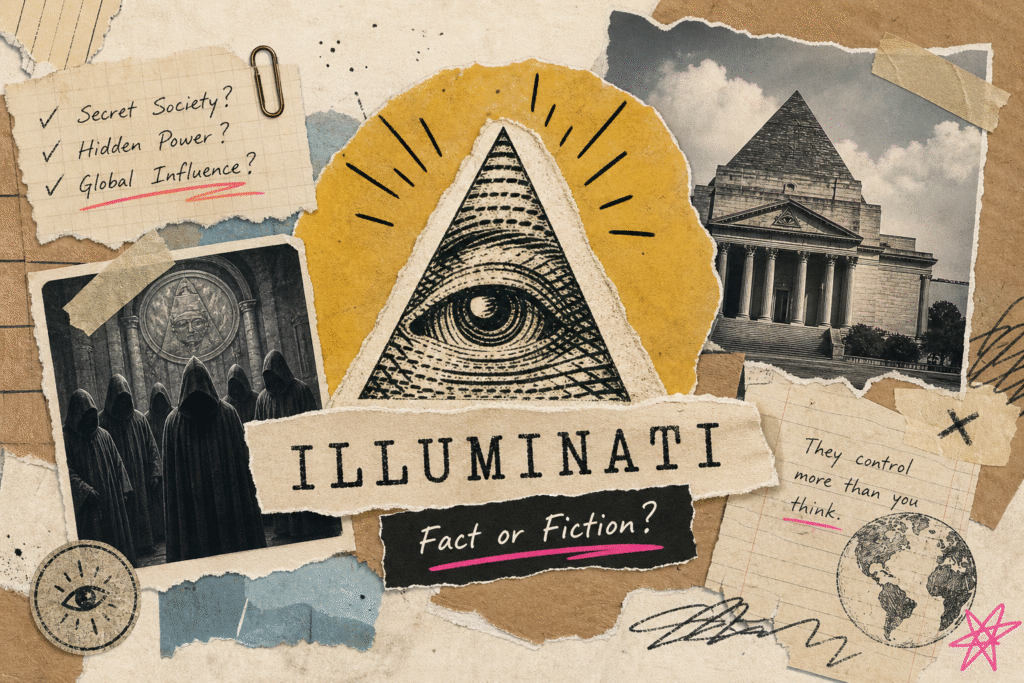
What is the Illuminati? Ask it in a crowded room and you’ll get a dozen different answers: a secret society, a myth, a pop culture meme, a real power structure hiding in plain sight. Every answer reveals something about the person giving it, and almost none of them agree on the facts. That tension is precisely what makes this question about what is the illuminati worth answering carefully.
Here is what history confirms: on May 1, 1776, a German law professor founded a secret brotherhood with radical ambitions. That brotherhood lasted nine years before governments dismantled it, seized its papers, and banned its rituals under penalty of death. The organization collapsed before the French Revolution, before the U.S. dollar bill, before most of the symbols now credited to it even entered common use. And yet the story refused to die.
What you’re about to read is the actual record: where the Illuminati came from, how a nine-year society became a 250-year legend, what the symbols really mean, and why this mythology still electrifies culture today. Organizations like Illuminati Fraternities exist precisely because the questions never stop, and because the tradition, whatever its origins, carries real weight for those drawn to the arcane, the aspirational, and the idea that there is an Order beneath the visible world.
What is the illuminati, and how has it shaped our understanding of secrecy and power?
What Is the Illuminati? Origins and the Real Founding
On May 1, 1776, in the Bavarian university town of Ingolstadt, a law professor named Adam Weishaupt gathered five men and founded what he called the Order of Perfectibilists. The name says everything about his ambitions. Weishaupt believed that human nature was improvable, that superstition and monarchy were not inevitable features of civilization, and that a network of enlightened individuals, embedded in society’s institutions, could quietly redirect the course of history.
What is the illuminati? It was a question that Adam Weishaupt sought to answer through his radical ideas.
Weishaupt was Jesuit-trained, which is why the Order’s structure borrowed heavily from the Society of Jesus: ranked degrees, compartmentalized knowledge, and loyalty hierarchies. He brought in Adolph Knigge in 1780, a skilled recruiter who integrated Masonic lodge networks and gave the organization both legitimacy and reach. Within four years of that partnership, membership had grown from 27 to over 2,000, including nobles, academics, and influential civic figures across German-speaking Europe.
What the order actually wanted to achieve
The Bavarian Illuminati‘s stated goals were ambitious in their idealism and radical in their politics: enlightenment through reason, moral perfection of the individual, the replacement of organized religion with rational ethics, and the gradual dismantling of monarchical government. The name “Perfectibilists” was no accident. This was a brotherhood that took its own stated mission seriously, not a shadow government engineering wars from a cave.
The Masonic overlap that Knigge introduced was practical, not conspiratorial. Lodge networks provided ready-made social infrastructure and a culture of discreet brotherhood. But this overlap would later do enormous damage to the historical record, blurring the line between two distinct organizations in the minds of later writers who had no interest in making careful distinctions. The Freemasons vs. Illuminati confusion that persists today traces directly to that moment.
The nine years that ended in exile
In discussing the Bavarian Illuminati, one must ask: what is the illuminati’s impact on modern conspiracy theories?
The Bavarian Illuminati’s lifespan was shorter than most doctoral programs. By 1784, internal fractures were already weakening the structure. Knigge and Weishaupt clashed over control, rituals, and the order’s direction. Knigge resigned that year, removing the organization’s most effective organizer at exactly the moment external pressure began mounting.
The Bavarian government moved swiftly. A 1784 edict banned secret societies broadly. Elector Karl Theodor’s March 2, 1785 decree then targeted the Illuminati by name, triggering raids that confiscated roughly 1,000 internal documents and delivering the effective deathblow. Weishaupt fled to Gotha under the protection of Duke Ernst II and spent the rest of his life writing apologies for the order from exile. By 1787, membership was punishable by death. The organization did not go underground. It dissolved.
The seized documents matter because they form the evidentiary foundation for everything that followed. What those papers revealed was not a blueprint for world domination. They showed a group consumed by internal rankings, ideological purity disputes, and the kind of organizational drama familiar to anyone who has ever served on a committee. No evidence of surviving networks, successor organizations, or continued operations ever emerged from those records.
How a dead society became a living myth
The Illuminati dissolved in 1785. The French Revolution began in 1789. Those four years between the Illuminati’s collapse and the Revolution’s outbreak are the gap that certain writers decided to fill with invention.
After the Illuminati dissolved, what is the illuminati? This question intrigued many writers and historians.
In 1797, two men published books that changed everything. Scottish scientist John Robison released Proofs of a Conspiracy, arguing that the Illuminati had survived suppression, gone underground, and orchestrated the Revolution through infiltrated Masonic lodges. That same year, French Jesuit Abbé Barruel published Memoirs Illustrating the History of Jacobinism, expanding the narrative to include a Judeo-Masonic-Illuminati plot to destroy Christianity and install a world republic. Both men used the same seized Bavarian documents. Neither produced evidence of post-1785 activity, because no such evidence existed.
Their books sold rapidly and reached American shores within a year. The Revolution’s violence made the narrative irresistible to conservatives across the political spectrum: it explained chaos without crediting broader Enlightenment forces, and it provided a scapegoat with a paper trail, even if that trail had been largely fabricated. American clergy like Jedidiah Morse amplified the warnings from pulpits across New England. The myth had found its audience.
What happened next was predictable: the narrative detached from history and became a flexible template. Each new generation applied it to whatever seemed most threatening. Winston Churchill cited the Illuminati in a 1920 article about communism. The John Birch Society built their worldview on top of it. Social media accelerated what printing presses had started. The story of a shadowy elite pulling history’s strings turned out to be infinitely adaptable, and its adaptability is exactly why it never dies.
What Is the Illuminati’s Symbolic Legacy? Decoding the Icons
The symbols and mythology surrounding the question of what is the illuminati continue to fascinate.
The symbols most associated with the Illuminati are among the most misread icons in Western culture. Understanding where they actually come from dissolves much of the myth’s visual power. Three in particular deserve close attention: the Eye of Providence, the unfinished pyramid, and the broader language of Illuminati conspiracy theories built around them.
The Eye of Providence
The Eye of Providence, the symbol you see on the reverse of the U.S. dollar bill, predates the Illuminati by roughly 5,000 years. The Egyptian Eye of Horus dates to approximately 3000 BCE. Christian artists adopted a triangular “eye of God” motif in the Renaissance to represent divine omniscience. By 1525, it appeared in Pontormo’s Supper at Emmaus. The version on the U.S. Great Seal was designed in 1782 by Charles Thomson, a non-Mason, as an Enlightenment symbol of divine guidance over the new republic. Congressional records confirm this. The Bavarian Illuminati had already been disbanded for three years by the time the Seal was finalized, and no Illuminati involvement in its design appears in any primary source.
The Unfinished Pyramid
The unfinished pyramid on that same seal represents national strength and ongoing work. The 13 steps stand for the 13 original states. The Roman numerals read 1776, marking independence. The Latin phrases reference divine favor and a new order of the ages, language drawn from Virgil, not from any secret brotherhood’s internal memo. The pyramid and the eye tell the story of an 18th-century republic invoking classical and religious imagery, which was entirely standard practice.
For those drawn to the deeper layer of symbolic meaning, Illuminati Fraternities documents its own interpretation of the Eye, the Pyramid, and the Eternal Circle on its official symbolism pages. The organization offers something the academic record rarely provides: a living tradition’s reading of iconography that history has long misrepresented, neither the dry archival account nor the conspiracy meme, but something between revelation and philosophy.
Modern claims and why they keep spreading
Celebrity allegations dominate the contemporary version of this mythology. Jay-Z’s diamond hand gesture, Beyoncé’s Super Bowl iconography, Katy Perry’s music video imagery: each has been decoded as an Illuminati signal by researchers whose methods consist largely of finding triangles in publicly available footage. Jay-Z’s diamond shape is the logo of his record label, Roc-A-Fella Records. Katy Perry told Rolling Stone the theory belonged to “weird people on the internet” and noted that its existence meant she had made it. None of the accused have documentary connections to any organization. The symbols in question appear in commercial art globally, with no esoteric origin that survives scrutiny.
What’s fascinating about the modern interpretations is how they reflect what is the illuminati in our current cultural context.
Government-focused claims follow a similar pattern. The Illuminati has been credited with engineering the JFK assassination, the 9/11 attacks, and the architecture of a coming one-world government. Official investigations, declassified government records, and decades of historical analysis have produced zero connections between any of these events and any secret society. The phrase “New World Order” originated in political speeches about international cooperation, not in a cabal’s internal correspondence.
The persistence of these Illuminati conspiracy theories without supporting evidence is not a mystery, but it does require an explanation. Researchers including psychologist Karen Douglas, whose work on conspiracy belief has been published in journals such as Psychological Bulletin, find that these narratives offer genuine cognitive comfort: a single cause for complex events, the feeling of seeing through official lies, and the social reward of possessing hidden knowledge. These appeals operate independently of evidence. The mythology endures because it is useful, not because it is accurate.
What the Illuminati means in culture today
For many, the question remains: what is the illuminati and how does it influence their perceptions of power?
Starting in the early 1990s, Illuminati references saturated American hip-hop, Hollywood, and mass media. Rappers referenced it in lyrics. Music video directors coded it into imagery. Dan Brown built bestsellers around it. Blockbuster films made it a shorthand for hidden power. The appeal, in most of these contexts, is not literal belief but aesthetic: secrecy, power, and the suggestion that beneath the visible world there is a deeper order accessible to those willing to look.
For younger audiences who feel economically or socially locked out of conventional paths to wealth and influence, the symbolism resonates at a different register. The Illuminati mythology names a real desire: belonging to something that matters, access to networks that deliver on their promises, a recognition that extraordinary people operate by different rules. That desire does not require the conspiracy to be true. It requires the aspiration to be real.
The enduring appeal of the myth raises the question, what is the illuminati for those seeking belonging?
Illuminati Fraternities is the contemporary organization that channels this tradition directly: a membership community, a body of symbolic philosophy rooted in the Eye, the Pyramid, and the Eternal Circle, and a platform for those drawn to the arcane aesthetic and aspirational promise of the Order. The historical Bavarian Illuminati lasted nine years. The idea it generated has lasted nearly 250. That endurance belongs not to any government or celebrity cabal, but to the human need for meaning, belonging, and a sense that the initiated see something others cannot.
The answer the history actually gives
So what is the Illuminati? The honest answer has two parts. Historically, it was a short-lived Enlightenment society with radical ideas about reason, political reform, and human perfectibility that was suppressed by a nervous government before those ideas could take root. It left behind seized documents, one exiled founder, and no verifiable successor organization.
Ultimately, when we ponder what is the illuminati, we reflect on our need for meaning in a chaotic world.
Mythologically, it became a vessel for every era’s deepest anxieties about who really holds power and why ordinary people are excluded from it. The symbols, the stories, and the aspirational pull of the Illuminati idea have outlasted any political agenda Adam Weishaupt ever drafted. That endurance reveals something true about human nature: the desire to believe there is an Order behind the chaos, and a seat at the table for those bold enough to seek it.
The history is worth knowing. The mythology is worth understanding. For those drawn to both, Illuminati Fraternities is the place where they converge, the organization’s own perspective on what the Illuminati represents today, documented in its symbolism, its membership philosophy, and its community of those who have decided that seeking the light is not a conspiracy theory but a way of life. Explore the official membership portal to discover what that belonging looks like.
To explore the depths of this question, what is the illuminati today, one must engage with its rich historical tapestry.
