
Uncategorized
Illuminati conspiracy theories: facts, history, and symbols
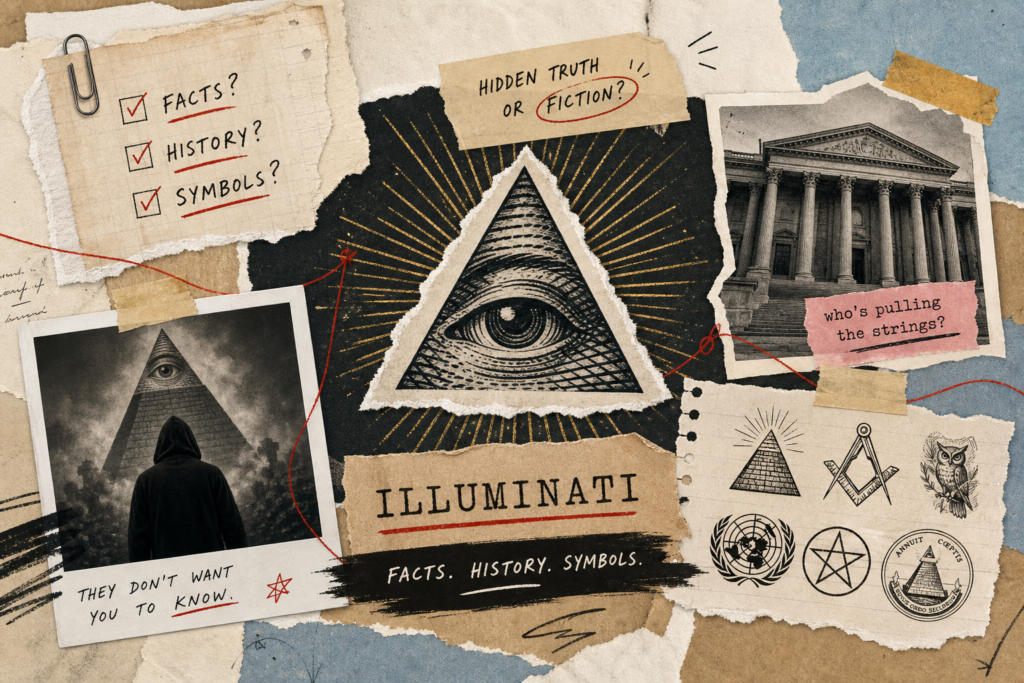
Illuminati conspiracy theories promise a master key that unlocks every locked door. You have seen the triangles, the one-eyed closeups, the dollar-bill pyramid, and the viral clips that pass as revelation. This field guide separates what is documented from what is dreamed, then gives you a practical way to test any new claim you encounter in 2026.
As the custodians of Illuminati Fraternities’ public lore, we embrace curiosity and clarity in equal measure. We will trace the real 1776 society, decode the Eye and the Pyramid, examine the power‑and‑money storyline, and show how psychology and platforms transform coincidence into a creed. You will leave with a clear lens and a simple rubric you can use anywhere, from a group chat to a history seminar.
Keep your sense of wonder and bring your receipts. The Eye is a lesson, not a shortcut.
Mapping the myth: what people mean by Illuminati conspiracy theories
The umbrella story and its core claims
The modern story clusters around three arenas of control: governments and geopolitics, global finance and markets, and celebrity culture as mass influence. In this frame, symbols, lyrics, wardrobe, set design, and sudden career turns are treated as signals from a hidden boardroom. Rumors and edited montages become “data points” that reinforce the narrative. The theory scales a small 1776 society into a perpetual, world‑spanning cabal without a documented chain of custody.
From a 1776 circle to a 2026 super cabal
The historical Bavarian Illuminati lived briefly, then vanished from the record after 1785. The 2026 super‑conspiracy imagines an unbroken lineage that absorbed every later secret network into one continuous Order. In practice, popular discourse often swaps precise Illuminati history for a generic secret‑society collage, then backfills it with whatever headline fits the mood of the moment.
What “evidence” usually looks like
Most “proof” is interpretive rather than archival, which is why it spreads so fast online. You will usually see:
- Ambiguous symbols, hand signs, numerology, and close‑cropped screenshots
- Edited montages, out‑of‑context quotes, and recycled urban legends
- Anonymous posts or unverifiable “insider” claims that cite no primary documents
When no letters, ledgers, or minutes surface, believers often claim the absence itself proves perfect secrecy. That flips evidence standards upside down. Documents and verifiable links outweigh gestures, lyrics, and stagecraft.
Where Illuminati Fraternities fits in the picture
As a public‑facing membership brand in the entertainment/novelty space, Illuminati Fraternities shares its own lore and symbol guides as self‑description. In our published materials, we frame what we call a “Globalist Agenda” as prosperity, stewardship, and access to knowledge in the light (see our ethos page). Our public writings treat the Eye, the Pyramid, and the Eternal Circle as teaching tools, not as remote‑control sigils. Curated context turns a scavenger hunt into literacy: you learn what our symbols mean in our own words, and where the myths begin. Learn more about our rationale and public posture on our Why A Secret Society page.
From Weishaupt to wildfire: the documented origin story
Bavarian beginnings: Adam Weishaupt and the Perfectibilists
The historical Illuminati began in Ingolstadt on 1 May 1776 under Adam Weishaupt, a professor of canon law. The founding circle, first called the Perfectibilists, included four students: Massenhausen, Bauhof, Merz, and Sutor. Members used aliases to emphasize ideals over ego: Weishaupt as Spartacus, Massenhausen as Ajax, Bauhof as Agathon, Merz as Tiberius, and Sutor as Erasmus Roterodamus. Their aims were Enlightenment aims: reason, moral reform, disciplined friendship, and the pruning of superstition (see the edited Bavarian Illuminati correspondence; Britannica: Illuminati). For a focused summary of the original Bavarian organization, see the Bavarian Illuminati entry.
How the order operated: grades, aliases, Masonic bridges
The Order used internal grades, ciphers, and selective recruitment that prized education and character. It built bridges into some Masonic lodges to expand reach, but influence there was uneven and limited. Credible estimates place membership between roughly 650 and 2,000 before suppression, concentrated in German‑speaking lands (summarized in Britannica and prosopographic studies by Hermann Schüttler). What members actually did was closer to networking and ethical self‑improvement than to world domination. They wrote, mentored, and tried to seed reform from the inside.
Edicts and exposure: 1785 suppression and aftermath
By the mid-1780s, Bavarian authorities issued bans, seized papers, and dismantled the network. Surviving correspondence and edicts let historians map the rise and fall, and then the trail goes cold. The historical record ends; legend begins. For the suppression and its scope, see standard references and source editions (e.g., Britannica and the edited Illuminati documents).
The myth makers: Barruel and Robison ignite the panic
In the 1790s, Augustin Barruel and John Robison published bestsellers that blamed a clandestine Illuminati for the French Revolution. Their books fused fear and speculation into a template that still repeats: a hidden elite steering upheaval from the shadows. The wildfire started there and has found new fuel in every crisis since (see the essay on John Robison and the birth of the Illuminati conspiracy).
Power and money: testing the control narrative in illuminati conspiracy theories
Do secret networks steer governments and wars?
The grand claim says covert agents infiltrate states, swing elections, and script wars and pandemics. The closest historical anchor is that the 1776 group recruited quietly and sought influence. Yet after 1785 there is no primary‑source continuity that links that circle to modern statecraft; historians find no verified chain connecting Weishaupt’s order to present organizations (see Britannica). When a sweeping script lacks names, minutes, budgets, or chains of command, it is a story, not a dossier.
Finance and the New World Order story
The New World Order conspiracy argues that a single occult boardroom controls banks, corporations, and forums where the wealthy meet. Wealth concentration is real and measurable, and powerful people coordinate interests in perfectly ordinary ways. That is different from a unified occult command center with ritual signs and universal obedience. Structural inequality and regulatory capture explain far more than a triangle in a music video.
What passes the evidence test
Strong claims need strong beams: named sources, original documents, transparent timelines, and independent corroboration. Ask how a plot would actually move money, laws, and armies at scale without leaks or paperwork. Extraordinary control claims require verifiable mechanisms, not symbolic mosaics.
Fame and symbols: decoding illuminati conspiracy theories in celebrity culture
The Eye and the Pyramid: older meanings before the internet
The Eye in a triangle is the Eye of Providence from Christian art, later used in Masonic teaching about the Great Architect of the Universe. On the United States Great Seal, official explanations describe the Eye as divine providence and the unfinished pyramid as strength and duration; “Annuit Coeptis” affirms favor on the undertaking, and “Novus Ordo Seclorum” marks a new American era beginning in 1776 (see Charles Thomson’s 1782 report summarized by the U.S. Department of State: Great Seal and the U.S. National Archives notes). For an accessible lesson-plan perspective on the Great Seal’s symbolism, see the American Revolution Institute’s guide to the Great Seal. None of these are stamps of a secret society’s property.
Hand signs, triangles, and stagecraft
Live shows use geometry because it reads from the cheap seats. Directors frame one‑eye shots because asymmetry is dramatic. Fans and haters alike remix those images into narratives that feel potent. Modern hand gestures do not carry a stable, centuries‑long lineage that would let them function as reliable membership badges.
Case reads: Beyoncé, Jay‑Z, Madonna, and beyond
Analyses of Beyoncé’s 2013 halftime gesture, Jay‑Z’s diamond hands, or Madonna’s provocations tend to treat branding as blood oath. What you are seeing is attention economics, not affidavits (see mainstream coverage of Beyoncé’s 2013 Super Bowl performance, the Jay‑Z “diamond/roc” hand sign as a brand gesture, and Madonna’s 2015 track “Illuminati”). Artists push buttons to drive talk, and triangles are the simplest shape in the designer’s kit. Pop imagery courts attention; attention is not an affidavit.
A symbol glossary, not a scavenger hunt
Use context and provenance instead of freeze‑frames, and consult first‑party sources about symbol intent. Illuminati Fraternities maintains public iconography guides (see our Symbols Of Illuminati) for the Eye, the Pyramid, and the Eternal Circle that explain intent and philosophy; treat those as a glossary. When you recognize the letters, you stop mistaking every triangle for a signature.
Why these stories thrive: psychology and social incentives
Pattern‑seeking minds under uncertainty
When life feels volatile or unfair, the brain favors big causes for big effects. Laboratory and field research shows that uncertainty, low perceived control, and the urge for closure increase belief in coordinated plots (e.g., van Prooijen & Jostmann, 2013, JESP; Douglas et al., 2018, Current Opinion in Psychology). Seeing agency in noise can be comforting because it trades chaos for intention. Even silence becomes signal when you decide the enemy is simply that good at hiding.
Social identity and the secret‑society aesthetic
Conspiracy belief can function as group identity. “I see what the sheep miss” creates instant belonging and status. The arcane look helps: robes, sigils, dim light, and whispered names suggest access to a higher tier. It is aesthetics as armor.
Algorithms, virality, and memetic fuel
Platforms reward intrigue, novelty, and visuals. Triangles and one‑eye frames compress into memes that move fast through feeds. Repetition creates familiarity, and familiarity feels like truth. Speculation becomes trending “evidence” through sheer circulation.
Debunking with dignity: keeping the bridge open
If you want your facts to land, respect is a prerequisite. Try these tactics in conversation:
- Ask for sources, then read them together instead of trading insults
- Agree on a few baseline facts before moving to interpretation
- Explore incentives and mechanisms rather than motives alone
- Offer primary documents and invite the other person to verify them
Respectful inquiry lowers defenses; facts can land.
A clear lens for 2026: official lore, methods, and next steps
What we publicly state: philosophy, symbols, and the Globalist Agenda
Our public ethos is simple: prosperity should be stewarded, influence should serve human flourishing, and light should reach those navigating the Maze of Existence. In our publications (including our in‑house magazine, Illuminations), symbols are didactic tools for focus and responsibility, not talismans of remote control. The Eye asks you to be seen and to see. The Pyramid reminds you to build with endurance. When we say “Globalist Agenda,” we mean our stated shorthand for cooperative prosperity, environmental stewardship, and open knowledge, not a clandestine command center (see our ethos overview).
Evaluating illuminati conspiracy theories: a skeptic’s rubric (7 questions)
Save this checklist and run it on every “Illuminati exposed” thread you see:
- Source: Who says so, and what is their track record for accuracy?
- Document trail: Are there original documents, names, dates, and places you can verify?
- Incentives: Who benefits from this story being believed or shared?
- Mechanism: How would this plot move money, laws, or armies in the real world?
- Scale vs. means: Does the claimed control match the resources and channels shown?
- Falsifiability: What evidence would prove this wrong, and would the believer accept it?
- Expert consensus: What do qualified historians and analysts conclude (e.g., standard reference works and edited correspondence)?
If a claim fails three or more of these, treat it as entertainment until it earns an upgrade.
Where to learn more: primary sources and curated lore
For the Bavarian chapter, start with edited correspondence and edicts compiled by scholars such as Markner, Neugebauer‑Wölk, and Schüttler (e.g., the Illuminati correspondence) and with digitized letters hosted by reputable archives. For the Great Seal, read the government’s own notes: the Eye signifies providence, and the Pyramid signifies strength and duration (see the State Department’s Great Seal page). Then explore our symbol library, Eye of Providence, Pyramid, and Eternal Circle, and publications like Illuminations. For a concise, general overview you can compare against primary sources, see Illuminati (Wikipedia). If you want context for a claim you saw online, contact our public‑facing Member Outreach. Study the record, then decide. Curiosity plus method beats fear.
If you seek belonging as well as knowledge, join the Illuminati Fraternities community. Learn the language of the Eye, build with the Pyramid, and contribute light to your circle. For additional resources, see More, Illuminati Fraternities. When evaluating illuminati conspiracy theories, rely on primary documents and a skeptical method: the myth is loud, but the work is quiet and visible.
