
Uncategorized
When Was the Illuminati Founded? The Real 1776 Story
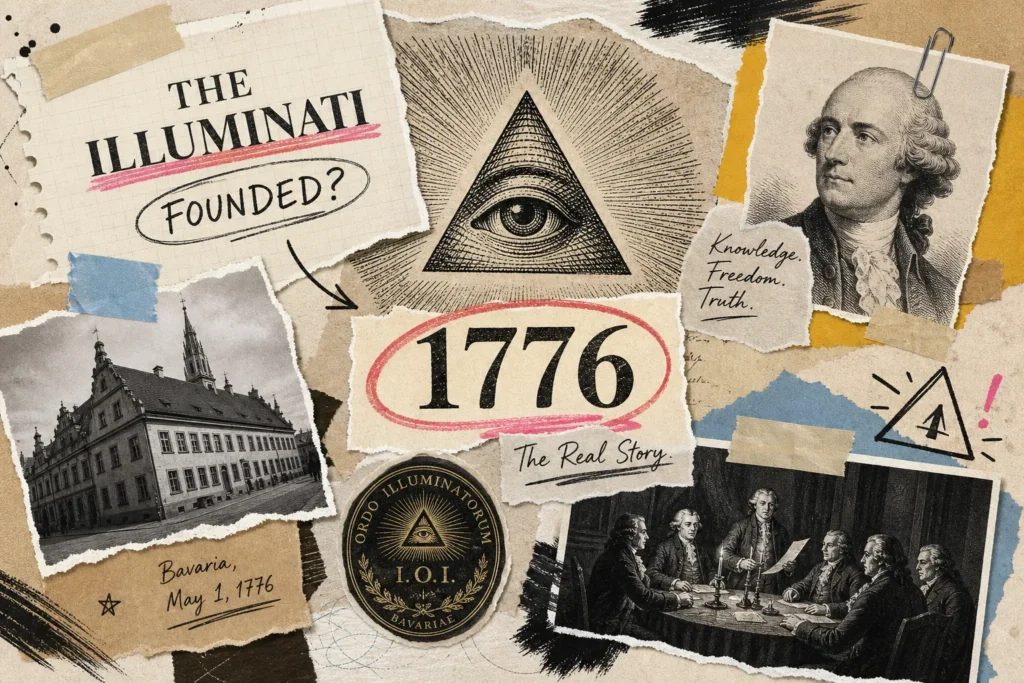
When was the Illuminati founded? The historical answer is precise: the Bavarian Illuminati was founded on May 1, 1776, in the university city of Ingolstadt, Bavaria. A specific date, a documented place, a named founder, and a surviving paper trail, from that small beginning, a brief and very human organization became a myth with a lifespan far longer than its own archives.
Across only a few years, the Order of the Illuminati accumulated more speculation than most groups collect in centuries. The record shows professors, writers, minor nobles, and bureaucrats; the legend swears it controlled revolutions and crowned kings. That gap between document and rumor is exactly what this article closes.
You will meet the man who lit the first candle, see why Ingolstadt mattered, learn what the Order believed and how it was built, understand why it was crushed, and separate the surviving documents from the later conspiracy myths. Trusted primary and secondary sources are listed at the end so you can verify every claim.
When Was the Illuminati Founded? Meet the Man Who Started It All
Who Weishaupt Was Before the Order
Adam Weishaupt was born in 1748 in Ingolstadt. He was educated under Jesuit instruction, an experience whose rigid methods he would later come to resent and consciously reject. By 1775, he held a professorship in canon law at the University of Ingolstadt, making him a rare non-Jesuit voice inside a faculty still shaped by Catholic authority. He had credentials, access, and a direct view of the limits of intellectual freedom in late-18th-century Bavaria.
That vantage point mattered. Weishaupt was inside the machine he wanted to rewire, fluent in theology and law, and acutely aware of how superstition and entrenched privilege restrained reform. His academic standing gave the future Order legitimacy with educated recruits who wanted change without chaos.
Why He Felt Compelled to Build a Secret Society
Weishaupt believed the Enlightenment was not a salon hobby but a civic necessity. Reason, secular education, and moral improvement were, in his view, being throttled by religious dogma and court politics. He tested the Masonic lodges and found them too expensive, too theatrical, and too deferential to inherited status.
So he built his own vehicle, one with staged knowledge, carefully designed ranks, and an ideology that prized rationality over ritual. The strategy was deliberate: recruit the capable, bind them by oath, and place them quietly in the institutions where real influence resided.
When Was the Illuminati Founded? May 1, 1776 in Ingolstadt
The Founding Date and Its Significance
When was the Illuminati founded? On May 1, 1776, Weishaupt formally established the Order with a small circle of students and colleagues in Ingolstadt. The group’s initial name was the Order of Perfectibilists, later refined to the Illuminati, from the Latin for “the enlightened ones.” May 1, 1776 is not rumor or lore. It is the documented founding date of the historical Bavarian Illuminati, recorded in the Order’s own early papers.
Ingolstadt was not a neutral stage. The University remained a stronghold of Catholic scholarly tradition even after the Jesuit Society’s formal suppression in 1773, and establishing a rationalist society there amounted to a quiet provocation. Founding the Order in the shadow of that power center signaled the ambition: reform from within, not rebellion from without.
The Enlightenment Context That Made It Possible
Europe in the 1770s teemed with lodges, salons, and reading societies. Books, pamphlets, and private correspondence moved ideas faster than censors could track. Within that landscape, a disciplined secret association could thrive in the seams between courts, churches, and universities.
Weishaupt timed his experiment to ride that current while avoiding immediate detection. The name Illuminati was a promise to initiates: carry the inner light of reason through the corridors of custom and superstition. The method was discreet, the doctrine clear, the mission long.
What the Order Actually Believed and How It Was Structured
The Ideology Behind the Arcane Ritual
Strip away the mystique and the Order’s aims were straightforward. The Illuminati opposed superstition, sought to restrain abuses of state power, and promoted secular education and moral self-discipline as the basis for a better civic life.
- Oppose religious domination of public life and policy.
- Encourage reason, scientific inquiry, and useful education.
- Advance moral reform and civic virtue inside existing institutions.
Weishaupt was not building a cult or a theater troupe. He designed a network where secrecy, symbols, and pseudonyms served function, not fantasy. Rituals existed to forge loyalty, standardize training, and keep doctrine consistent as the circle expanded.
The Hierarchical Ranks of the Illuminati
The Order’s early structure drew from Jesuit discipline and Masonic staging. New entrants began as Novices, advanced to Minerval, then to Illuminated Minerval, each step revealing more doctrine and greater responsibility. This progression is documented in the Order’s 1776 General Statutes and related constitutional texts from the early 1780s.
After 1780, reorganizations led by Baron Adolph von Knigge added Masonic degrees and higher “mystery” classes, ensuring that only the most proven members grasped the full scope of the Order’s program. Members adopted classical pseudonyms, Weishaupt reportedly used “Spartacus” and Knigge “Philo,” according to accounts derived from the seized papers published in 1787, and communicated through a standardized cipher system. Hierarchy kept the message coherent while giving ambitious initiates a clear ladder to climb.
Rapid Growth and the Order’s Brief Golden Era
How Membership Expanded Across German States
For the first few years, growth was modest. Through the late 1770s, the Order remained a small group clustered around Bavaria, likely no more than a few dozen committed members. The inflection point came in 1780, when Knigge joined, refined the grades, and opened recruiting channels through existing Masonic lodges across the German states.
Within a few years, Illuminati influence reached lodges from Bavaria to the Thuringian states. Contemporary observers claimed membership had climbed toward 2,000 or more by 1784 to 1785, while modern historians, working from membership lists and correspondence recovered in the 1787 document publication, place the verifiable core closer to 650. Whatever the precise total, the network’s reach had become real, visible, and worrisome to Bavarian authorities.
Who the Members Actually Were
The roster skewed toward writers, professors, lawyers, civil servants, and minor aristocrats, men who controlled schools, pamphlets, salons, and local bureaucracies rather than thrones or armies. Names linked to the Order include the statesman Ernst II, Duke of Saxe-Gotha-Altenburg, the astronomer Johann Bode, the publisher Friedrich Nicolai, and the philosopher Friedrich Jacobi. Goethe’s association is frequently cited but remains debated in both depth and certainty.
The profile was influential rather than imperial, capable of shaping opinion and institutional culture more than commanding political power directly.
The 1785 Crackdown: How the Order Was Suppressed
The Edicts of Charles Theodore
Elector Charles Theodore of Bavaria moved first against unauthorized associations with a 1784 edict banning societies not licensed by the state. In March 1785, a second edict named the Illuminati directly and made membership illegal. From that moment, the Order became a hunted organization inside its own birthplace.
Defectors and seized papers gave authorities a window into internal communications. Documents recovered from members revealed correspondence that authorities interpreted as hostile to monarchical order and as evidence of coordinated infiltration strategies, concerns substantial enough to alarm the Bavarian court. Weishaupt lost his professorship and fled to Gotha under the protection of Ernst II, where he continued writing defenses of Illuminism until his death in 1830.
Why the Suppression Was So Effective
Unlike Freemasonry, the Illuminati lacked an international framework capable of absorbing a state-level crackdown. Internal tensions between Weishaupt and Knigge, culminating in Knigge’s departure in 1784, had already frayed the leadership’s unity before the edicts arrived.
Police actions and the publication of seized documents, most notably the 1787 collection Einige Originalschriften des Illuminatenordens, turned the Order’s secrecy into self-incrimination. By 1790, no verifiable chapter of the historical Bavarian Illuminati remained in operation.
Did the Illuminati Survive? History, Myth, and the Modern Legacy
Where the Historical Record Ends
As a functioning organization founded in Ingolstadt, the Order of the Illuminati was effectively gone by the late 1780s. No credible primary source documents a continuous body operating after 1790, and the surviving archives chart the Order’s rise and dissolution with unusual clarity for an 18th-century secret society.
The survival myths arrived later. In 1797, John Robison’s Proofs of a Conspiracy argued that Illuminati infiltrators had helped spark the French Revolution, and Abbé Barruel echoed the charge across his multivolume history of Jacobinism. Those claims supplied a template for two centuries of conspiracy literature, yet they rest on inference and political anxiety rather than on documented organizational continuity.
The Living Legacy and What It Means Today
What Weishaupt actually created was radical in its method and modest in its scale: a disciplined network of educated men aiming to steer culture from within through initiation, symbolism, and the patient accumulation of influence. That formula seeded a permanent fascination with secret fraternity, philosophical lineage, and the long game of ideas. The blueprint endures because each generation finds new reasons to reach for it.
From the Eye and the Eternal Circle to the lived practice of initiation and community, the symbolic language matters because it codifies intent and memory across generations.
Illuminati Fraternities carries that philosophical thread forward in a contemporary key, teaching the symbols, preserving the lore, and convening a community that treats enlightenment as a living practice rather than a historical footnote. To verify the primary record yourself, start with the sources historians actually consult:
- Primary: Bavarian edicts of 1784 and 1785, and Einige Originalschriften des Illuminatenordens (1787), published from seized papers.
- Primary: Adam Weishaupt’s own defenses, including A Complete History of the Persecutions of the Illuminati in Bavaria (1785) and An Apology for the Illuminati (1786).
- Secondary: Encyclopaedia Britannica entries on the Illuminati and on Adam Weishaupt.
- Secondary: Scholarly histories of 18th-century secret societies in the German lands, including studies of Freemasonry and Enlightenment networks.
- Contextual: John Robison’s Proofs of a Conspiracy (1797) and Abbé Barruel’s Memoirs Illustrating the History of Jacobinism, read critically as sources for later myth-making rather than as historical evidence.
Conclusion
So when was the Illuminati founded? The answer is documented and direct: May 1, 1776, in Ingolstadt, Bavaria, by Adam Weishaupt. Built to advance reason, secular education, and moral reform through a graded secret network, the Order grew quickly across the German states, then was suppressed by Bavarian edicts in 1785 and dissolved within a few years of that crackdown.
Between that documented history and the world-spanning mythology lies a wide distance. That distance explains the name’s endurance: a small academic society became an enduring emblem of secret influence, a canvas onto which each era projects its own fears and aspirations.
If that original spark resonates with you, step closer. Illuminati Fraternities is your portal to deeper study of the symbols, the statutes, and the story, from the Eye and the Eternal Circle to the lived practice of initiation and community. Read the sources, test the ideas, and carry the light forward.
