
Uncategorized
Hidden Illuminati symbols in everyday life: decoded
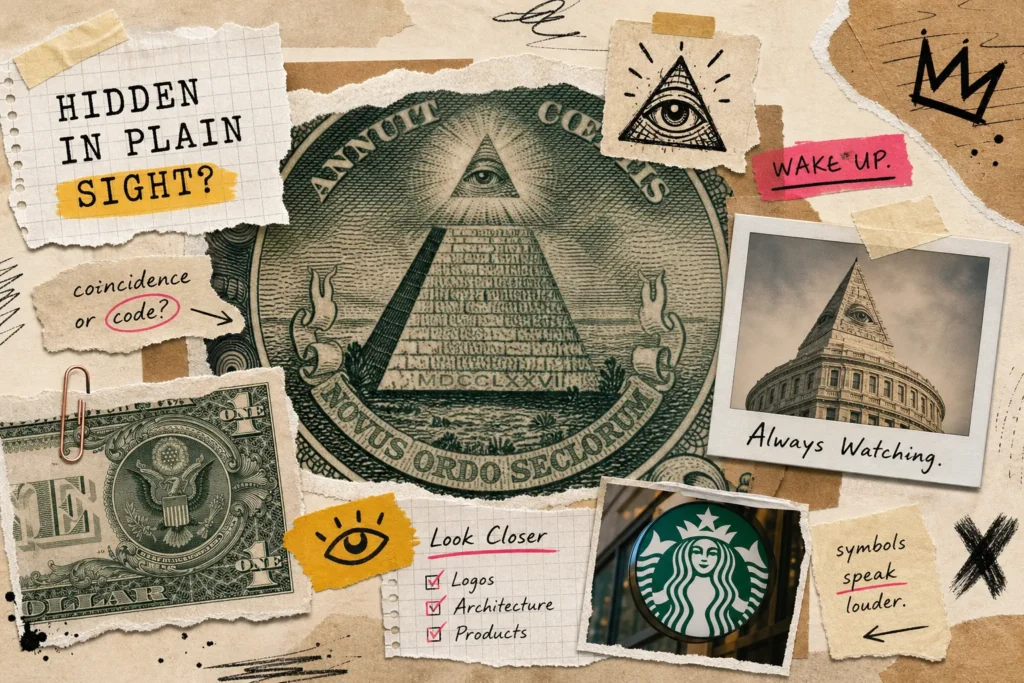
Hidden Illuminati symbols in everyday life are easier to spot once you know what you are actually looking for, and harder to misread once you understand where they genuinely come from. A triangle in a corporate logo catches your eye during a commute. An all-seeing eye stares back from a banknote in your wallet. A pyramid frames the climax of a music video. Once you notice the pattern, it refuses to disappear. These images feel arranged, deliberate, connected across centuries and industries in ways that seem to defy coincidence.
Whether secret society iconography truly hides in plain sight is a frequently discussed conspiracy topic online, and it deserves a serious answer rather than a dismissive shrug or uncritical acceptance. The truth sits in a more interesting place: some of these symbols carry entirely verifiable esoteric histories, many have been misidentified beyond recognition, and the difference between those two categories matters enormously. This article gives you the map, the documented origins, the confirmed misattributions, and the cognitive mechanisms that keep the myths alive.
The Eye of Providence: what this symbol actually means
The Eye of Providence did not begin in the shadow of a secret society. Its documented origin sits in Renaissance Europe, specifically in 16th-century Christian emblem books where an eye enclosed within a triangle represented God’s divine omniscience and the three persons of the Trinity. Pontormo’s painting Supper at Emmaus (1525) offers one of the earliest verifiable examples, depicting the triangulated eye as unambiguous theological imagery. Cesare Ripa codified it further in his influential Iconologia (1593), cementing the symbol within a tradition of devout Christian allegory that had nothing to do with clandestine power structures.
Freemasonry adopted the all-seeing eye into its iconography significantly later. Thomas Smith Webb’s The Freemason’s Monitor (1797) formalised its Masonic use, where it represented the ‘Great Architect of the Universe’, a concept of moral watchfulness rather than conspiratorial surveillance. This is where a critical conflation enters the picture. Freemason symbols and Illuminati iconography are routinely treated as interchangeable in conspiracy culture, but they belong to distinct traditions with separate memberships and entirely different intentions. The Bavarian Illuminati, founded in 1776 and disbanded in the 1780s, borrowed from Freemasonry precisely because it was the dominant esoteric framework of the era. That adoption does not erase the two centuries of prior, entirely unrelated theological use that preceded it.
Hidden Illuminati symbols in everyday life, banknotes and architecture
The Eye of Providence appearing on the reverse of the Great Seal of the United States is, for many people, the cornerstone piece of evidence. The documented facts are straightforward: the Great Seal was adopted in 1782 and designed by Charles Thomson and William Barton, neither of whom held membership in the Illuminati or any related organisation. The symbol moved onto the one-dollar bill in 1935 under Roosevelt as part of a redesign combining both sides of the seal. The philosophical reasoning behind the choice reflects the era’s dominant civic theology, divine providence watching over the new republic. That is a documented design decision, not a coded instruction from a hidden hierarchy. For a concise historical overview of the symbol itself, see the Eye of Providence entry on Wikipedia: Eye of Providence.
The same logic extends to architecture and monuments across the Western world. The Eye of Providence appears above the original 1789 French Declaration of the Rights of Man and of the Citizen, in church facades across Europe, and in the coats of arms of multiple towns and regions from Canada to Eastern Europe. Jeremy Bentham incorporated it into his 1794 Panopticon prison design to represent judicial integrity, encircled explicitly by the words “Mercy, Justice, and Vigilance.” Symbolism on banknotes and architecture often reflects the dominant theological or civic philosophy of its era, not the operational instructions of a shadow government. Brick, stone and engraving leave paper trails that historians have verified, repeatedly and consistently.
How hidden Illuminati symbols in everyday life appear in corporate logos
Triangles dominate the literature on shape psychology in branding, and for well-documented reasons. Delta, Adidas, Google Drive, Airbnb, HSBC and Caterpillar all feature triangular elements. Design analysis and brand case studies explain the rationale consistently: triangles convey stability, directional momentum and strength. Orientation carries its own coded language within design itself. A base-down triangle reads as grounded and powerful; a tilted one signals movement and dynamism. These are deliberate aesthetic choices rooted in visual psychology, not secret society iconography borrowed from Masonic or Illuminati traditions. For practical examples and analysis of triangle logos in contemporary branding see this guide to triangle logos.
The more meaningful question is whether any company has ever produced a verifiable primary source confirming an intentional esoteric reference in their logo. Drawing from every available public record, the answer is no. No advertiser, brand team or creative director has released a documented statement, internal briefing or interview confirming that a triangular logo was designed to signal allegiance to a secret society. Hidden symbols in logos become “Illuminati symbols” almost entirely through audience projection. Confirmation bias does the rest: once a viewer is primed to search for occult geometry, triangles in every corporate identity begin to look purposeful. The shapes were always there; the conspiratorial framework arrived afterwards.
Occult imagery in music, film and entertainment
Pop culture’s relationship with esoteric iconography is entirely real, but it operates differently from how conspiracy narratives describe it. Directors, artists and music video producers openly borrow secret society and Masonic imagery as stylistic shorthand for power, mystique and cultural authority, particularly within hip-hop and pop. The all-seeing eye, pyramid hand gestures and Freemason symbols carry enormous visual weight precisely because audiences already associate them with hidden power. That association makes them extraordinarily effective storytelling tools, and their effectiveness depends on the audience’s prior familiarity with the conspiracy framework, which is borrowed and reflected back rather than originated. For an authoritative explanation of common Masonic symbols and their meanings see Freemason symbols.
No musician, filmmaker or advertiser has released a verified primary source confirming they used occult symbols to represent genuine membership in, or operational allegiance to, a real secret society. Beyoncé addressed the Illuminati rumours directly in “Formation” (2016), singing “Y’all haters corny with that Illuminati mess.” Jay-Z has acknowledged triangle gestures but attributed them to his Roc Nation diamond and explicitly denied Illuminati membership. The KLF incorporated imagery from the Illuminatus! trilogy as deliberate culture-jamming. In every documented case, the symbolism is a borrowed aesthetic tool, not a lived confession. Dan Brown’s fiction, Disney fan clubs and music video directors all draw from the same rich cultural symbol pool for dramatic effect. Intent and appearance are entirely different things.
Why your brain sees secret patterns in ordinary shapes
The neurologist Klaus Konrad coined the term “apophenia” to describe the human tendency to perceive meaningful patterns in random or unrelated data. The sceptic Michael Shermer extended the concept with “patternicity,” defining it as the evolved tendency to find patterns and infuse them with meaning, intention and agency. Crucially, this is not a cognitive flaw, it is an evolutionary adaptation that allowed our ancestors to survive. The individual who assumed that rustling leaves meant a predator was present outlived the one who did not. In a modern environment saturated with logos, screens, currency and architecture, that same instinct fires constantly and without discrimination.
Once a person adopts the Illuminati interpretive framework, confirmation bias locks the pattern in place. Studies in political psychology, including work by researchers such as Lewandowsky and Wood, have found that belief in one conspiracy theory strongly predicts belief in others, not because each theory has been independently verified, but because the act of believing becomes self-reinforcing. Incoming information is filtered to support the existing framework; contradictory evidence is dismissed as part of the cover-up. Social media amplifies this dynamic by rewarding the sharing of sensational pattern-matches with social validation, accelerating the spread of the interpretation regardless of its accuracy. Understanding this mechanism is not an insult to the people caught inside it. It is recognition of how a normal, functional cognitive process interacts with a specific informational environment.
A practical test for evaluating any symbol claim
Most viral claims about hidden Illuminati symbols in everyday life collapse under three straightforward questions. Consider what makes these questions reliable: each one targets a different layer of the claim, historical origin, stated intent, and explanatory parsimony, so that no single piece of circumstantial evidence can carry the argument alone. Apply them to any image, logo or monument before accepting the framing at face value.
- What is the documented historical origin of this symbol, and does it pre-date any secret society? If the Eye of Providence appears in 16th-century Christian art, its presence on a 21st-century building requires a much higher burden of proof to qualify as an Illuminati marker.
- Has the person, brand or institution using it ever confirmed an esoteric intent? Verified primary sources, not secondhand interpretation, are what count here.
- Does removing the conspiracy framing leave a simpler, more plausible explanation? A triangle in a logo designed by a graphic design agency almost always has a documented rationale rooted in visual psychology.
If the answer to questions one and three is yes, and the answer to question two is no, the claim rests on projection rather than evidence. That does not make the symbols uninteresting. It makes the real history of those symbols more fascinating than the conspiracy version, because the real history involves millennia of layered meaning, theological debate, artistic evolution and deliberate philosophical choice. That history rewards serious study.
For readers who want a rigorous, lore-deep resource beyond surface-level debunking, Symbols Of Illuminati, Illuminati Fraternities maintains an official guide to each of these symbols, including the Eye, The Pyramid, Illuminati Fraternities, the Eternal Circle and The Mark of the Illuminati, Illuminati Fraternities, tracing their verified histories and explaining what the iconography genuinely represents across successive cultures and institutions. If you want to go beyond the viral version and into the documented record, their symbol guide is a substantive starting point.
The smarter way to read hidden Illuminati symbols in everyday life
Esoteric and secret society iconography genuinely does appear on currency, in architecture, in corporate branding and across entertainment, that part of the claim is real. What is almost never real is the conspiratorial intent behind those appearances. Most of these symbols carry centuries of layered meaning, absorbed and reused by successive cultures, institutions and designers who found them visually or philosophically useful. The human brain, primed to find meaningful patterns in complex environments, supplies the hidden narrative.
The smarter approach is neither blanket belief nor reflexive dismissal. It is the habit of asking for primary sources, documented origins and verified intent before accepting any claim about hidden meaning. Applied consistently, that habit reveals something genuinely surprising: the actual history of hidden Illuminati symbols in everyday life is richer, stranger and more compelling than any conspiracy theory built on top of it. Explore the Illuminati Fraternities symbol guide as your next step into that history, the documented record has more to offer than the myth ever did.
