
Uncategorized
What Is the Illuminati? History, Symbols, and Myths
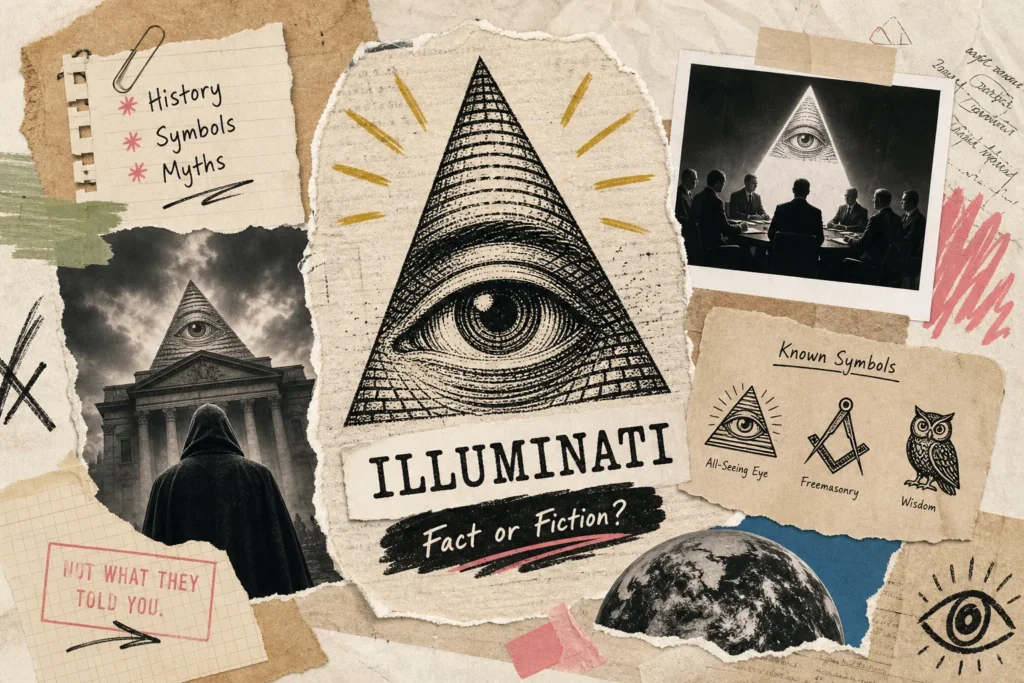
Ask ten people what the Illuminati is and you will get ten different answers. If you’re asking whats the illuminati, here’s the concise answer: a documented, short-lived Enlightenment society from Bavaria that later became a catch-all myth for hidden power. Somewhere between the Owl of Minerva and a triangle on a dollar bill, a small Enlightenment-era society was refashioned into a mythic puppet master. That tension is the problem and the invitation: the real Order was brief and documented, while the cultural echo grew into something far larger and stranger.
If you want a clear path from surface curiosity to informed understanding, explore Illuminati Fraternities. We steward the arcane without the noise, pairing verified history with living symbolism, member offerings, and curated Illuminations. In one sitting you will see the foundation, the iconography, and the modern claims with the clarity most sources avoid.
We will trace the origins, decode the sigils people misread, and evaluate the New World Order storyline on evidence. Then we will show you where sincere exploration belongs inside our Order. You are about to receive the clarity others promise but rarely deliver.
What’s the Illuminati? The real origins of a secret society born in 1776
Adam Weishaupt and the founding moment
The Bavarian Illuminati began on May 1, 1776, in Ingolstadt, Bavaria. Its founder, Adam Weishaupt, was a professor of canon law at the University of Ingolstadt, Jesuit educated yet openly critical of religious institutional control. He used insider knowledge of disciplined networks to blueprint a countervailing intellectual alliance. The original name was the Order of Perfectibilists, soon refined to the Illuminati, a nod to enlightened improvement.
That founding date has attracted endless speculative readings, yet it was simply the day Weishaupt chose to inaugurate his project. The term “Illuminati” did not imply a shadow throne. It signaled a program of illumination: a shift from dogma to reason, from passive obedience to active virtue. He borrowed organizational polish seen in Jesuit and Masonic circles, then redirected it toward Enlightenment aims.Britannica
What the original order was actually built to achieve
The mission was direct. The Order sought to advance reason, morality, and civic virtue against superstition and arbitrary monarchy. It functioned as an intellectual fraternity with secret rites, not a clandestine government. In practice, members held Minerval assemblies, used catechisms and reading circles, and paired initiates with patrons for mentorship; these structures appear in seized internal papers and later publications of the Order’s degree materials.Robison 1797Britannica
At its height, estimates of participation range from roughly 650 to 2,500 across Bavaria and neighboring states, based on membership rolls in the seized documents (published in 1786, 87) and later syntheses by scholars of Western esotericism.Hanegraaff 2006Originalschriften 1787Barkun 2013 Think scholars with rituals, not emperors with levers; the mystique came from disciplined organization, not omnipotence.
What Weishaupt’s Illuminati believed and how it fell apart
Enlightenment philosophy as the order’s core doctrine
The Order opposed the Church’s grip on education and the arbitrary privilege of monarchs. It argued for reason-tested governance and secular ethics, aiming to produce citizens capable of self-rule. Its ideal was reform through enlightened character, not ruin through chaos.
Members were largely academics, administrators, writers, and reform-minded nobles. Their structure gave the Order its secretive texture: three broad classes with progressive disclosure. Early grades included Novice, Minerval, and Illuminatus Minor; middle stages borrowed from Masonic practice; the Mysteries culminated in Priest, Regent, Magus, and Rex. The choreography of grades made the arcane feel earned.
Secrecy served pedagogy and safety, not silent conquest. The mystique was a means to cultivate trust, test virtue, and pace instruction in a volatile political climate.
The 1785 suppression and what it actually ended
In 1785 the Bavarian government issued an edict banning secret societies, naming the Illuminati directly. Weishaupt fled into exile, several members were disciplined, and the network’s infrastructure unraveled. Authorities seized internal papers that were then published in 1786 and 1787, including Einige Originalschriften des Illuminaten Ordens and its Nachtrag, along with defenses like Weishaupt’s Apologie der Illuminaten.Robison 1797Britannica
Those documents created an unusual historical window, then closed it. The record trails off after the crackdown, with no credible evidence of operational continuity. Historical consensus is firm: the Bavarian Illuminati ceased functioning by the late 1780s. That documented dissolution matters when judging every later claim of survival. For a concise modern overview of the organization’s background, see the Bavarian Illuminati entry at Britannica.
Real Illuminati symbols versus borrowed mythology
The Owl of Minerva: what’s the Illuminati symbol history actually records
The owl, sacred to Minerva, is the emblem that history reliably links to the Order. It appeared most clearly in the Minerval degree, evoking wisdom, learning, and the patient sight that perceives through darkness. A few 18th-century printed inventories and marginal notes associated with the Order mention simple marks such as a dot within a circle, but this is sparsely attested compared with the owl and should be treated cautiously in interpretation.Originalschriften 1787Britannica
When you study authentic iconography, you find restraint. The Bavarian Illuminati favored the owl’s quiet intelligence over spectacle. Everything else you have seen online needs scrutiny and a demand for sources. For further discussion of historically attested marks and their interpretation, see our The Mark of the Illuminati, Illuminati Fraternities.
How the Eye of Providence and the pyramid got misappropriated
The Eye of Providence predates Weishaupt. It began as a Christian emblem of divine watchfulness, later appearing in some Masonic contexts. The symbol’s history is summarized at the Eye of Providence entry. In the United States it entered the Great Seal in 1782, set above an unfinished pyramid. Contemporary explanations tied the eye to providential favor and the motto Annuit Coeptis, understood as “He has favored our undertakings.”Great Seal overview For a focused narrative on the symbol’s adoption into the American seal see this history of the Great Seal.
The pyramid on the Great Seal has no documented link to the Bavarian Illuminati. The inscription Novus Ordo Seclorum means “New Order of the Ages,” a poetic claim about American independence, not a blueprint for a secret cabal. >Conspiracy writers in the 19th and 20th centuries grafted Illuminati meaning onto existing state and religious symbols. The symbols did not change. The stories attached to them did.
Modern conspiracy theories about the Illuminati: what the evidence actually shows
From Bavarian history to New World Order mythology
The central modern claim says the Illuminati survived 1785 and now steers governments, finance, and media toward a single New World Order. No credible documentation shows organizational continuity from Weishaupt’s network to any modern command structure. Early polemics by Augustin Barruel and John Robison in 1797 and 1798 seeded the survival idea, then mid-20th-century activists folded it into anti-globalist narratives.Barruel 1797Robison 1797Barkun 2013
In the 1960s, the John Birch Society milieu popularized the fusion, with writers like Mary M. Davison and Gary Allen making “Illuminati” shorthand for a modern elite plot.Davison 1966; Allen 1972 Meanwhile, specific events were retrofitted as evidence: the French Revolution, the 1800 U.S. election, the JFK assassination, and even world wars. Historians find assertions, not primary proof; absence of a verifiable chain beats the presence of a dramatic story.
There are also anti-Semitic variants that blend Illuminati lore with older hate myths. Those should be rejected on both evidentiary and ethical grounds. Bigotry thrives on vagueness; scholarship requires names, dates, and documents.
Why symbolic “proof” is not actually proof
Symbols travel. The all-seeing eye, triangles, columns, suns, and labyrinths appear across centuries of art, religion, and state design. Their presence in a building, logo, or video is not evidence that a specific secret society planted them there.
On social platforms, a celebrity hand sign or a lyric becomes “proof” by caption alone. The pattern is consistent: start with the conclusion that the Illuminati runs everything, then reverse-engineer images to fit. Correlation in symbolism is not causation. When you demand primary sources, verifiable members, and a working chain of command, the modern conspiracy dissolves into screenshots and insinuation.
If you want to evaluate a claim, ask three questions: What original documents support it, who are the named participants, and where is the operational continuity from 1787 to now? Claims that cannot clear those bars are stories, not history.
Why the Illuminati never left pop culture
The Illuminatus! Trilogy and the first modern spike
Robert Shea and Robert Anton Wilson’s The Illuminatus! Trilogy arrived in 1975 as satire that read like revelation. It blended pranks, philosophy, and conspiracy into a playful labyrinth that many mistook for disclosure. The idea migrated from counterculture salons into early internet forums, where ambiguity is a feature, not a flaw.
The 2000s delivered a second wave. Dan Brown’s Angels & Demons repackaged the concept for mass audiences, while YouTube rewarded visually decoded “clues.” Fiction, memes, and half-remembered history fused into a single pop shorthand for hidden power.
Hip-hop, celebrity culture, and social media amplification
American hip-hop carried the conversation into the mainstream. Beyoncé, Jay-Z, Rihanna, Kanye West, Lady Gaga, and Katy Perry were named often, sometimes responding with winks or reversals. A triangle hand gesture at a major halftime show or a lyric about power became fuel for viral accusation; coverage of these moments often referenced “Illuminati” outright in headlines and commentary.Britannica
Image-driven platforms made symbol-spotting a game. Any triangle, halo, or checkerboard could be clipped, slowed, and reinterpreted as a signal. Some artists played along, turning rumor into art direction, while others ignored it. The entertainment value keeps the myth alive long after historians have settled the record. The Illuminati endures in culture because the story is sticky, not because the Bavarian Order still convenes in secret chambers.
Where genuine curiosity goes next
Illuminati Fraternities: a place for serious exploration
Now that you can separate documented history from cultural overlay, you are ready for the deeper work. That work becomes real here: a living hub for membership, philosophy, and symbolic literacy. We teach the Eye, the Pyramid, and the Eternal Circle as durable icons that span traditions, not as proof of a monolith. These offerings are part of our entertainment and lifestyle platform and are not presented as evidence about what the historical Bavarian Illuminati did.
Explore our Illuminations eBook, study our view of large-scale coordination, and examine the Pendulum of Power as an in-house lens for cultural cycles. We invite you to move from passive consumer of rumors to active interpreter of symbols. This is not a recruitment script. It is an open door to an Order that treats your curiosity with respect.
What membership and philosophy actually look like
Inside the Order you will find a blend of education, community, and ritual minimalism. Our Apex Circle advances through clear stages, guided by Outreach mentors who prioritize wisdom over theatrics. If you prefer signal to noise, you will feel at home.
- Symbolic education with guided studies in iconography, from the Owl to the Eternal Circle
- Community access to members who share research, art, and applied ethics
- Digital libraries, including Illuminations, and seasonal dispatches of new teachings
- Workshops that apply the Pendulum of Power and our Order’s frameworks to modern life
- Private Outreach through our Department of Citizen Outreach for questions and next steps
- Pathways into the Apex Circle for members who demonstrate commitment and clarity
When you are ready to participate intentionally, visit our Outreach portal and introduce yourself. For a quick orientation, see the Sample Page, Illuminati Fraternities, and consult our Privacy Policy, Illuminati Fraternities. Your initiation begins with a conversation, not a conspiracy.
Conclusion
You now hold three clear distinctions. The Bavarian Illuminati was a real, short-lived Enlightenment society founded in 1776. The most famous images people shout about online, like the Eye and the pyramid, are not the Order’s own sigils. The sweeping modern tale of a surviving cabal that runs history does not rest on credible evidence.
The mythology persists because it speaks to recognizable desires: a promise of clarity when life feels confusing and a sense of belonging when the world feels isolating. There is wisdom in acknowledging those needs and meeting them with study rather than panic. That is why Illuminati Fraternities exists, so you can engage myths and symbols as a builder, not a bystander.
If you still wonder whats the illuminati or find yourself asking what the Illuminati is today, ask it with us, always with sources in one hand and a patient eye in the other. The door is open.
FAQ: whats the illuminati meaning and related questions
Whats the Illuminati meaning in history?
Historically, “the Illuminati” refers to Adam Weishaupt’s Bavarian society (founded 1776) promoting Enlightenment ethics and civic virtue through graded instruction and secrecy, not a world government.Source
Is the Illuminati real today?
What’s the Illuminati symbol?
The Owl of Minerva is the best-attested emblem in authentic degree materials. The Eye of Providence and pyramid on the U.S. Great Seal are not Illuminati insignia.Originalschriften 1787Great Seal overview
